

Not every tube of caulk on a hardware store shelf is built for the same job. If you manage a commercial property or multi-unit building in the Greater Toronto Area, using the wrong sealant in a fire separation could put lives at risk and leave you in serious violation of the Ontario Building Code. Ordinary caulking cannot substitute for firestop caulk in rated assemblies. This guide covers exactly why that distinction matters, what Canadian codes require, how firestop caulking systems work, and what GTA property owners and facility managers need to know to stay compliant and genuinely safe.
Table of Contents
- Why fire stopping matters: beyond ordinary caulking
- Key Canadian codes and firestop caulking requirements
- How firestop caulking systems work: materials, installation, and performance
- Pitfalls to avoid: common firestop caulking mistakes
- Fire stopping for Greater Toronto Area buildings: what to expect from inspection and documentation
- Why the role of firestop caulking is misunderstood—and what actually keeps buildings safe
- How professional firestop caulking services support building compliance and peace of mind
- Frequently asked questions
Key Takeaways
| Point | Details |
|---|---|
| Certified caulking only | Only use ULC-listed firestop caulking as part of a tested system to ensure fire and smoke separation. |
| System, not just sealant | Firestop caulking works within a whole system; ordinary caulk cannot replicate its protection. |
| Follow Canadian codes | Penetrations must be sealed per NBC and ULC requirements for full compliance in the GTA. |
| Avoid common mistakes | Ensure correct installation, use of backing materials, and thorough inspection to prevent failures. |
| Document and inspect | Maintain detailed records and schedule regular inspections to stay compliant and safe. |
Why fire stopping matters: beyond ordinary caulking
Most people assume that sealing a gap is sealing a gap. In everyday construction, that logic holds. But during a fire, the material you used to close that penetration becomes the difference between a contained incident and a building-wide emergency.
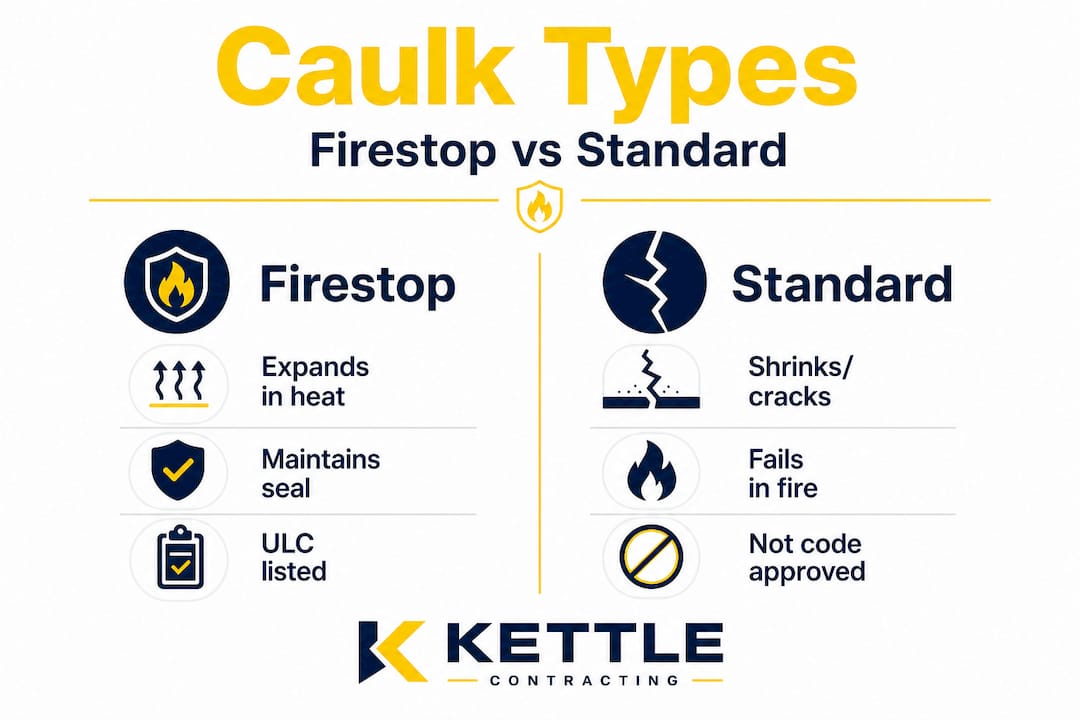
Standard silicone, latex, or acrylic caulks are designed for air sealing, weatherproofing, and moisture control. They perform well in those roles. Under fire conditions, however, ordinary caulks can burn or melt, leaving open gaps that allow flames, heat, and toxic smoke to travel freely through a building. That is not a minor technical detail. It is a fundamental failure of fire compartmentation.
Firestop caulking is engineered with intumescent chemistry, meaning it expands significantly when exposed to heat. This expansion physically blocks the penetration, cutting off the path that fire and smoke would otherwise follow. The result is a maintained fire separation that buys occupants and emergency responders critical time. Understanding advanced caulking methods helps clarify just how different these products are from general-purpose sealants.
Ordinary caulk vs. firestop caulk: a direct comparison
| Feature | Ordinary caulk | Firestop caulk |
|---|---|---|
| Fire resistance | None | Rated (F/FT ratings) |
| Smoke control | None | Yes, when properly installed |
| Intumescent properties | No | Yes |
| Code-listed | No | Required by NBC/ULC |
| Suitable for fire separations | No | Yes |
Fire stopping is also a system, not a single material. Only firestop sealant systems restore fire separation and smoke control, not ordinary construction caulk. That means the caulk, the substrate, the penetrant type, and the installation method must all work together as a tested, listed assembly.
“Fire stopping is not about applying a product. It is about restoring the integrity of a rated assembly through a verified, code-compliant system.”
This is a critical mindset shift for property owners and facility managers. Purchasing a product labelled “firestop” is only the starting point. The entire system must be correct.
Key Canadian codes and firestop caulking requirements
System selection must be guided not just by performance, but by regulatory code, and Canadian requirements are specific and enforceable.
The National Building Code of Canada (NBC) requires that all penetrations and joints in fire separations be sealed with certified, listed firestop systems. This applies to pipe penetrations, cable trays, conduit runs, duct openings, and construction joints. The standard that governs product testing and listing in Canada is CAN/ULC-S115. NBC and CAN/ULC-S115 require that firestop systems match or exceed the fire-resistance rating of the assembly they penetrate.
What does that mean in practice? If a wall carries a two-hour fire-resistance rating, the firestop caulking system used in any penetration through that wall must also achieve a two-hour rating. A product with a one-hour listing does not meet the requirement, regardless of how well it is installed.
Fire-resistance ratings at a glance
| Rating type | What it measures |
|---|---|
| F rating | Time the firestop prevents flame passage |
| T rating | Time before temperature rise on unexposed side exceeds limits |
| FT rating | Combined flame and temperature performance |
| L rating | Air leakage performance at ambient and elevated temperatures |
Pro Tip: When sourcing firestop caulking for a GTA project, always request the ULC listing number from your supplier. Cross-reference it against the tested assembly details to confirm the product is appropriate for your specific penetrant type, annular space, and substrate.
Ontario’s Building Code Act also gives municipal building officials the authority to inspect fire stopping and require documentation of compliance. Inspectors are not simply looking for the presence of sealant. They are verifying that the installed system matches a listed assembly, that the installation follows the manufacturer’s system details, and that appropriate records exist. A tube of generic sealant painted over a pipe penetration will not pass. The consequences of failing inspection include stop-work orders, mandatory remediation, and potential liability in the event of a fire-related incident.
Key code takeaways for GTA property managers:
- Every penetration in a fire separation requires a listed firestop system
- ULC certification is mandatory, not optional
- The system rating must equal or exceed the assembly rating
- Documentation of compliance is part of the legal requirement
- Inspections assess workmanship and system accuracy, not just material presence
How firestop caulking systems work: materials, installation, and performance
Understanding code and systems, it is time to explore what makes an installation robust and reliable.
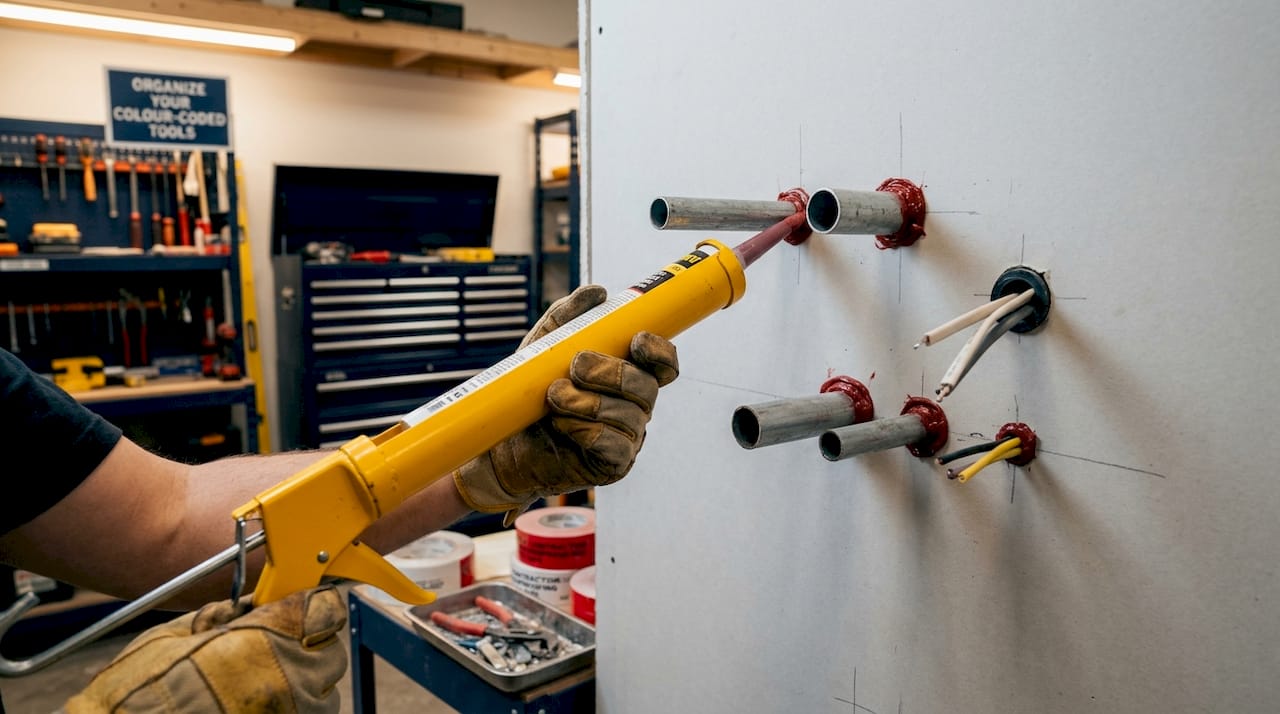
Intumescent firestop caulking expands and insulates when exposed to heat. Most intumescent caulking products begin expanding at temperatures between 150°C and 200°C, ultimately achieving expansion ratios of 10 to 1 or higher. This expansion fills the annular space around a penetrant and, in the case of combustible pipes, fills the void left as the pipe melts or burns away. The result is a dense, char-like plug that resists flame passage and limits smoke transmission.
But the chemistry alone does not guarantee performance. Correct firestop installation must verify penetration geometry, compatible materials, correct sealant depth, and proper finishing. Every one of those variables matters.
Step-by-step firestop caulking installation process:
- Identify the assembly. Confirm the fire-resistance rating of the wall or floor being penetrated and locate the corresponding ULC-listed system for your penetrant type.
- Prepare the substrate. Clean the opening thoroughly. Remove dust, grease, loose material, and any existing sealant that is not part of the listed system. Dry the surface completely.
- Install backing material if required. Many listed systems require a mineral wool or ceramic fibre backing to support the caulking and achieve the correct sealant depth.
- Apply the firestop caulking. Fill the annular space to the depth specified in the system listing. Underfilling is one of the most common installation errors and directly compromises fire resistance.
- Tool the surface. Smooth the sealant to ensure full contact with both the penetrant and the substrate. Voids or air pockets reduce performance.
- Allow full cure. Do not disturb the installation during the manufacturer’s specified cure time. Premature loading or movement can break adhesion.
- Document the installation. Record the system listing number, product used, installer name, date, and location for inspection purposes.
For guidance on achieving clean, consistent results, reviewing smooth application tips and selecting the right best caulking tools makes a measurable difference in the quality of the finished installation.
“An installation that looks finished is not necessarily compliant. The depth, backing, and system match are what determine whether the assembly will perform when it matters.”
Pro Tip: Always keep the manufacturer’s system detail sheet on site during installation. If an inspector visits and the installed work does not match the listed detail exactly, you may be required to remove and redo the application regardless of how clean it looks.
Pitfalls to avoid: common firestop caulking mistakes
After learning good practice, it is worth examining real-world failures and how to avoid them.
The most damaging errors in firestop caulking are not always obvious at the time they happen. Using generic sealants, failing to fully tool or cure caulking, or ignoring manufacturer instructions are common causes of failure in the field. These mistakes often go undetected until an inspection or, in the worst case, an actual fire event.
Common firestop caulking mistakes to watch for:
- Wrong product selection. Using a general-purpose silicone or acoustic sealant in a fire separation because it was on hand or cheaper than the listed product.
- Incorrect annular space. Applying firestop caulking to a penetration that exceeds the maximum annular space tested in the listed assembly. Larger gaps require different systems.
- Insufficient sealant depth. Applying a thin bead when the system requires a specific minimum depth to achieve the rated performance.
- Missing backing material. Skipping the required mineral wool or ceramic fibre backer, which affects both sealant depth and the system’s structural integrity during a fire.
- Poor surface preparation. Applying caulking to dusty, damp, or contaminated surfaces reduces adhesion and can cause the sealant to pull away from the substrate.
- Failing to document. Completing a technically correct installation but not recording the system details, leaving no evidence of compliance for inspectors or future facility managers.
Gaps and incomplete fire stopping are code violations. That is not a grey area. Any unsealed penetration in a fire separation is a breach of compartmentation, and the responsibility for that breach falls on the property owner or the contractor who performed the work.
Sealing new penetrations on the same day they are created is a best practice that protects both the building and your liability. Temporary plugs are not a substitute for listed firestop systems. Understanding how to avoid window caulking mistakes in general helps build the attention to detail that firestop work demands.
Fire stopping for Greater Toronto Area buildings: what to expect from inspection and documentation
Finally, successful fire stopping includes passing inspection and maintaining thorough records.
GTA building inspectors follow a structured process when reviewing fire stopping. They are trained to identify the difference between a compliant listed system and a cosmetically similar but non-compliant application. Knowing what they look for helps you prepare.
What a typical firestop inspection covers:
- System identification. The inspector will ask for the ULC listing number and cross-reference it against the installed conditions, including penetrant type, pipe diameter, annular space, and substrate.
- Sealant depth verification. In some cases, inspectors probe or measure the depth of the applied caulking to confirm it meets the listed system requirement.
- Backing material confirmation. The presence and correct placement of required backing materials will be checked.
- Surface condition. Inspectors look for signs of poor adhesion, shrinkage cracks, or separation from the substrate.
- Documentation review. You will be expected to provide records showing the products used, the system listing, the installer’s credentials, and the date of installation.
- Outstanding openings. Any unsealed penetrations in the inspection area will be flagged as violations, regardless of whether work is ongoing.
Specs require compliance documentation and that openings not in immediate work areas be sealed same day. This requirement is especially relevant during phased construction or renovation projects, where new penetrations are created regularly and the temptation to defer sealing is high.
Key documentation to maintain for each firestop installation:
- ULC listing number and system detail sheet
- Product name, manufacturer, and batch number
- Location of the penetration (floor, wall, room reference)
- Date of installation and installer name
- Photographs of the completed installation before concealment
Maintaining this documentation protects you during inspections, supports warranty claims, and provides critical information for future facility managers or renovation contractors who need to understand what is already in place.
Why the role of firestop caulking is misunderstood—and what actually keeps buildings safe
With the facts established, it is worth stepping back and sharing a perspective that goes beyond the technical details.
The most common failure we see in the field is not a lack of product knowledge. It is the assumption that applying something to a penetration is enough. Property managers and contractors often believe that if the gap is filled and the surface looks clean, the job is done. That belief is genuinely dangerous.
A tube of intumescent caulk applied to the wrong assembly, at the wrong depth, without the required backing, is not a firestop system. It is a visual impression of one. And in a fire, the difference between those two things is measured in lives and structural losses.
The industry has made significant progress in product development and code clarity. But the gap between code intent and field reality remains wide, particularly in older GTA buildings undergoing renovation. Contractors who do not specialise in fire stopping often treat it as an afterthought, something to complete quickly before the drywall goes up. That approach consistently produces non-compliant installations that pass visual inspection but fail under fire conditions.
What actually keeps buildings safe is a combination of verified system selection, trained installation, honest documentation, and regular review after any work that creates new penetrations. Reviewing expert caulking techniques is one part of that picture. But the bigger commitment is treating fire stopping as a professional discipline, not a finishing task.
Ethical property management in the GTA means going beyond minimum compliance. It means asking your contractors to show you the system listing, verifying the documentation, and scheduling routine inspections after any service work. That is not excessive caution. That is responsible ownership.
How professional firestop caulking services support building compliance and peace of mind
The complexity of firestop caulking, from system selection to documentation, makes professional expertise genuinely valuable for GTA property owners and facility managers.

At Kettle Contracting, we approach every fire stopping project with the same precision we bring to full building envelope work. That means assessing your specific penetrations, identifying the correct ULC-listed systems, and installing them to manufacturer specifications with full documentation. Whether you are preparing for a building inspection, completing a renovation, or addressing a compliance gap, our team provides the site-specific assessment and quality assurance that protects your property and your occupants. Explore our guidance on window caulking preparation and caulk durability to understand the standard we bring to every project. Contact Kettle Contracting today to discuss your building’s fire stopping requirements.
Frequently asked questions
What is the main purpose of firestop caulking?
Firestop caulking seals penetrations and joints in fire separations to maintain fire and smoke barriers, preventing the spread of fire through a building and meeting code requirements. Only firestop sealant systems restore fire separation and smoke control in rated assemblies.
Can I use regular silicone caulking for fire stopping?
No. Regular silicone or latex caulking is not rated for fire separations and will fail under fire conditions. Ordinary caulks can burn or melt, leaving the penetration completely open to fire and smoke passage.
How do inspectors verify firestop caulking compliance?
Inspectors check that the installed caulking matches the listed system details, confirm correct depth and backing, and review documentation. Specs require compliance documentation and same-day sealing of all openings not in active work areas.
Are ULC certifications required for firestop caulking in GTA buildings?
Yes. Canadian building codes mandate ULC-certified, listed firestop systems for all penetrations in fire separations. Penetrations and joints must be sealed with certified systems that match or exceed the assembly’s fire-resistance rating.
How often should firestop caulking be inspected or maintained?
Firestop caulking should be reviewed routinely, and specifically after any renovation, service work, or new penetration that affects a fire separation. Even minor trades work can compromise a previously compliant installation if new openings are not immediately sealed with a listed system.
Recommended
- Window Caulking: Safety Tips and Best Practices – Kettle Contracting
- The Hidden Link Between Window Caulking and Home Security You Can’t Ignore – Kettle Contracting
- Unlocking the Secrets to Long-Lasting Caulk: Science Meets Durability – Kettle Contracting
- Preventing Water Damage with Effective Window Caulking – Kettle Contracting