
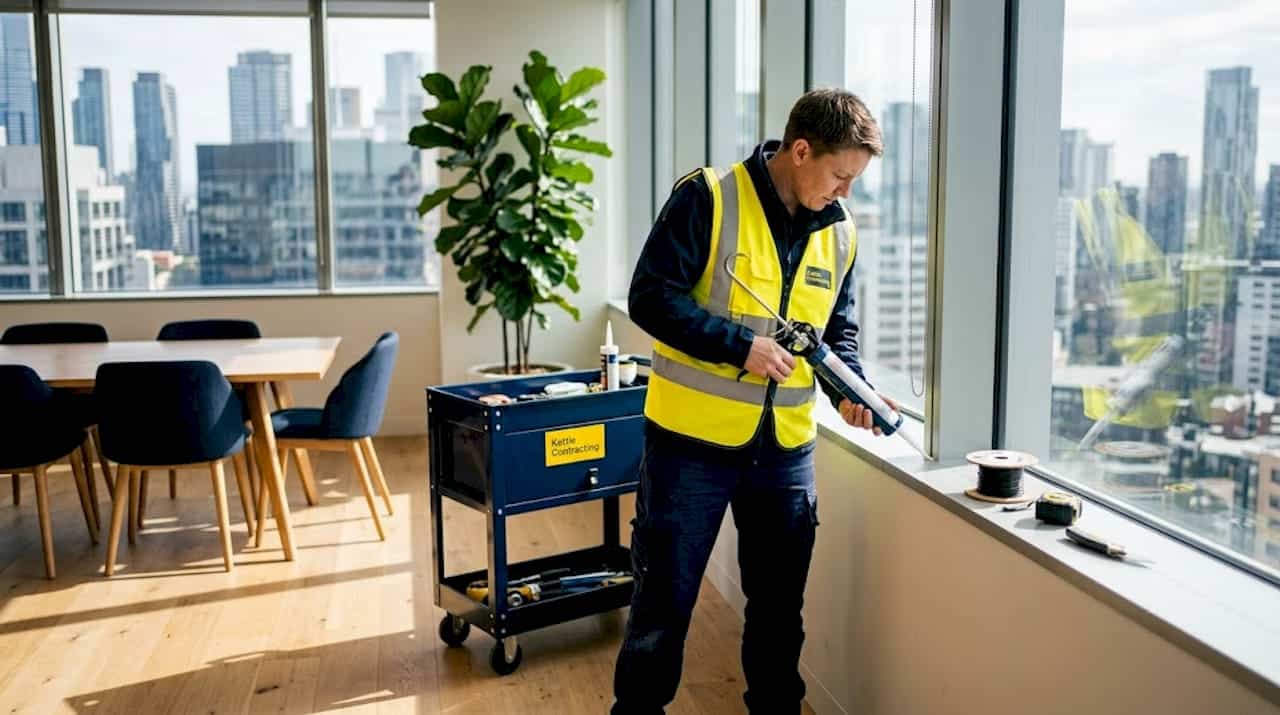
Most commercial property owners think of sealant as a finishing detail, something applied at the end of a project and forgotten about. That thinking is expensive. The role of sealant in commercial windows goes well beyond aesthetics. A properly sealed window system is your first defence against water infiltration, air leakage, and the structural damage that follows both. Get it wrong, and you are looking at compromised insulation, mould growth, failed glazing units, and HVAC systems working overtime to compensate. This article breaks down exactly what sealant does, where it fails, and how to get it right.
Table of Contents
- Key takeaways
- How sealants protect commercial window systems
- Common mistakes in sealant selection and installation
- The real benefits of getting sealant right
- Choosing the right sealant for the job
- Maintenance and inspection practices that protect your investment
- My perspective after 25 years in commercial sealing
- Work with Kettlecontracting on your commercial windows
- FAQ
Key takeaways
| Point | Details |
|---|---|
| Sealants are structural, not cosmetic | They form the air and moisture barrier that protects your window system and building envelope. |
| Wrong sealant voids warranties | Using incompatible chemistry on IGUs can void a 10 to 20 year manufacturer warranty. |
| Joint design matters as much as product | Missing backer rods or incorrect bead sizing causes premature tearing regardless of sealant quality. |
| Twice-yearly inspections protect your investment | Catching early adhesion loss or cracking prevents water ingress and costly interior damage. |
| Proactive sealing lowers operating costs | Proper commercial window sealing reduces HVAC loads, comfort complaints, and unplanned maintenance. |
How sealants protect commercial window systems
The role of sealant in commercial windows starts at the building envelope. Every window in a commercial building sits within a frame that experiences constant movement. Thermal expansion and contraction, structural settling, and wind loading all shift the relationship between the window frame and the surrounding wall assembly. Sealant is the flexible joint that absorbs that movement without letting water or air through.
Joint sealants are a primary line of defence against air, moisture, and even sound infiltration. When they perform correctly, they protect embedded steel from rust and concrete from spalling. When they fail, moisture reaches those structural elements and the damage builds quietly, often invisibly, until the repair costs are significant.
Here is what a properly functioning sealant system does in a commercial window installation:
- Prevents moisture ingress at the perimeter joint between the window frame and the wall assembly, stopping water before it reaches insulation or framing
- Seals against air leakage, which is one of the most common causes of uneven temperature distribution and occupant comfort complaints in commercial buildings
- Maintains the vapour barrier, which is critical in Ontario’s climate where temperature differentials between indoors and outdoors are substantial for months at a time
- Accommodates building movement without cracking or losing adhesion, provided the joint is correctly designed and the right sealant type is selected
Adhesion is where many systems fail. Sealant must bond reliably to the specific substrate it contacts, whether that is aluminium cladding, vinyl, concrete masonry, or the edge seal of an insulated glass unit. Each material has different surface energy, porosity, and chemical compatibility requirements.
Pro Tip: Before any sealant is applied, confirm that the product is listed as compatible with both substrates in the joint. Manufacturers publish compatibility guides, and skipping that step is one of the most common causes of early failure we see in the field.
Common mistakes in sealant selection and installation
Getting the product right is only part of the equation. Joint design is equally critical to long-term performance. A poorly designed joint will fail even when a premium sealant is used, because the sealant cannot flex the way it needs to without the right geometry and backing.
These are the installation mistakes that lead to the most costly failures:
- Skipping the backer rod. A backer rod creates the bond-breaker interface that allows the sealant to flex at two points rather than three. Without it, the sealant bonds to the back of the joint and tears under thermal movement.
- Using the wrong bead size. The depth-to-width ratio of a sealant bead is engineered to match the movement capacity of the joint. Installers who eyeball this rather than follow specifications end up with beads that are too thick, too thin, or both.
- Poor surface preparation. Dust, oil, curing compounds, and residual moisture all compromise adhesion. A sealant applied to an improperly cleaned substrate will not bond correctly, regardless of how good the product is.
- Using incompatible chemistry. Applying incompatible sealants to modern insulated glass units accelerates failure and voids warranties that typically cover 10 to 20 years. Linseed oil putty on a modern IGU is a classic example of this error.
- Treating sealant as cosmetic finish. This is probably the most damaging mindset in the industry. When sealant is applied as a cosmetic step rather than a weatherproofing system, the preparation and execution reflect that lower standard.
“Owners should consider sealant strategy part of sustainable design and lifecycle planning, not a finishing trade detail.” Source: W. R. Meadows
One nuance that is often missed: sealing every gap indiscriminately can make things worse. Improperly sealed drainage or ventilation points can trap moisture inside wall assemblies, leading to hidden rot and mould. Understanding how water and air move through the assembly is necessary before applying sealant, especially in remedial work on older buildings.
Pro Tip: On commercial remedial projects, always trace the water path before you seal. Blocking the wrong opening can turn a manageable leak into a concealed moisture problem inside the wall.
The real benefits of getting sealant right
Proper commercial window sealing delivers returns that show up directly on your operating budget. Air leakage around commercial windows drives higher HVAC runtime and recurring operating expenses for facility teams. When that leakage is eliminated, your heating and cooling systems run less, wear more slowly, and last longer.
The benefits stack up across several categories:
- Lower energy costs. Effective window sealing reduces HVAC loads by stopping conditioned air from escaping and unconditioned air from entering. You can estimate what that looks like for your building using a window caulking savings calculator before committing to a project.
- Fewer comfort complaints. Cold spots near windows in winter and hot perimeter areas in summer are almost always linked to air leakage. Addressing the sealant at perimeter joints often resolves issues that tenants have been reporting for years.
- Extended window lifespan. Water that enters the perimeter joint deteriorates insulation, corrodes fasteners, and causes wood framing to rot. Sealant that performs correctly keeps all of that moisture out.
- Building code compliance. Commercial buildings in Ontario are subject to energy performance requirements under the Ontario Building Code. Properly sealed window systems contribute to meeting those requirements, which matters at permit and occupancy stages.
- Reduced maintenance work orders. Facilities managers who invest in correct sealant application upfront consistently report lower volumes of reactive maintenance, because the source problems are addressed before they escalate.
If you want a broader view on how sealant fits into the full picture, the guide on reducing energy loss in commercial buildings covers the building envelope as a system.
Choosing the right sealant for the job
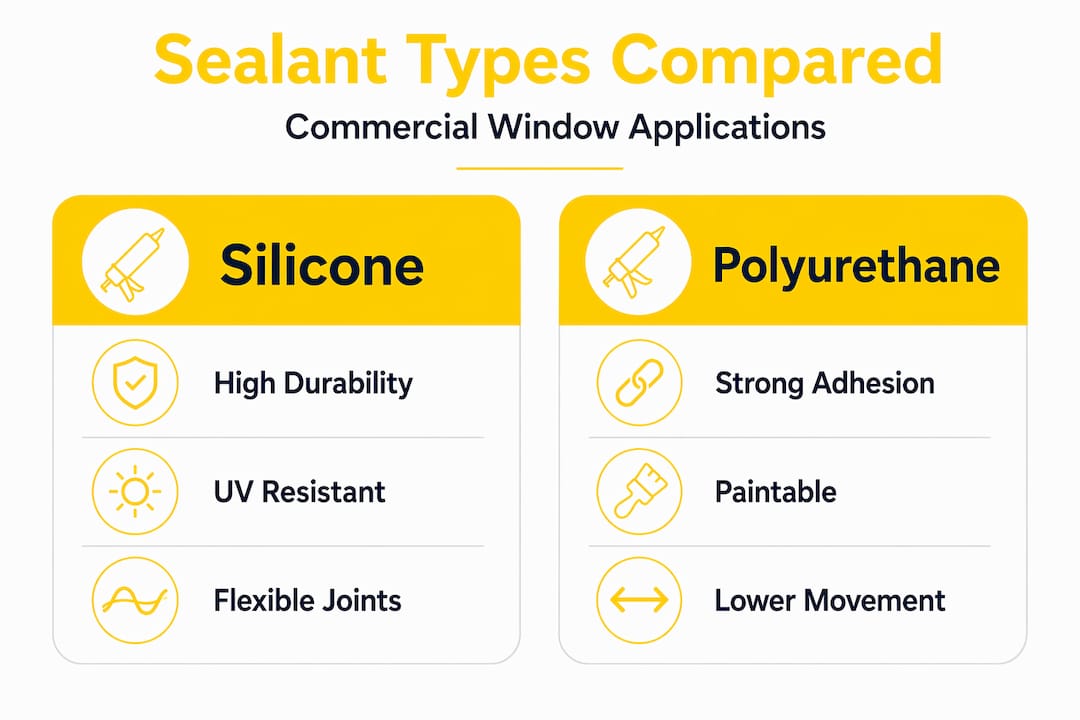
Not every sealant performs the same way, and the differences matter in a commercial context. Here is a practical comparison of the four main sealant types you will encounter when specifying for commercial windows:
| Sealant type | Best use case | Movement capacity | Durability | Key limitation |
|---|---|---|---|---|
| Silicone | Glazing perimeters, metal curtain walls | High (±25 to 50%) | Excellent UV and weather resistance | Cannot be painted; difficult to reapply over old silicone |
| Butyl | IGU edge seals, secondary glazing seals | Low | Good moisture barrier | Stains some substrates; not for exposed joints |
| Acrylic (latex) | Interior joints, low-movement perimeters | Low to moderate | Paintable; easy to apply | Degrades with prolonged UV and moisture exposure |
| Hybrid (silicone-modified) | General perimeter joints, mixed substrates | Moderate to high | Paintable in some formulations; good adhesion | More expensive; verify IGU compatibility |
Sealant material selection must confirm compatibility with the specific frame material and IGU construction. For most commercial window perimeter applications on aluminium or vinyl frames, neutral-cure silicone or a hybrid product is the standard recommendation. Acetoxy-cure silicones release acetic acid during curing and can damage certain coatings and edge seals.
For a detailed comparison of caulk and sealant products and how they apply to different window materials, the caulk versus sealants guide from Kettlecontracting is a practical reference.
The movement capability of the sealant must also match the expected joint movement. Sealants are engineered components designed to accommodate specific percentages of joint width movement. Choosing a product rated for 12.5% movement on a joint that moves 25% under thermal cycling guarantees early failure.
Maintenance and inspection practices that protect your investment
A sealant system is not install-and-forget. Ontario’s climate puts significant stress on perimeter seals through freeze-thaw cycling, UV degradation, and temperature extremes. Without regular inspection, failures develop gradually and are often not noticed until water damage has already occurred inside the building.
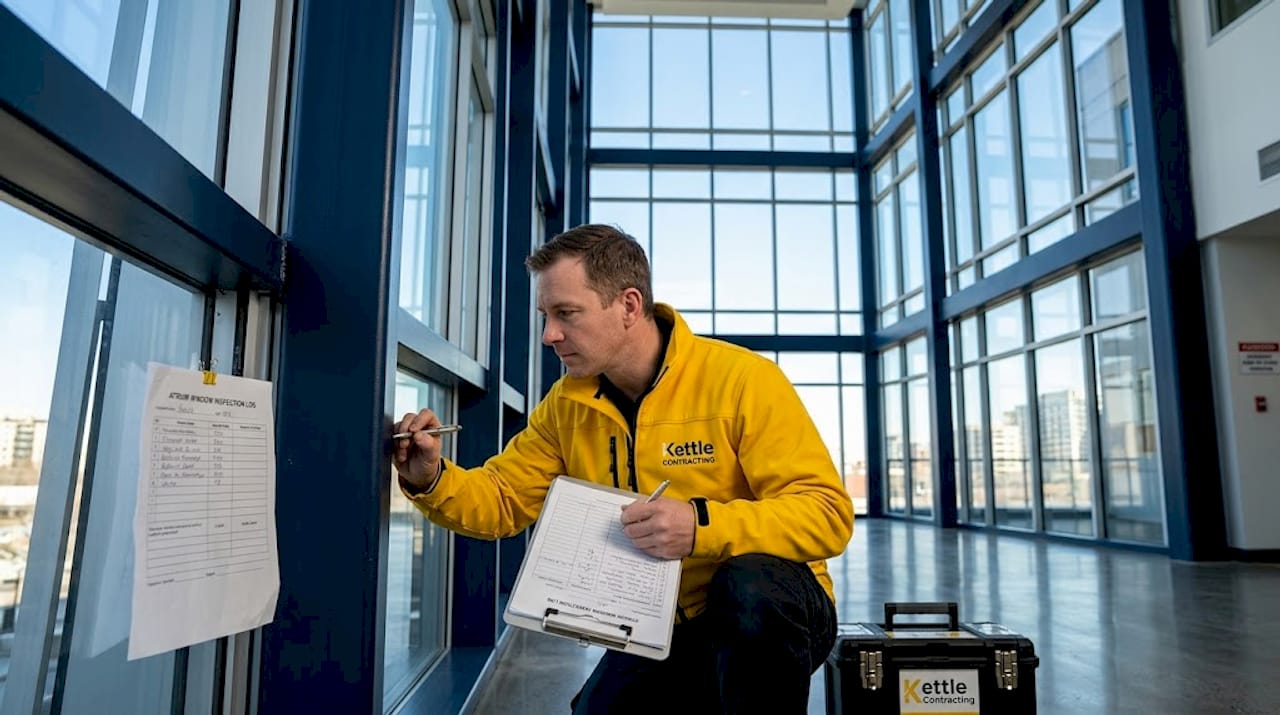
Visual inspections twice yearly are the standard baseline for commercial window maintenance. Spring and autumn inspections align with the seasons when recent thermal stress is most likely to have opened new cracks or lifted adhesion at the bond line.
During inspections, look for:
- Cracks or splits running through the sealant bead, particularly at corners and transitions
- Adhesion loss along one or both edges of the joint, visible as a gap between sealant and substrate
- Chalking, surface hardening, or shrinkage that indicates UV degradation
- Discolouration or staining below window sills, which can indicate water has been finding a path through
Cleaning protocols matter for warranty compliance. Manufacturers specify which cleaning products are safe for use around IGU edge seals. Using solvent-based or abrasive cleaners not on the approved list can accelerate seal degradation and potentially void the glazing warranty.
Infrared thermography identifies hidden failures in sealants and IGU edges before visible deterioration appears. Thermal imaging reveals cold spots and air infiltration at the building envelope that the naked eye cannot detect. For large commercial buildings with extensive glazing, a thermal scan every three to five years is a worthwhile investment.
Pro Tip: When you find a failed perimeter seal during inspection, document the location, photograph it, and repair it within the same season. Leaving it through a winter accelerates water ingress and almost always means a more expensive repair come spring.
For a structured approach to ongoing care, the window caulking maintenance checklist from Kettlecontracting is a good reference for building your own inspection programme.
My perspective after 25 years in commercial sealing
I have seen the same pattern repeat itself across hundreds of commercial projects. The sealant work gets treated as the last item on the budget and the first place cuts are made. A cheaper product, less surface preparation, no backer rod, a rushed installation. Six years later, the property manager is dealing with water-damaged insulation behind the window frames, mould complaints from tenants, and a repair that costs ten times what the original work would have if it had been done properly.
Quick-fix mentality consistently undermines envelope integrity and leads to exponentially higher repair costs over time. I have seen buildings where unsealed ingress points caused freeze-thaw damage that required full window replacement and partial facade remediation. None of that was inevitable. It was the result of decisions made years earlier when the sealant work was treated as expendable.
What I tell every facility manager I work with: sealant is not a maintenance item you react to. It is a system you manage proactively. The buildings I have seen hold up best over 20 and 30 year spans are the ones where the owners scheduled inspections, repaired early failures promptly, and used specified products with proper joint design from the start. That is not complicated. It just requires treating sealant with the same seriousness as any other building system.
— Felix
Work with Kettlecontracting on your commercial windows

If you manage a commercial property in the Greater Toronto Area and you are not certain your window sealant systems are performing, Kettlecontracting can help. Our team has been delivering professional-grade caulking and sealing work on commercial buildings across the GTA for years, with a focus on correct preparation, compatible materials, and lasting results. Start with our window preparation guide to understand what proper sealing requires from the beginning. For ongoing issues or a full assessment of your existing seals, our commercial window caulking service covers everything from perimeter resealing to full building envelope assessments. Contact us to arrange a site visit.
FAQ
What does sealant actually do in a commercial window?
Sealant forms the flexible joint between the window frame and the surrounding wall assembly, preventing water and air from passing through. It also accommodates building movement without cracking or losing adhesion over time.
How often should commercial window sealants be inspected?
Visual inspections twice yearly, typically in spring and autumn, are the standard recommendation for commercial buildings. Early detection of cracking or adhesion loss prevents water ingress and protects glazing warranties.
Can the wrong sealant void my window warranty?
Yes. Incompatible sealant chemistry on insulated glass units can void manufacturer warranties that typically cover 10 to 20 years. Always verify product compatibility with the IGU manufacturer before application.
Which sealant type is best for commercial windows?
Neutral-cure silicone is the most widely used product for exterior glazing perimeters due to its UV resistance and high movement capacity. Hybrid silicone-modified sealants are a good option where paintability or mixed-substrate adhesion is required.
Does proper window sealing actually lower energy costs?
Yes. Eliminating air leakage at window perimeters reduces HVAC load, lowers energy consumption, and extends equipment lifespan. For commercial buildings with large areas of glazing, the cumulative savings are meaningful.