
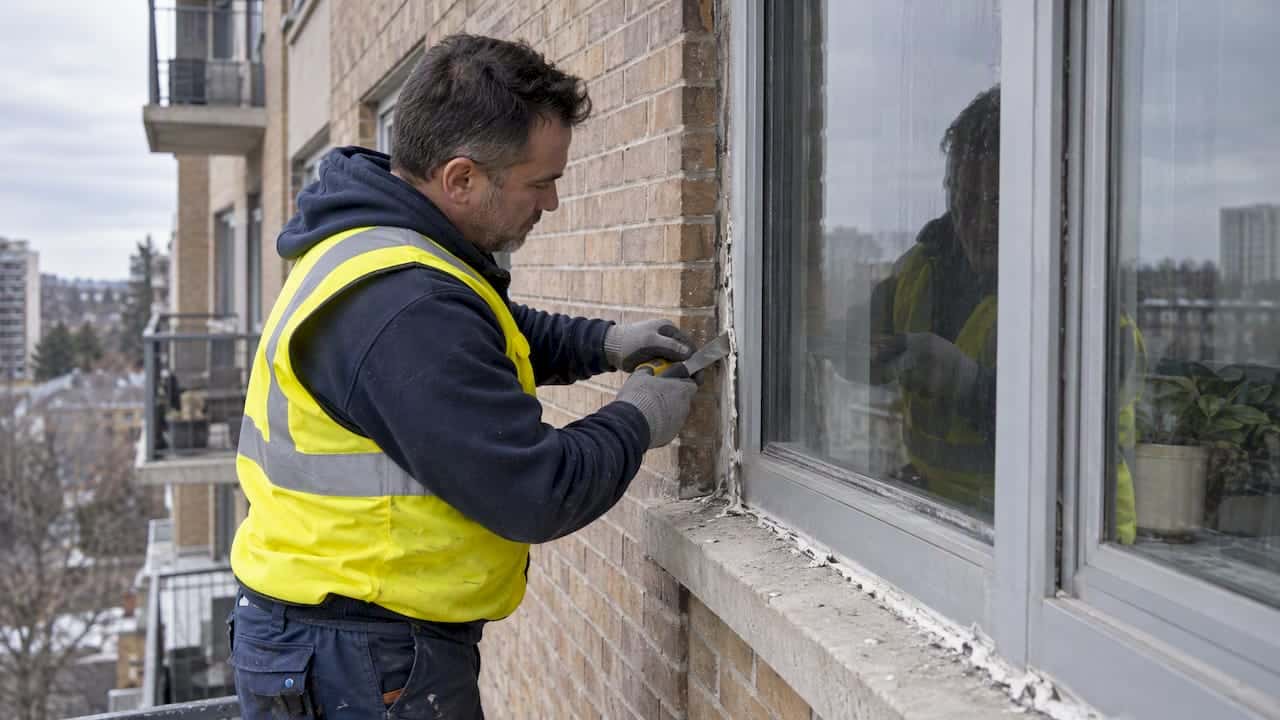
For most exterior jobs, the realistic low VOC options are silane modified hybrids and premium acrylic or advanced latex sealants. Compliant products exist under Canadian VOC rules, but the chemistry only does half the job: the joint still has to be sized and prepped right. For high movement or critical joints, we’d rather look at it in person before you commit to a product.
TL;DR:
- Since Canadian VOC limits took effect in 2022, check the technical sheet, not the label, for VOC percentage, service temperature, movement rating, and substrate compatibility.
- Acrylic and latex take paint well on trim; hybrids handle more movement, while silicone resists weather but may not bond to unprimed wood or masonry.
- Make joints at least four times wider than expected total movement; otherwise, sealant can tear at the bond line within a season or two.
- DIY work suits small, accessible, low movement joints; hire a professional for high movement areas, heritage masonry, recurring leaks, or jobs above safe reach.
Table of Contents
- What ‘low VOC’ means and how to read the label
- Exterior formulations that are low VOC and what they actually do
- Performance factors that determine whether a low VOC seal lasts outside
- A practical checklist for choosing low VOC exterior caulk
- How we apply these choices on real jobs
- Cost considerations: pricing ranges and expected total investment
- Questions to ask a professional caulker about low VOC products and warranties
- What actually matters versus what sounds good
- Book an assessment with low VOC exterior caulk in mind
- FAQ
- Sources
What ‘low VOC’ means and how to read the label
In Canada, caulks and sealants are a regulated product category under the Volatile Organic Compound Concentration Limits for Certain Products Regulations, which set mandatory concentration limits aimed at reducing emissions at the source. These limits took effect in 2022 and apply to the manufacturers and importers who put the product on the shelf, not to you as the buyer. That matters because “low VOC” printed on a tube is marketing language. What you actually want is the number behind it.
Manufacturers show compliance as a percentage of VOC content by weight, and some categories have adjustment room through compliance mechanisms like PULE permits or the VOC Compliance Unit Trading System. None of that changes what you need to check before buying. Pull the technical data sheet and look for:
- VOC percentage by weight, stated as a number, not just a “compliant” badge
- Service temperature range, so you know it will cure and hold in your climate
- Movement capability, usually shown as a plus or minus percentage
- Substrate notes, since not every sealant bonds the same way to wood, vinyl, or masonry
If a product sheet is missing any of those four, treat that as a red flag rather than an oversight.
Exterior formulations that are low VOC and what they actually do
Three chemistries dominate the exterior low VOC shelf, and they are not interchangeable.
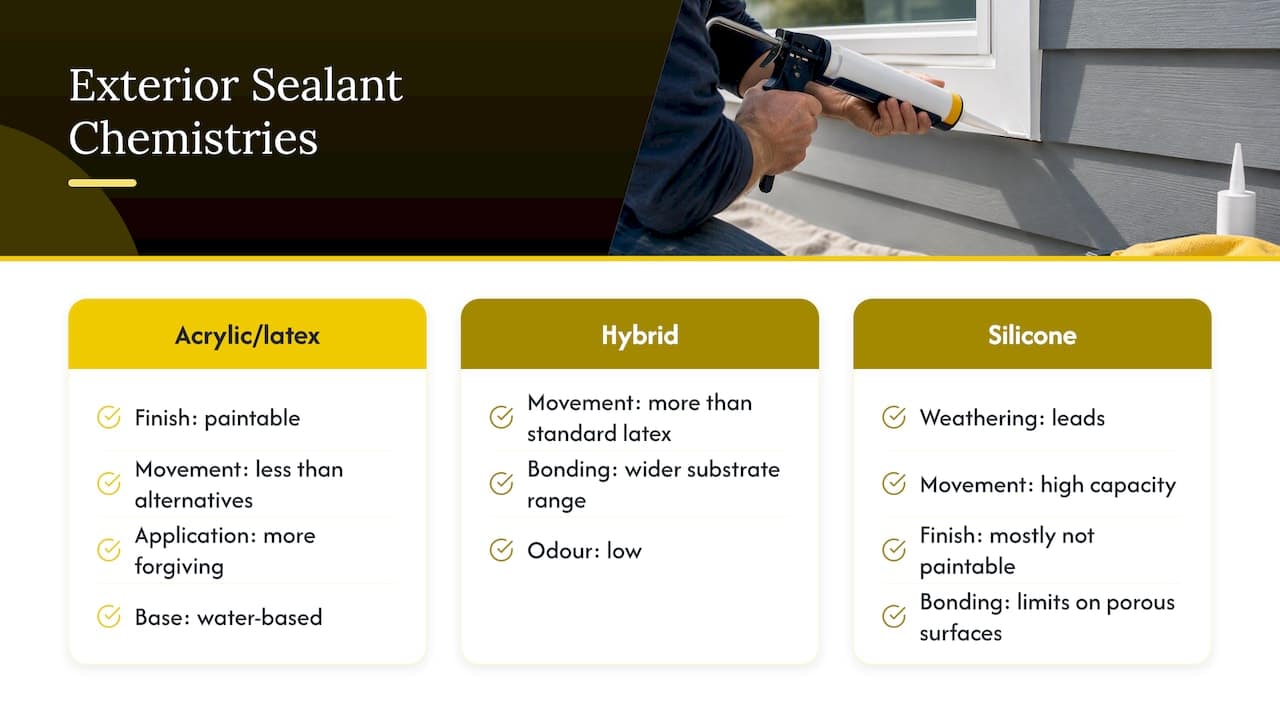
Acrylic and advanced latex sealants are water based, paintable, and usually land comfortably within VOC limits. They’re a solid choice for trim, siding, and anywhere you need the caulk line to disappear under paint. They tend to be more forgiving to apply but offer less movement range than the alternatives.
Silane modified polymers and hybrid formulations split the difference. They’re low odour, bond well to a wider range of substrates, and flex more than standard latex, which makes them a better fit for joints that see real seasonal movement, like window perimeters on older masonry.
Silicones and neutral cure sealants still lead on weathering and movement capacity, but most aren’t paintable, and some have bonding limits on porous substrates like unprimed wood or certain masonry. That’s a real tradeoff, not a flaw: you’re choosing between flexibility and finish.
Product data sheets are the fastest way to compare these claims. The DAP Dynaflex Ultra technical data sheet provides service temperature and movement capability specifications typical of quality low VOC exterior sealants, along with rain ready and paintable times suitable for a normal exterior schedule. That’s a useful benchmark for what a decent low VOC exterior product should claim, regardless of brand.
Before deciding between silicone and acrylic for a window specifically, our comparison of caulk types for exterior windows walks through the same tradeoff in more depth.
Performance factors that determine whether a low VOC seal lasts outside
Chemistry gets most of the attention, but joint design is what actually decides whether a seal survives an Ontario winter.
Movement capability is stated as a plus or minus percentage, and it only means something next to your joint width. The rule we use on site: design the joint to be at least four times wider than the total movement you expect, so the sealant never gets stretched past its rated range. Skip that math and even a premium product will tear at the bond line within a season or two.
Service temperature matters just as much. A sealant rated down to −34°C, like the Dynaflex Ultra example above, will keep flexing through a deep freeze instead of going brittle and cracking. Cheaper low VOC products sometimes narrow that range to save on formulation cost, so it’s worth checking rather than assuming.
A few other things worth confirming before you buy:
- Adhesion varies by substrate, so a sealant that’s great on vinyl may need a primer on masonry or weathered wood
- UV and mildew resistance affect how the bead looks and performs after a few summers, not just how it cures on day one
- Backing rod and bond breaker tape are small details that change how a joint moves, and skipping them is a common cause of early failure
Pro Tip: Sealant manages movement; it isn’t your primary defence against water. Joint design and flashing details do the heavy lifting, and no caulk compensates for a flashing detail that was never built right in the first place.
A practical checklist for choosing low VOC exterior caulk
Work through these in order and you’ll avoid most of the mistakes we see on inspection visits.
- Confirm VOC compliance on the actual TDS, not just the front label, and note the percentage by weight.
- Check movement capability against your joint’s real width and expected seasonal shift, using the four times rule as a floor.
- Verify substrate compatibility and whether the product is paintable, since this decides whether it works for trim versus unpainted masonry.
- Weigh application conditions, including minimum application temperature and rain ready time, against your schedule and comfort doing exterior work at height.
If the joint is small, accessible, and low movement, like a short bead around a single trim board, a careful DIY application with a quality low VOC product can hold up fine. Once you’re dealing with high movement joints, masonry, or anything above ground level that’s hard to reach safely, that’s when it makes sense to bring in a professional rather than redo the work in two years.
How we apply these choices on real jobs
This work often comes down to the same question this article walks through: which sealant actually holds up where water, air, and movement all meet at once. The focus is high-performance sealing that protects buildings from water infiltration, air leaks, and long-term structural damage while improving energy efficiency and curb appeal.
On site, that means precise caulking for windows, doors, expansion joints, and full building envelopes, regardless of the property type. Each project is treated with attention to craftsmanship and detail, because a rushed bead today is a callback in two winters.
A professional install is generally recommended for high movement joints, heritage masonry, full building envelope work, or any spot with a repeat leak history. Those are the situations where the margin for error is smallest and the cost of redoing it properly, twice, adds up fast.
Cost considerations: pricing ranges and expected total investment
Flat rates for caulking work are not published, since jobs vary significantly in scope. Pricing for residential window caulking, commercial window caulking, and building envelope sealing depends on the number of joints, access conditions, substrate condition, and whether old sealant needs to be removed first.
What we can tell you is what drives the number up or down. Removing failed sealant and properly prepping the joint takes more labour than applying fresh caulk to a clean surface, and that prep work often influences the seal’s longevity. Height and access affect the cost, with upper-level work typically being more challenging than ground floor jobs. Material choice is usually a smaller cost factor compared to labour and access considerations on most jobs.
Quotes are best given after an on-site assessment to determine what exactly needs to be done, rather than guessing a number beforehand.
Questions to ask a professional caulker about low VOC products and warranties
A few questions separate a contractor who knows their materials from one who’s just filling tubes.
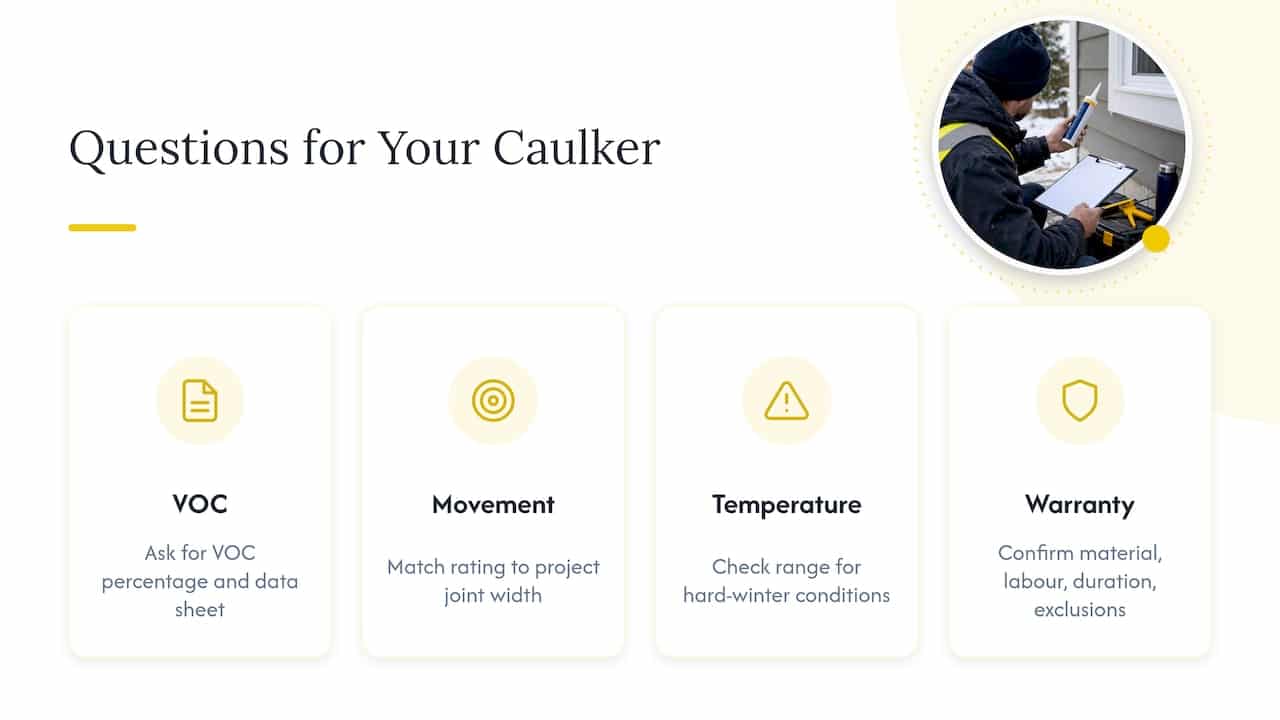
Ask what VOC percentage the product is rated at and whether they can show you the technical data sheet, not just the tube. Ask what movement capability the sealant offers and whether that matches the joint width on your specific project, since a mismatch here is the most common cause of early failure. Ask about service temperature range, particularly if you’re in a climate with hard winters, because a product rated for milder conditions can go brittle and crack.
On warranties, ask specifically what’s covered: is it the material, the labour, or both, and for how long? Ask whether the warranty is voided by normal building movement or settling, since some fine print excludes exactly the failure mode you’re trying to prevent. A contractor who answers these clearly and without hesitation is usually one who’s done the homework on the products they’re using.
What actually matters versus what sounds good
Most advice on low VOC caulk stops at “check the label,” which is true but incomplete. The regulation sets a ceiling on emissions, not a promise about durability, and a compliant product with the wrong movement rating for your joint will fail just as fast as a non-compliant one. That’s the gap conventional advice misses: VOC compliance and exterior performance are two separate questions, and you need to answer both.
The other thing we’d push back on is the instinct to treat caulk as a cosmetic fix. A fresh bead over a joint that was never sized correctly, or over a flashing detail that was missing in the first place, buys you a season, maybe two, before the same leak comes back. If you take one thing from this article, let it be that joint width and movement capability deserve as much attention as the VOC number on the tube. Get those two things right and the rest tends to fall into place.
— Felix
Book an assessment with low VOC exterior caulk in mind
Picking the right chemistry is only half the work. Getting the joint prepped, sized, and sealed so it survives a few freeze thaw cycles without cracking is the part that actually protects your building, and it’s the part we handle every day across the Greater Toronto Area.
If you’ve got windows, doors, or expansion joints showing their age, we’re happy to take a look and tell you honestly what’s needed. For most homes, that starts with our residential window caulking service, and for larger commercial or multi-unit properties, our building envelope sealing work covers the full exterior. Reach out and we’ll get you a straight answer and a fair quote.
FAQ
Does acoustic caulk really work?
Acoustic sealants are a distinct-regulated category with their own VOC allowance, adjusted specifically for Canadian climates. They’re designed to stay flexible and maintain an airtight seal around penetrations, which is what actually reduces sound transmission rather than the caulk itself blocking noise. For a deeper look at acoustical treatments in a wall assembly, see this soundproofing guide from our renovation partner.
What is a non-toxic waterproof sealant?
There’s no single regulatory definition of “non-toxic” for sealants in Canada, but a reasonable proxy is a product that meets the VOC concentration limits for its category and uses water-based or silane modified chemistry rather than solvent-heavy formulations. Waterproofing performance still depends on proper joint design and movement capability, not the sealant alone.
Is there an exterior decorators caulk?
Paintable acrylic and advanced latex sealants are generally what’s meant by a decorator’s caulk, since they’re designed to take paint cleanly and blend into trim, siding, and casing work. They’re a good fit where finish matters more than extreme movement capacity, which is typically the case on painted exterior trim.
What is the best caulk for windows?
The right choice depends on the substrate and how much movement the joint sees, with silane modified hybrids often striking the best balance of flexibility and adhesion for window perimeters. Our detailed comparison of caulk types for exterior windows breaks down when silicone, acrylic, or hybrid formulations each make sense.
Sources
- Volatile Organic Compound Concentration Limits for Certain Products Regulations: factsheet
- DAP Dynaflex Ultra technical data sheet (clear)
- UBC technical guidelines — joint sealants