For most Ontario homes, argon is the right choice. It costs little, works well in the standard double-pane gap, and has a long record in Canadian windows. Krypton earns its price only when the space between panes has to be thin, which is mostly the case in triple-pane units. After 25 years on job sites around Oshawa, I can tell you the gas matters less than people think. The edge seal, the frame and the caulking around the window decide how your house feels in January.
TL;DR
- Both gases are inert, clear, odourless and denser than air. They slow heat moving across the sealed space between the panes.
- Argon works best in a gap of about 1/2 inch, the usual double-pane build. Krypton works best in thinner gaps, which is why it shows up in triple-pane windows.
- Argon usually adds very little to a window’s price. Krypton can raise it a lot, and the gain in a standard double-pane is small.
- A well-made unit loses roughly 0.5% of its gas a year, so the fill lasts for decades.
- Gas fill does nothing for a leaky perimeter. Failing caulking undoes the benefit of either gas.
Table of Contents
- What gas fill does inside a window
- Argon vs krypton: the short comparison
- Why the gap width decides the winner
- Which one fits your home
- What the standards ask for in Canada
- How long does the gas last?
- How can you tell if your windows have argon?
- Our perspective
- Get the perimeter sealed properly
- FAQ
- Sources
What gas fill does inside a window
A sealed insulated glass unit (IGU) is two or three panes of glass separated by a spacer. Natural Resources Canada explains that these units are typically filled with an inert gas such as argon or krypton to reduce heat transfer through the glass. The spacer also holds a desiccant that absorbs moisture after sealing, so the unit doesn’t fog.
Why does a heavier gas help? The US Department of Energy’s window guideline says argon and krypton are denser than air and conduct heat less well, which cuts heat transfer between the glass layers by limiting the convection currents in the gap. The same guide notes the gases are nontoxic, nonreactive and odourless, and stay that way even if they leak out or mix with air.
The Glass Association of North America puts a number on it. Inert gases lower the U-factor of an IGU typically by 10 to 15 percent compared with air. That is a real gain, but it is a gain of some percent, not a doubling. Lower U-factor means less heat escapes, so the inside glass stays warmer in winter.
Argon vs krypton: the short comparison
| Air | Argon | Krypton | |
|---|---|---|---|
| Density vs air | Baseline | Roughly 6 times denser per Ecohome | Roughly 12 times denser per Ecohome |
| Typical nominal gap | About 1/2 inch (13 mm) | About 7/16 inch (11 to 12 mm) | About 5/16 inch (8 mm) |
| Best suited to | Budget or low-spec units | Standard double-pane windows | Narrow gaps, often triple-pane |
| Cost | Lowest | Usually a small add-on | Can raise the package price significantly |
The gap widths come from the Glass Association of North America. The density and cost points come from Ecohome’s Canadian guide to argon and krypton, which says argon adds often just a few dollars per square foot while krypton can raise the price a lot.
Why the gap width decides the winner
This is the part most comparison pages skip, and it is the whole answer. Each gas has a gap width where it performs best.
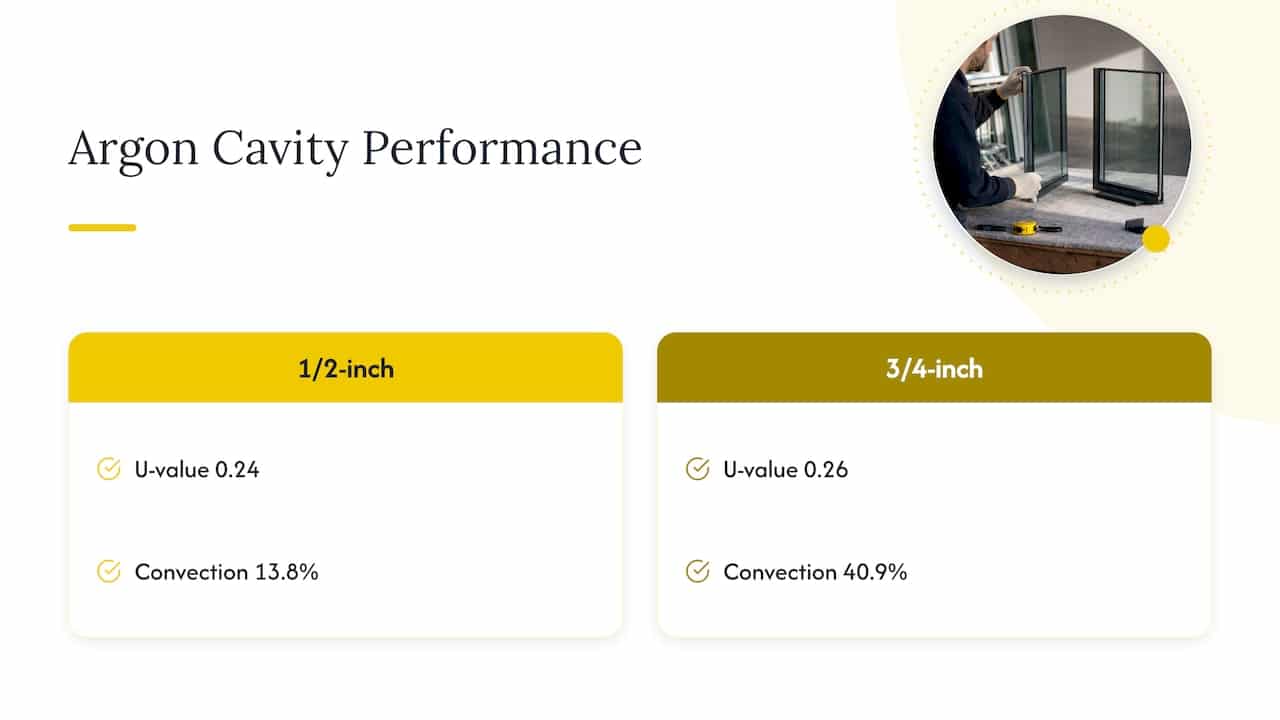
Vitro’s technical team explains that heavier gases make convection harder to start, but if the space grows beyond the optimum width, buoyant forces overcome the gas’s resistance and convection takes back what the gas gained. Their example: with a 1/2-inch space and 90% argon, the centre-of-glass U-value is 0.24. At 3/4 inch, convection jumps from 13.8% to 40.9% of the heat flow and the U-value gets worse, at 0.26.
So the optimum gap is widest for air, slightly narrower for argon and narrowest for krypton. The US Department of Energy says the optimal spacing for argon is about the same as for air, around 1/2 inch. Krypton does better than argon when the space has to be thinner, for example 1/4 inch, but it costs more.
A UK glass manufacturer’s published cavity table shows the same pattern for a pane with a low-E coating. The optimum cavity is 14.7 mm for 90% argon and 9.7 mm for 90% krypton. The same source adds that krypton in a 16 mm cavity brings a negligible benefit over argon. Put krypton in a wide gap and you have paid extra for very little.
Window + Door magazine summarizes it this way: krypton gives roughly the same performance as argon in two-thirds to one-half the cavity width. That allows a thinner unit.
Why krypton shows up in triple-pane windows
A triple-pane unit has to fit three panes into a frame that is often about the same depth as a double-pane. That forces each gap to be narrow. Ecohome’s Mike Reynolds explains that in those narrow cavities argon would not perform efficiently, but krypton does, giving very high R-values without bulky non-standard frames.
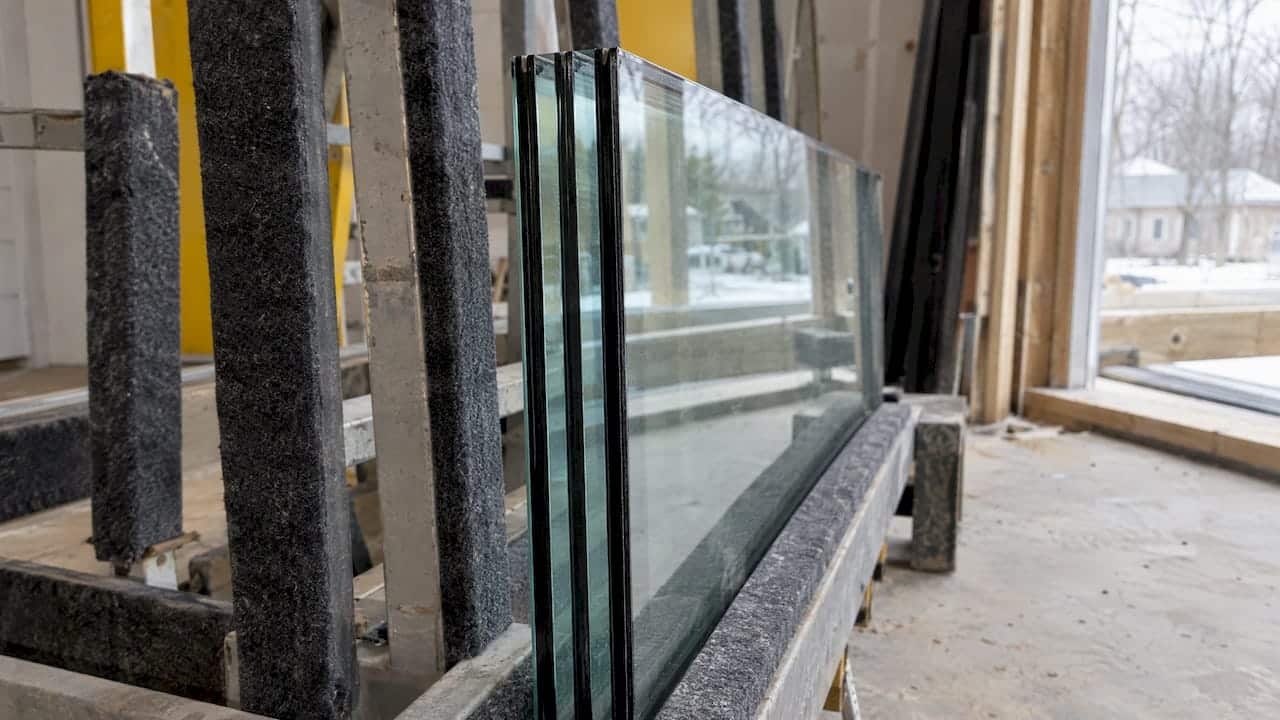
Bayview Windows’ guide adds that krypton is typically used where the total glazing thickness must be kept small, and that a krypton and argon mix is sometimes used to balance cost and thermal performance.
Which one fits your home
Choose argon if:
- You are replacing standard double-pane windows in a typical Ontario house.
- You want the best return per dollar. Canadian Choice Windows & Doors says that on most Canadian replacement projects, argon delivers strong value without the krypton premium.
- Your frames are standard depth and the gap is around 1/2 inch.
Consider krypton if:
- You are buying triple-pane windows, where thin gaps are built in.
- You have a deep-set or narrow frame that cannot take a wider unit.
- You are building to a high-performance target and the budget is set up for it.
On a standard double-pane window, Ecohome’s view is that the small U-value improvement from krypton does not justify the steep price increase for most homeowners. I agree with that from what I see on real jobs.
What the gas can’t fix
The same Ecohome guide makes a point I repeat to every client: gas fill is one part of the unit. It needs to be paired with a low-E coating and a thermally broken frame, and a krypton unit in a poor frame is wasted money.
The gas does nothing for noise either. Canadian Choice Windows & Doors points out that glass thickness, laminated layers, pane spacing and the frame do far more to cut traffic noise than the gas does.
And it does nothing for air leakage around the unit. That is a sealing issue, not a glass issue. If you want to see how caulking affects your heating bill, our write-up on window caulking and energy bills walks through it. For the wider picture of cooling and heating choices working together, this piece on energy efficient cooling choices is a good companion.
What the standards ask for in Canada
Natural Resources Canada’s R-2000 Standard asks for windows that are double-glazed with a low-emissivity coating, an inert gas fill and an insulated spacer. Canadian ENERGY STAR certified windows meet or exceed those requirements. Since 1 January 2020, ENERGY STAR Canada has used one national bar: a maximum U-factor of 1.22 W/m²·K or a minimum Energy Rating of 34. The window is judged as a whole product. Argon is one common way to get there.
When you compare quotes, ask for the U-factor or Energy Rating of the whole window, not just the gas name. Two windows both labelled “argon” can perform quite differently.
How long does the gas last?
Less time than you’d fear, more than you’d expect. The US Department of Energy reports studies showing less than 0.5% leakage per year in a well-designed and well-fabricated unit, about a 10% loss over 20 years. That would change the U-factor by only a few percentage points. The NFRC consumer guidance says the same: after 20 years, a unit with some leakage still performs at about 90% of its original capacity.
Window + Door magazine’s Dan Haglin adds a helpful picture. Gas escaping is a two-way exchange, like a helium balloon that shrinks but still holds helium. The real failure is the seal letting moist air in. Once that happens, you see fogging between the panes, and the gas benefit goes with it.
Freeze-thaw is hard on those seals. Glass heats in the sun and contracts in the cold, working the edge seal and spacer for years. Expect sealed units to start failing somewhere around 10 to 20 years, sooner in harsh conditions and later with a good warm-edge spacer, according to Crystal Glass in Alberta. Ontario winters are not much kinder.
How can you tell if your windows have argon?
You can’t see or smell it. Argon and krypton are both clear and odourless. Here is what I tell homeowners to do instead:
- Check the paperwork. The quote, invoice or manufacturer’s spec sheet should name the gas fill, the low-E coating and the spacer type.
- Look at the label. Many windows carry a label or etched mark in a corner of the glass or on the spacer. Newer units usually list the performance rating.
- Ask the manufacturer or the installer. Give them the model or the order number from the window.
- Don’t drill or poke the unit. Breaking the seal lets in moist air and you lose the benefit. If a window is fogged between the panes, the seal has failed regardless of what gas was in it.
Our perspective
In 25 years working around Oshawa, Whitby and Ajax, I have seen more energy lost around windows than through them. A homeowner pays extra for a krypton triple-pane, then the perimeter joint cracks after a few winters, and cold air walks right past the glass.
Our approach is simple. We recommend the gas fill your window supplier specifies for the gap and frame, and we put our effort into the part we control: the seal between the window and the wall. We use premium materials suited to the Canadian climate, we prepare the joint properly, and we plan the job to last through freeze-thaw cycles, not just through the first spring.
If you are replacing windows, get the installation and the perimeter sealing done as one piece of work. If your windows are fine but drafty, resealing the exterior joint is often the smarter first step.
Felix
Get the perimeter sealed properly
Whether your windows hold argon, krypton or plain air, the joint where the frame meets the wall decides how much of that performance you keep. We seal and reseal windows and doors for homes and commercial buildings across the Greater Toronto Area, and we install windows and doors too.
Start with our residential window caulking service, or see our window and door installation work if you are replacing units.

For larger properties, our commercial window caulking and building envelope sealing cover the whole building. Contact us through kettlecontracting.com for a quote.
FAQ
Is krypton better than argon?
In thermal terms, yes, krypton insulates better than argon when the gap is narrow. In a standard 1/2-inch double-pane gap the difference is small, and argon is close to optimal. Krypton makes the most sense in triple-pane units.
Are argon windows worth it in Ontario?
For most homeowners, yes. Argon usually adds a few dollars per square foot according to Ecohome, and it lowers the U-factor by roughly 10 to 15 percent compared with air. It works best alongside a low-E coating and a good frame.
Do argon windows lose their gas?
A little, slowly. A well-built unit loses about 0.5% per year, so roughly 10% over 20 years. That changes performance only a few percentage points. The bigger issue is seal failure, which shows up as fog between the panes.
Can I mix argon and krypton?
Yes. Bayview Windows notes that a krypton and argon mix can balance cost and thermal performance. Ask your window supplier whether a mixed fill is offered for your unit.
Does argon reduce noise?
Not meaningfully. Glass thickness, laminated layers, pane spacing and the frame system matter far more for noise from traffic or busy streets.
Sources
- Natural Resources Canada: Technology primer
- US DOE: Measure Guideline, Energy-Efficient Window Performance
- Glass Association of North America: Performance Improvements in Insulating Glass Units
- Ecohome: Argon vs. Krypton Gas Windows
- Vitro TD-101: Gas Space Convection Effects
- Saint-Gobain Glass: U-values
- Window + Door: Gas Fill 101
- Bayview Windows: Almost everything you need to know about windows
- Canadian Choice Windows & Doors: Argon gas windows
- Natural Resources Canada: Details of the R-2000 Standard
- Frost Air Conditioning: Why choose energy efficient cooling