
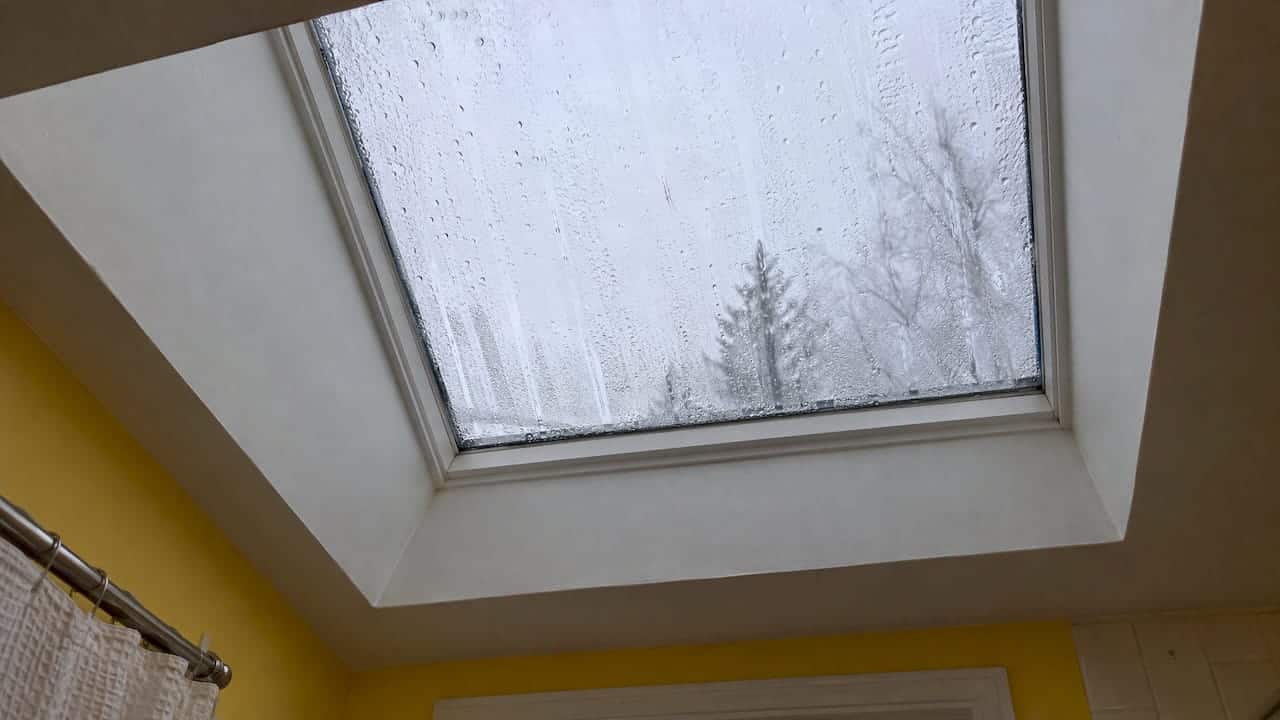
If your skylight drips only on cold mornings, the water is clear, and the ceiling around it stays dry, you are almost certainly looking at condensation. If it drips during or just after rain or a thaw, and you see brown stains at one corner, you have a leak. Timing is the quickest way to tell them apart, and most of the rest of this article shows you how to confirm it. After 25 years of sealing and fixing the building envelope in Oshawa and across the GTA, I can tell you that many “leaking” skylights are really a humidity problem. The reverse is just as common, and the two need completely different fixes.
TL;DR
- Condensation shows up on cold, dry mornings, as beads or clear water running down the inside of the glass and frame. It is worse in rooms with bathrooms, kitchens and bedrooms nearby, and it eases when indoor humidity drops.
- A leak tracks the weather: it appears during or after rain or a thaw, usually from one corner or the uphill side, and leaves brown rings on drywall.
- The one-hour test: wipe the glass and frame dry on a dry morning. If they are wet again within the hour, think condensation. If they stay dry until it rains, think leak.
- Fog between the panes that you cannot wipe off means the sealed glass unit has failed. That is a replacement, not a caulking or ventilation job.
- Misdiagnosis is expensive. Condensation needs humidity, insulation and air-sealing fixes. Leaks need flashing and roof-level work.
Table of Contents
- Why a skylight sweats in the first place
- The quick checks that sort condensation from a leak
- The case people miss: fog between the panes
- When condensation is really a defect
- How to reduce skylight condensation
- What to do if it is a leak
- What it costs to fix each problem
- Where we can help
- FAQ
- Sources
Why a skylight sweats in the first place
A skylight is usually the coldest surface in the room. Warm, moist indoor air rises, touches that cold glass and drops its moisture, the same way a cold glass of water sweats in summer. Natural Resources Canada explains that condensation often occurs in colder weather when moist indoor air meets cooler surfaces, and that the risk goes up as the weather gets colder or as indoor humidity rises.
So yes, it is normal for a skylight to have some condensation. It does not mean the skylight is defective, and it does not mean water is getting in from outside. Columbia Skylights, a Canadian manufacturer, describes the droplets as moisture that was already in your home, not “sweating” from the outside.
The water can still look alarming. It runs down the glass, pools on the frame and drips onto the floor. In the dead of an Ontario January, with the furnace running and a humidifier on, that is exactly what you would expect. The same physics applies to ordinary condensation on windows, where indoor humidity, poor ventilation and cold surfaces combine.
Natural Resources Canada also notes that condensation can form in several places: on the glass, on the frames and sashes, near weather seals, on the walls around a skylight, and between the panes if the seal is broken. That last location matters, and we come back to it below.
The quick checks that sort condensation from a leak
You do not need tools for most of this. You need a dry cloth, a notebook (or your phone) and a few days of paying attention.
1. Check the weather when it happens
This is the single most useful clue. Roofing contractors in the GTA consistently describe the same pattern: real leaks follow the weather, appearing during or shortly after rain or a thaw, while condensation shows up on cold, dry mornings. Another Canadian contractor points out that moisture on cold mornings without rain fits condensation, while water that only appears in wind-driven rain points elsewhere.
Write down the date, the time, the outdoor temperature and whether it rained, snowed or thawed in the previous day. Two or three entries usually settle the question.
2. Do the wipe test
On a dry day, wipe the glass and frame completely dry in the morning. Then watch. A Canadian roofing company suggests that if the surfaces are wet again within an hour on a dry day, that points to condensation. Wetness that persists and lines up with rain points to a leak.
3. Look at where the water is
| Clue | Points to condensation | Points to a leak |
|---|---|---|
| When | Cold, clear mornings; overnight in bedrooms | During or just after rain, snowmelt or a thaw |
| Where | Evenly along the bottom of the glass and frame, a damp ring at the glass edge | One corner, one side, or the uphill side of the shaft |
| Water | Clear, in beads or even runs | Often stained; brown rings on drywall |
| Surrounding ceiling | Dry, no staining | Stains, bubbling paint, soft or wet drywall |
| Changes with humidity | Improves when you run fans or lower the humidifier | No change with indoor humidity |
These patterns are drawn from several Canadian roofing sources, including Fair and Square Roofing, which describes condensation as tiny beads on the glass, dampness on the frame or morning dripping, and a leak as brown rings on drywall, wet insulation or soft spots that grow over time. A Toronto-area contractor adds that brown staining at one corner of the shaft suggests a leak, while a general damp ring at the glass edge suggests condensation.
4. Look at the room
Condensation is worse in rooms that generate moisture. A skylight over a bathroom, kitchen or a bedroom where two people sleep with the door shut will sweat more than one in a hallway. Another Canadian source says condensation runs down the inside of the glass evenly and is worse in those rooms overnight, while a leak comes from a frame corner or through the drywall well.
5. Go into the attic, if you can do it safely
If you can reach the attic safely, trace any stain upward with a flashlight during or right after rain. One Ontario roofing contractor calls this the most reliable single step for separating a leak from condensation. Wet insulation, a damp roof deck or a wet trimmer beside the skylight during rain tells you the water is coming from outside. Stay off the roof in rain, wind or frost.
The case people miss: fog between the panes
If the cloudiness sits inside the glass and you cannot wipe it off from either side, it is not room condensation and it is not a roof leak. The sealed glass unit has failed, and moisture has got between the panes. Natural Resources Canada lists condensation between the panes as a sign of a broken seal, with replacement of the insulating glass unit as the remedy.
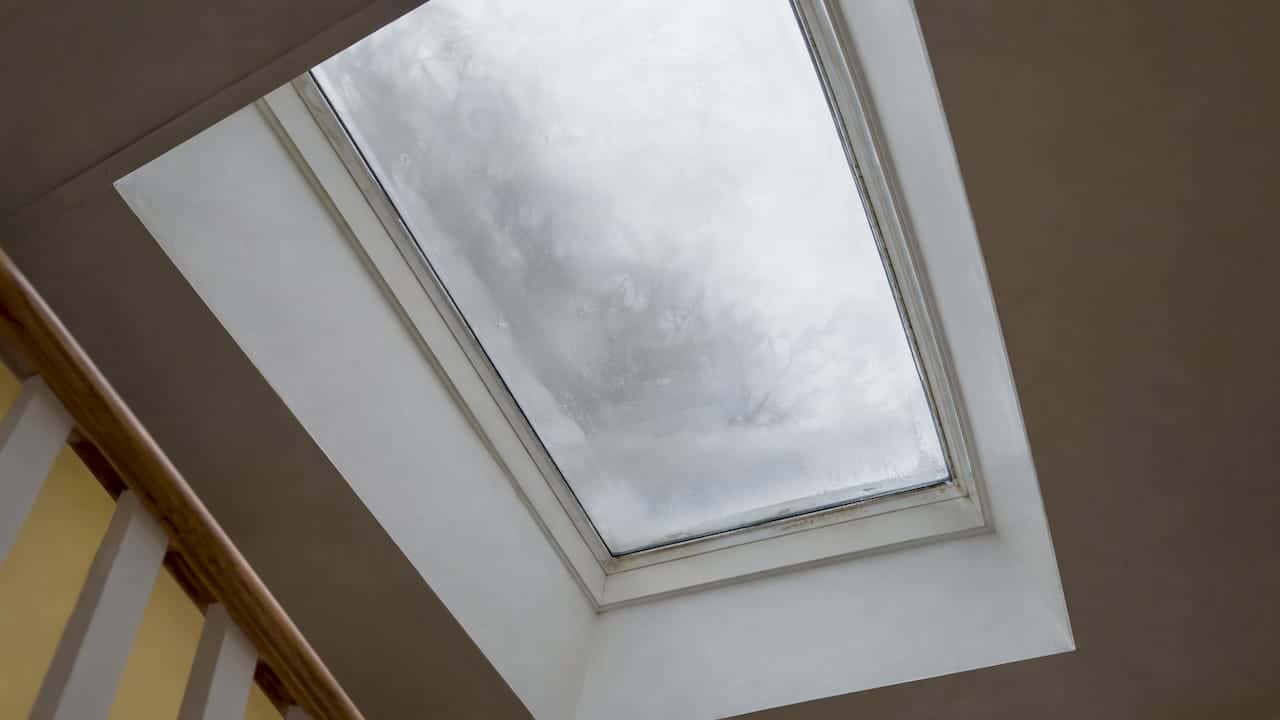
One Toronto contractor makes a useful distinction: droplets on the accessible, room-facing surface may be ordinary condensation, but cloudiness enclosed within the glazing needs a different assessment. No amount of dehumidifying or sealing will clear it.
When condensation is really a defect
Sometimes condensation is normal, and sometimes the skylight was never set up to handle it. Two situations come up.
Gaskets and the top frame. Some fixed skylights can let warm, moist air get behind the gaskets, condense on the underside of the top frame and then drip at the top of the unit or around the blind clip, even in dry weather. A GTA article describing a VELUX service document traces this to gaskets stapled in the wrong spot or cut short at the corners, and treats it as a job for the manufacturer’s technician.
Blocked drainage. Many skylights and roof lights have small channels and weep holes that carry condensation away. An Australian manufacturer notes that when weep holes are filled with sealant, the water can overflow and drip into the room rather than drain. This is a good reminder that more sealant is not always the answer.
How to reduce skylight condensation
Start with moisture, then work on the cold surface.
- Lower indoor humidity. FAKRO, a skylight manufacturer, recommends keeping indoor moisture at 60% or less. A cheap hygrometer tells you where you stand. In an Ontario winter, many homeowners find they need to run humidifiers lower.
- Use your fans. Columbia Skylights recommends ventilating regularly, using kitchen and bathroom extraction fans with doors closed, and avoiding indoor laundry drying where possible.
- Check your HRV. Natural Resources Canada advises making sure a heat recovery ventilator is on if you have one, and keeping air moving near the glass.
- Let warm air reach the glass. Open the skylight blind so room air can circulate against the glass instead of being trapped behind it. A Canadian roofing source also suggests this, along with running the bathroom fan longer.
- Insulate and air-seal the light shaft. Uninsulated shafts sweat. One roofing contractor lists insulating and air-sealing the shaft, and sealing gaps at the ceiling and skylight frame, among its condensation steps.
- Consider a better unit. Natural Resources Canada says high-performance ENERGY STAR certified skylights, with features such as triple glazing, low-e coatings, inert gas, improved spacer bars and insulated frames, reduce condensation. An old single-pane unit will sweat far more.
Air leakage matters more than people think. Gaps around frames let warm, humid air reach cold surfaces, and sealing them is the kind of work we do every week on windows, doors and building envelopes. The same logic applies to the windows in your house; our own guide on what causes window condensation walks through it.
What to do if it is a leak
Treat a true leak as a roof problem first. Most skylight leaks come from flashing, underlayment or shingles around the unit, or from water travelling from elsewhere on the roof. A Canadian contractor notes that water around a skylight does not always mean the skylight itself failed.
In the meantime:
- Protect the floor and contents, and put a container under the drip.
- Note the timing and the weather, and take photos of the water and any staining.
- Check the attic if you can do it safely.
- Do not caulk from inside, and do not go on the roof in rain, wind or frost.
- Call a roofer if leaks repeat, stains grow or moisture appears after storms. A roofing source from the US adds that the roof and skylight should be evaluated together, because moisture travels beyond where it first shows up.
Caulking inside the shaft hides the symptom and traps water in the wall. If you are choosing when to schedule roof-level work, it helps to know the best time of year to repair your roof. Winter jobs are possible but limited by frost and ice.
If your water shows up after snowmelt, our write-up on a skylight leaking after snow covers what to inspect during a thaw.
What it costs to fix each problem
Getting the diagnosis right first decides which repair you pay for. One roofing analysis puts it plainly: misdiagnosing condensation sends you to the wrong repair, such as flashing or glass work when you needed ventilation and insulation.
For reference, here are GTA ranges published by one contractor in 2025:
| Work | Typical GTA cost (2025) |
|---|---|
| Perimeter reseal of a skylight | $200 to $450, buying roughly 5 to 8 more years |
| Flashing repair or replacement | $350 to $900 |
| Full skylight replacement | $1,800 to $4,500 |
These come from Universal Roofs, and your quote will depend on roof pitch, access and the condition of the decking around the curb. Interior drywall repair is usually quoted separately. Fixing condensation by lowering humidity and sealing air gaps costs far less than any of the above, which is another reason to run the checks first.
A rough rule from another contractor: if a unit is more than 20 years old, shows several failures at once or has a frame with rot or movement, replacement usually makes more sense than repeated repairs. A 1990s skylight is typically single or basic double glazed, so a modern unit also improves winter heat loss and summer solar gain.
Our view from 25 years on Ontario jobs
Most calls about a “leaking” skylight start with a bucket and a worried homeowner. Before anyone climbs a ladder, we ask when it drips. If it is a clear, cold-morning drip with no rain, the building is usually telling you the air inside is too wet and too leaky around the cold glass.
The mistake we see over and over is reaching for a tube of caulk. Caulk works when a joint has failed and is open to weather. It does not fix humidity, and it should never be used to seal in water that has nowhere to go. Our approach is to do the job once and right so it lasts through Ontario freeze-thaw cycles, which means finding the actual source first.
Where air gets through frames, joints and the envelope around your windows and doors, proper sealing with the right sealant for the Canadian climate cuts the drafts that feed condensation. That is the part we do best, and we would rather tell you plainly what your problem is than sell you the wrong repair.
Felix
Where we can help
Skylight flashing is roofing work, but the air leaks and failed joints that feed moisture problems around your home are ours. We caulk and seal windows, doors, expansion joints and full building envelopes for homes, multi-unit properties and commercial buildings across the GTA, from Oshawa and Whitby to Ajax, Pickering, Bowmanville and Cobourg. Our residential window caulking service is where most homeowners start, and building envelope sealing covers larger properties.

If your windows drip or draft as well as your skylight, send us a note through kettlecontracting.com and we will look at where the air and water are getting through. If you want to rule out an outside leak at a window first, our five minute hose test shows you how.
FAQ
How do I know if it’s a leak or condensation?
Look at timing and location. Clear water on cold, dry mornings, spread evenly along the glass and frame, is condensation. Water during or after rain or a thaw, from one corner, with brown stains on the drywall, is a leak. The wipe test confirms it: if the surface is wet again within an hour on a dry day, it is condensation.
Is it normal for a skylight to have condensation?
Yes. Natural Resources Canada says condensation forms when moist indoor air meets cooler surfaces, and the risk rises as it gets colder or indoor humidity climbs. A skylight is often the coldest surface in the room, so it shows it first. Frequent heavy dripping is a sign to reduce humidity and check the shaft insulation.
Does condensation mean my house is too cold?
Usually it means the air inside is too humid for the temperature of the glass, not that the house is too cold. Lowering humidity, running extraction fans, keeping the blind open and sealing air gaps around the frame all help. A newer, better-insulated skylight stays warmer on the inside and sweats less.
How much does it cost to reseal a skylight?
In the GTA, one contractor published a perimeter reseal at roughly $200 to $450 in 2025, with flashing repair at $350 to $900 and full replacement at $1,800 to $4,500. Prices vary by roof access and the condition of the surrounding structure. Confirm the cause first, because condensation will not be fixed by resealing.
Sources
- Condensation, Natural Resources Canada
- Condensation, FAKRO Canada
- What Is Condensation, Columbia Skylights
- Why skylights leak and how roofers diagnose them
- How to Fix a Leaking Skylight
- Is Your Skylight Leaking or Is It Condensation?
- Skylight Leaking: Causes and Fixes
- Skylight Leak Repair in Toronto and the GTA
- Skylight Leak or Condensation?
- Leaking skylight: repair, reflash or replace in a GTA home
- Condensation and the gutters that carry it
- How Homeowners Can Understand Skylight Leaks
- Top Skylight Repair Tips
- 9 Best Skylight Repair Solutions for Pitched Roofs
- Skylight Leak: 7 Sources, Diagnosis and Repair Cost