
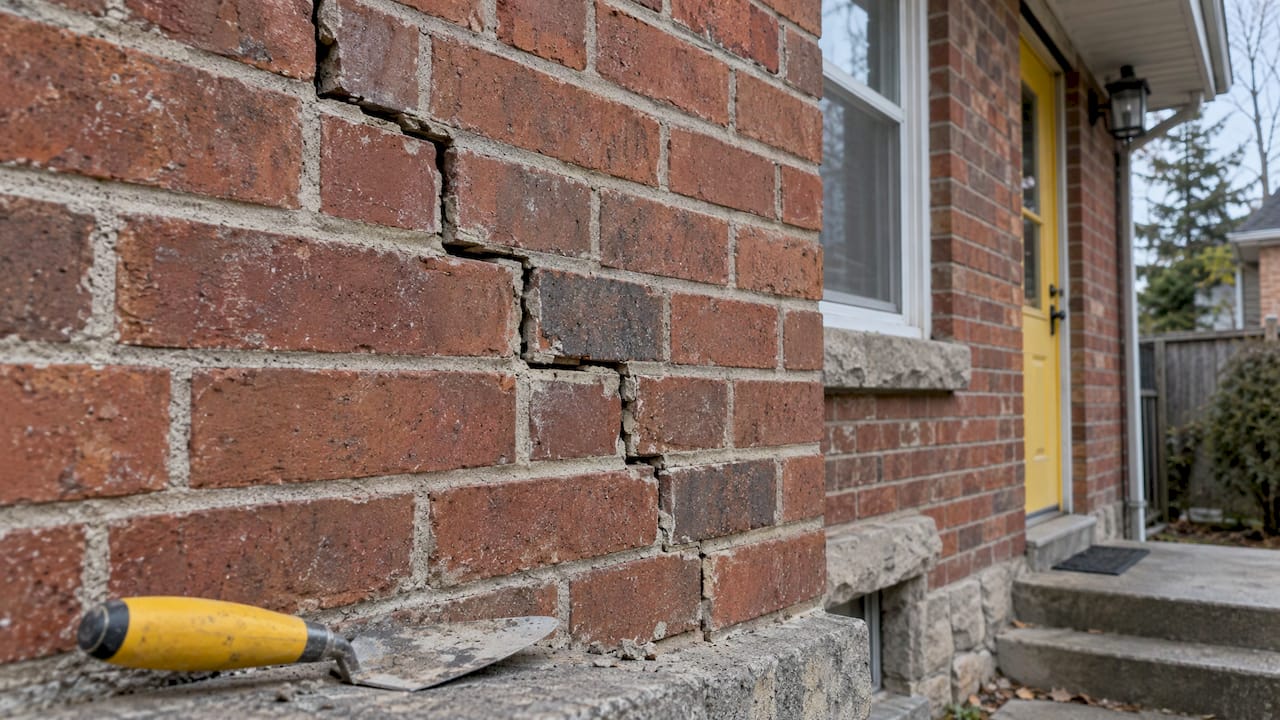
There are four main ways to repair a cracked brick wall: repointing the mortar joint, filling a hairline crack with a flexible sealant, injecting a crack that leaks, and stitching a crack with steel bars. Which one is right depends on one question first: is the crack still moving? A stable crack in a joint usually needs repointing. A crack that opens and closes with the seasons needs a flexible material. A crack that keeps growing needs someone to find the cause before anything is filled.
After 25 years sealing and repairing brick around Oshawa, Whitby and Ajax, I have seen the same mistake over and over. Someone fills a crack with rigid patch, the next freeze-thaw cycle opens it again, and the water gets in behind the repair. This guide walks through each method, what it is for, and when to call a professional.
TL;DR
- Work out the cause first. Monitor the crack to see if it is active. Active cracks get flexible sealant, and stable cracks in mortar joints can be repointed.
- Cracks that run through the mortar joints are usually fixed by raking out the joint, repacking it with suitable mortar and curing it damp.
- Crack stitching with steel bars only treats symptoms. Have a structural engineer look at wide, stepped, horizontal or growing cracks before any repair.
- Fix water entry first: check caulking around windows and doors, flashings and copings. Repair brick in mild weather, not in freezing temperatures.
- A fix that holds through Ontario winters depends on joint preparation, the right material and curing.
Table of Contents
- Start by reading the crack
- Deal with water before you touch the crack
- Method 1: Repointing cracked mortar joints
- Method 2: Flexible sealant for hairline and moving cracks
- Method 3: Injection for cracks that leak
- Method 4: Crack stitching for structural cracks
- Which method fits which crack
- What about cracks in interior brick?
- Our perspective
- Getting the repair done right
- FAQ
- Sources
Start by reading the crack
Before you pick a method, look at what the crack is doing. A few minutes on this saves a repair that fails in one winter.
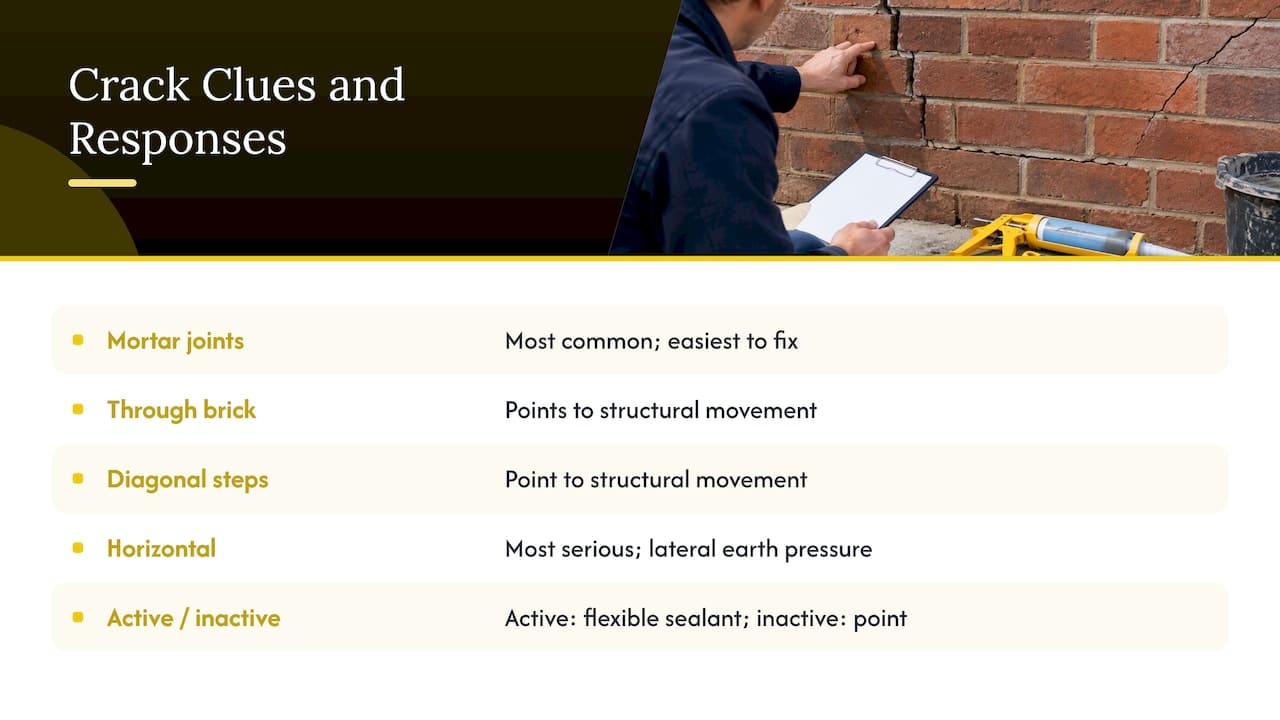
Where is it? Cracks that follow the mortar joints between bricks are the most common and the easiest to fix. Cracks that run through the bricks themselves, or that step diagonally up the wall, point to movement in the structure.
Which direction? A structural engineering firm in Ontario notes that crack orientation matters, and horizontal cracks are described as the most serious because lateral earth pressure can exceed what the wall can resist. That is usually a basement or foundation wall question, and it is a job for an engineer, not a caulk gun.
Is it active? The U.S. National Park Service advises that cyclical cracks should be monitored to see whether they are active. Active cracks should be sealed with flexible sealant, while inactive cracks may be pointed. It also says structural repairs should come before cosmetic ones.
A simple way to monitor: mark both ends of the crack with a pencil and date it, then photograph it with a ruler beside it. Check again after a hard freeze, after a thaw and after a wet spell. If it has not changed over a full year of seasons, it is likely stable. If it has grown, or it is wider in winter than in summer, treat it as active.
Not every crack signals a problem. The Region of Waterloo’s masonry guide for heritage properties notes that cracking can reflect past settlement that is now stable and may only need grouting or repointing to keep moisture out. It also warns that the cause of deterioration has to be determined before repointing.
Deal with water before you touch the crack
Brick walls fail where water gets in. The Region of Waterloo guide says to resolve moisture problems before masonry repairs, and names water penetration, repeated wetting and drying, and freeze-thaw action as common causes of deterioration.
NRC Canada’s guidance on leaky masonry says to check carefully around window and door openings, coping and flashings before extensive repairs, and to caulk and seal any cracks or openings found there. If moisture keeps coming through after that, it points to faulty mortar joints, or sometimes very porous brick.
In practice, a crack above or beside a window is often a failed seal, not a masonry problem. Our five-minute hose test for window leaks shows you where water is getting in. If the stain sits under a window head, the leaking window lintel test is worth doing first.
Method 1: Repointing cracked mortar joints
Repointing means removing old or damaged mortar from the joints and replacing it with new. The Waterloo guide says it is needed when mortar has eroded as deep as the joint is wide, or when water is penetrating. It also says repointing is only needed where mortar has failed, and that a building will seldom need to be completely repointed.
That matches what I see on site. Fix the failed joints and leave the sound ones alone. If you are weighing the terms, our guide to tuckpointing vs repointing explains the difference for Ontario owners.
The steps
- Rake out the joint. NRC recommends removing old mortar to a depth of ¾ to 1 inch (roughly 19 to 25 mm), then clearing loose material.
- Wash the joints. Dust and loose grit stop new mortar from bonding.
- Dampen the wall. The masonry should be damp but not wet when you start.
- Pack the mortar tightly. Press it in firmly, then tool the joint to a concave profile so it sheds water.
- Cure it damp. This step is the one people skip.
Joint preparation matters more than most people expect. NRC Canada notes that it is critical for good compaction of fresh mortar, and that the wrong tools or poor skill can damage the edges of the bricks. I have seen grinders chew brick faces badly. A neat joint on a chipped brick is still a bad repair.
Choosing the mortar
Match the new mortar to the old. A mortar that is much harder than the brick pushes stress into the brick instead of the joint, which is how you end up with spalling. NRC lists suggested mixes by masonry type when the original proportions are not known, and it says that poor repointing can lead to premature mortar deterioration. Older soft-brick homes in Cobourg and Port Hope often need a different mix than a 1990s subdivision home in Whitby. Colour and sand matter too, and we cover that in our guide to matching brick mortar colour in Ontario. If the brick itself is flaking, see spalling brick repair.
Curing and timing
NRC Canada says fresh mortar should be protected from rain, wind and sun and kept damp for three to seven days, with longer guidance for hydraulic lime than for portland-cement mixes. Canada Masonry Design Centre adds that rapid drying can raise the risk of shrinkage cracks. Damp curing can be done with wet burlap covered in plastic, but water should not run off the joints because leaching lime can stain the wall.
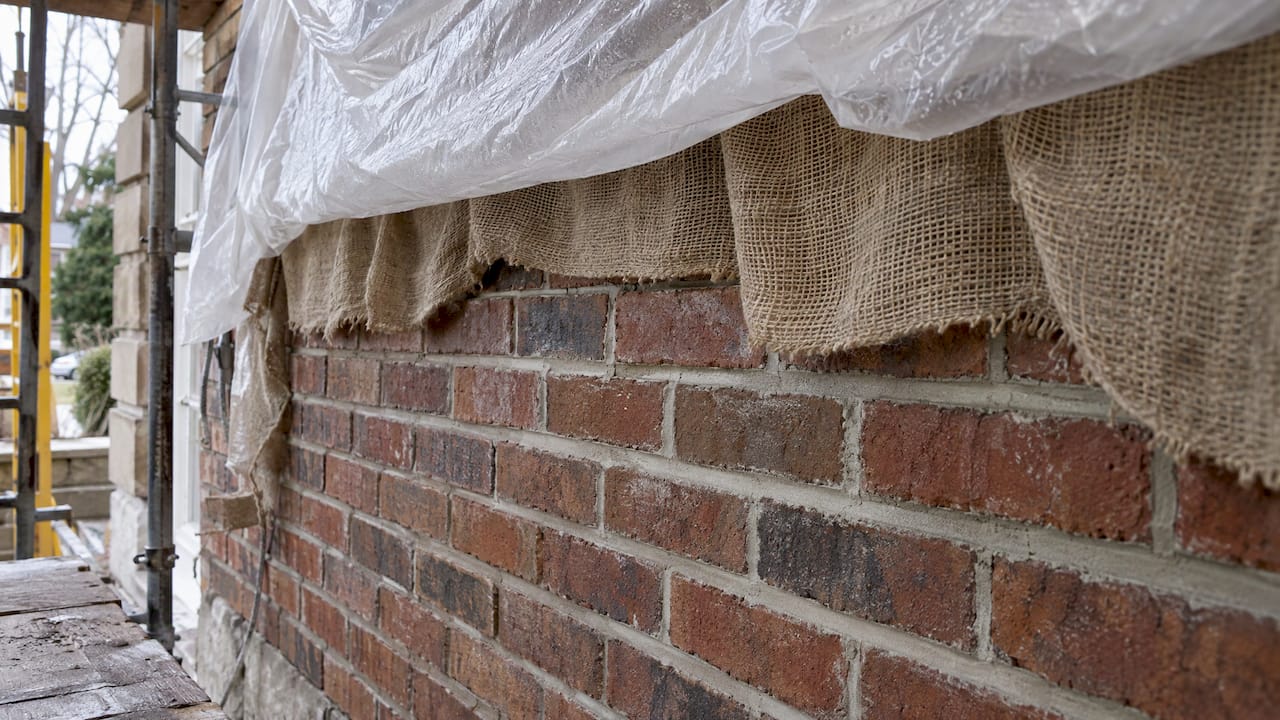
Timing is the Ontario part. NRC says repointing should be done well before or well after freezing weather, and if work runs into the cold season, a temporary heated enclosure is needed. As of early November, most of the GTA is past the window for fresh mortar work without protection. Plan it for late spring through early fall.
Method 2: Flexible sealant for hairline and moving cracks
Some cracks are not a mortar problem. A crack at a window frame, a control joint or a spot where two different materials meet will move with the seasons. Rigid mortar in that spot will crack again. A flexible sealant is the right tool.
Sika Canada describes Sikaflex Concrete Fix as a one-component elastomeric polyurethane sealant for weatherproofing joints and cracks in brickwork and masonry, suitable where the maximum sealant depth will not exceed 13 mm. It is stated to handle ±25% joint movement. That tells you the general rule: a crack needs to be narrow and shallow for this kind of product, and the surfaces must be sound, clean and dry, and free from frost, oil and grease.
Three practical points from the field:
- Do not overfill. A sealant should bond to two sides, not three. In deeper joints a backer rod sets the depth.
- Do not seal over a wet wall. Trapped moisture goes nowhere, then freezes.
- Do not use sealant for a failing mortar joint. If the mortar is crumbling, it needs repointing.
For the joints that are designed to move, such as the vertical expansion joints in long brick walls, see our guide on brick expansion joint sealant. For the window perimeter, see the best window caulking for brick homes.
Method 3: Injection for cracks that leak
When a crack is letting water through, usually in a foundation or below-grade wall, surface patching does not work. Injection fills the crack from within. Sika Canada describes its SikaFix injection kit as intended to stop water penetration through leaking cracks in foundations, using a polyurethane grout that forms a tough, flexible foam in the presence of moisture.
Injection treats the leak, not the reason the wall cracked. If the crack is wide, horizontal or still growing, get it assessed first. For a basement window that leaks around a brick opening, see basement window leaks: causes, fixes and when to call a pro.
Method 4: Crack stitching for structural cracks
Crack stitching ties the two sides of a crack together with stainless steel helical bars set in slots cut into the mortar beds and bonded with grout. One manufacturer’s system document lists the steps: cut the slots, clean with water, apply grout, insert the bars and repoint afterward.
The same document is clear about the limits: stitching cannot cure the cause of a crack, only stabilise the symptoms, and it advises getting structural engineer advice before structural repair. That is the honest answer to “does brick stitching work?” It works to hold a wall together once the cause, such as settlement, has been dealt with.
A few details from the installation guidance show why this is not a casual job:
- Helifix details call for the bar to extend at least 500 mm either side of the crack, with extra details when the crack sits close to an opening or wall end.
- Before drilling or cutting, locate, identify and isolate any electrical, water or gas services, and wear proper protective equipment.
If you are also working on a staircase or railing that fixes into the same masonry, a guide on fitting a masonry handrail covers the anchoring side.
Which method fits which crack
| What you see | Likely cause | Usual repair |
|---|---|---|
| Crumbling or recessed mortar, hairline cracks along joints | Weathering, water, freeze-thaw | Repointing the failed joints |
| Narrow crack at a window, door or control joint that opens and closes | Normal seasonal movement | Flexible sealant, with correct joint depth |
| Crack that leaks into a basement or foundation wall | Water pressure through the crack | Injection, after the cause is assessed |
| Stepped or diagonal crack, wider than a pencil line, or growing | Settlement or structural movement | Engineer’s assessment first, then stitching or other structural repair |
| Horizontal crack in a foundation wall | Lateral earth pressure | Engineer’s assessment before any repair |
| Flaking or crumbling brick face | Water and frost damage to the brick | Brick replacement or spalling repair |
What about cracks in interior brick?
Interior brick is not exposed to rain or frost, so it behaves differently. Hairline cracks in an interior mortar joint are usually cosmetic, and a small repointing or a colour-matched mortar patch is normally enough. Clean out loose material, dampen the area lightly and press the mortar in.
Two cautions. First, a crack inside is sometimes the other side of a problem outside, such as a failed seal or open joint letting water through. If the interior crack comes with staining, efflorescence or dampness, look at the exterior wall. Second, interior cracks that are growing or stepped are treated like any other structural crack: monitor and have them assessed.
Our perspective
After 25 years on Ontario job sites, we have a simple rule: the repair should match the reason the wall failed. A quick tube of filler might look fine in October, but it will not hold through a February freeze and an April thaw.
Most cracked brick we see comes down to water: a window seal that gave up, a joint that was never packed deep enough, or a mortar that was wrong for the brick. We start by finding the water path, then we repair the joint, the seal or the brick that caused it. That way the repair lasts, and you do not pay to fix the same spot twice.
We also tell owners plainly when a crack is beyond caulking and mortar. If a wall is moving, an engineer should see it first, and we will work with their findings. For everything else on the building envelope, from window and door sealing to expansion joints and brick repairs, we do the work to last through Ontario’s freeze-thaw cycles.
Felix
Getting the repair done right
If you have cracked brick or failing joints around your home or building in Durham Region or elsewhere in the GTA, we can look at the whole envelope: the mortar, the brick, and the seals around windows and doors that often cause the problem. Our brick and masonry repair and restoration work and building envelope sealing are built for the Canadian climate.

We publish no price list, because every wall is different. Send us photos and the location of the crack, and we will tell you what we see and what we would do. You can start from our services page or contact us through the main site.
FAQ
What should I use to fill cracks in brick?
It depends on where the crack is. Use matched mortar for cracked or eroded mortar joints, and a flexible sealant for narrow cracks that open and close, like those near windows or control joints. Leaking foundation cracks may need injection. Filling the crack is only the last step, after you have found the cause.
Does brick crack stitching work?
Yes, for the right job. Stitching uses stainless steel bars set into the mortar beds to tie a cracked wall together. Manufacturer documents state that it stabilises symptoms and cannot cure the cause, so a structural engineer should assess the crack first.
How do I fix brick cracks permanently?
Fix the reason for the crack, not just the crack. That means stopping water entry, checking whether the wall is still moving, and choosing a repair that fits. Properly prepared and cured repointing, or flexible sealant in a moving joint, will last far longer than a surface patch.
When should I call a professional?
Call one when a crack is wider than a hairline, stepped, horizontal, or growing, or when you see water coming through. Brick work on upper storeys, or anything that needs grinding and raking, is also better left to a trained crew.
Sources
- Repairing leaky masonry walls, NRC Canada
- Repointing mortars for older masonry, NRC Canada
- Masonry Practical Guide for Heritage Properties, Region of Waterloo
- Masonry guide for heritage properties, National Trust for Canada archive
- Common Problems with Brick Masonry, U.S. National Park Service
- What Does a Structural Engineer Actually Look For During a Home Inspection, Sinitski
- Review of factors affecting the durability of repointing, Canada Masonry Design Centre
- Sikaflex Concrete Fix, Sika Canada
- SikaFix Kit CA, Sika Canada
- Masonry Crack Stitching System
- Crack stitching a wall using HeliBars and HeliBond, Helifix
- Fitting a masonry handrail