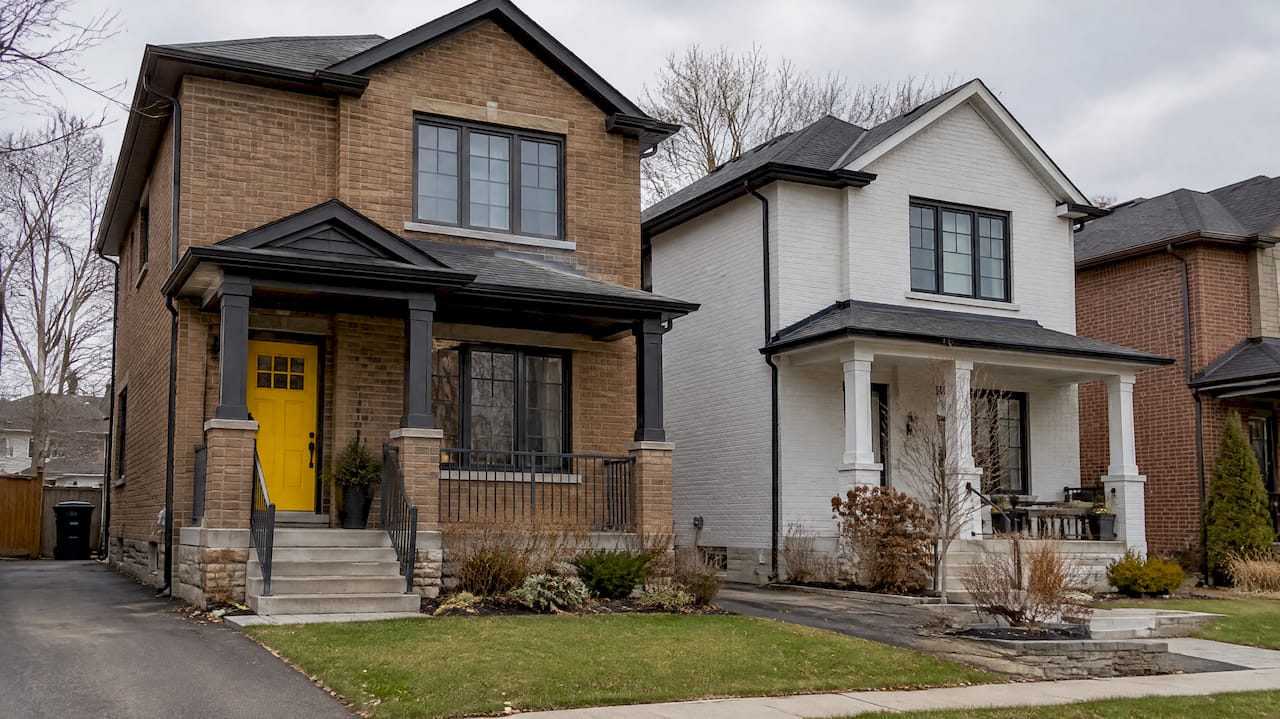
Stain changes the colour of brick and leaves the surface as brick. Paint puts a film over it. For most Ontario walls that difference decides everything else: how the finish ages, how it handles water and how hard it is to undo. Stain is generally the lower-maintenance choice, and paint is the choice when you need an opaque, uniform colour. Either way, the finish is only as good as the wall under it, and that is where we spend our time: failed mortar, open joints, cracked sealant and spalling brick.
This guide is for owners of brick homes, multi-unit buildings and commercial properties across Durham Region and the GTA who are deciding how to refresh brick, or who inherited a wall that someone already painted.
TL;DR
- Stain soaks into the brick, keeps its texture and does not form a film that can peel. It cannot lighten brick, and glazed brick will not take it.
- Paint gives a solid, uniform colour and the biggest change in look. It forms a surface coating that needs repainting over time and is hard to remove later.
- Either finish can trap moisture over a damaged wall. Repair mortar, cracks, spalled faces and failed caulking first.
- Do a water test before you commit: brick that sheds water or carries an old sealer will not accept stain.
- Ontario’s freeze-thaw cycles punish moisture trapped behind any coating, so prep matters more than the product.
Table of Contents
- What actually differs between stain and paint
- Why Ontario weather raises the stakes
- Fix the wall before you finish it
- Test your brick before you choose
- Preparing the surface
- How long each finish lasts
- Which one fits your situation
- Concrete stain on brick?
- Our perspective
- Get the wall ready first
- FAQ
- Sources
What actually differs between stain and paint
The Brick Industry Association (BIA) is the main technical body for clay brick in North America. Its Technical Note 6, updated in March 2025, describes the two finishes this way. Masonry stain changes the colour of the brick while keeping its natural texture, and it can range from semi-opaque to opaque. It bonds through the brick’s pores and does not affect structural integrity. Acrylic latex paint is opaque, softens the texture and has to be reapplied over time.
The Masonry Advisory Council makes the same point in plainer terms: stain bonds with the pore structure of the unit, while paint is a surface coating that masks the texture and does not make a chemical bond, so water can get behind the film.
Here is how that plays out on a house:
| Brick stain | Brick paint | |
|---|---|---|
| Look | Colour shifts, brick texture and variation stay visible | Uniform, opaque colour, texture softened |
| How it holds | Bonds in the pores, no film | Surface film over the brick |
| Colour range | Can darken or shift tone, cannot lighten brick | Almost any colour, including white |
| Upkeep | BIA reports no maintenance needed | Repainting over time |
| Undoing it | Restain in a compatible or darker tone | Often very difficult without damaging the brick |
| Works on glazed brick | No | Yes, with the right primer |
The BIA note says paint is often very difficult to remove without damage, while stain is a widely accepted practice that maintains texture. That single point is why we ask owners to be sure before they pick up a roller. A stain job can be adjusted later. A paint job usually becomes the permanent plan.
Why Ontario weather raises the stakes
Brick is porous. It takes on water and gives it back as vapour. A coating that slows that exchange keeps water in the wall, and in our climate that water freezes and thaws dozens of times a winter.
Natural Resources Canada’s research on masonry coatings notes that water moving through a wall can carry construction moisture to the surface, bringing alkali that can chemically attack some paints, or salts that can mechanically break a paint film through efflorescence. Efflorescence is the white, powdery salt deposit you sometimes see on brick. The same guidance points out that masonry takes longer to dry than non-porous surfaces after rain or high humidity, and that in cold climates air leakage can carry large amounts of water into outside walls.
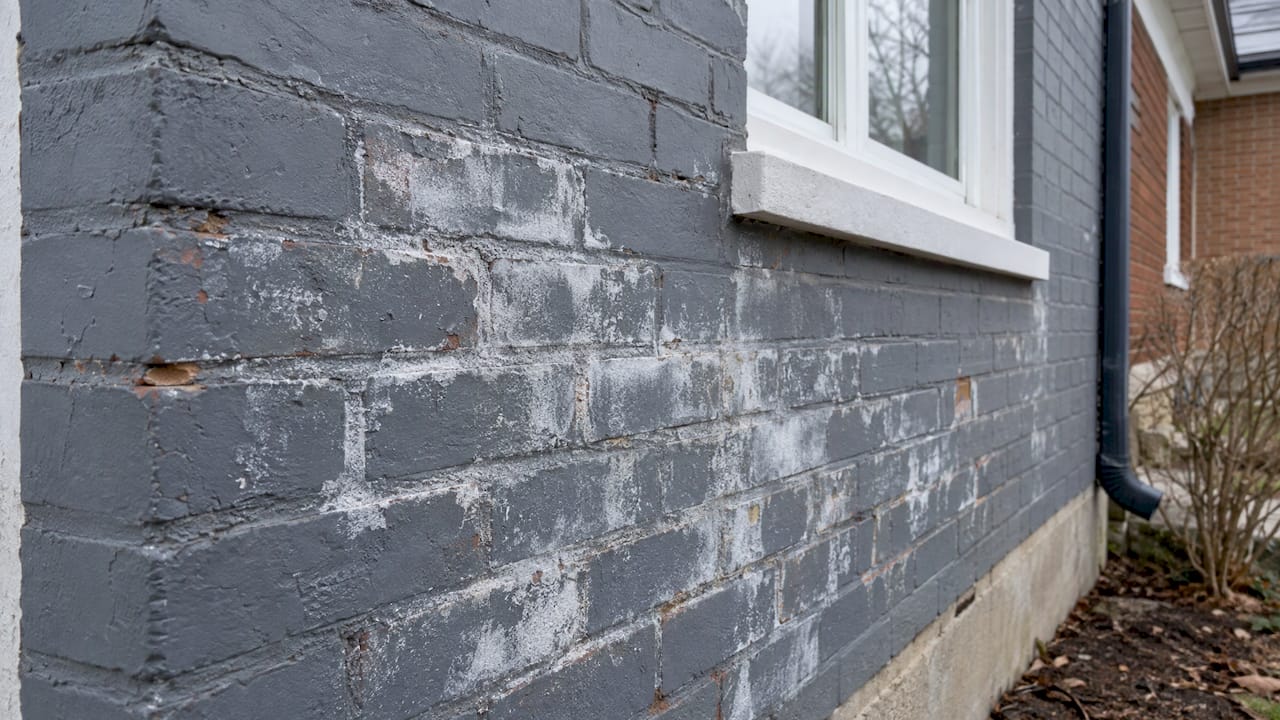
The BIA cautions that any treatment can trap moisture and worsen brick that is already deteriorating, so moisture problems have to be repaired before any finish goes on. It also advises that painted brick should generally be severe-weathering grade (Grade SW), the grade made for freezing climates. In the UK, the SPAB’s guidance on old brick walls goes further and advises against painting because it can force moisture to travel farther to escape and mobilise damaging salts. That is guidance for historic walls, but the physics is the same on an older Oshawa or Cobourg house with soft, early brick.
The BIA also says staining has been accepted industry practice for more than 50 years, including in freezing weather, and prefers mineral-based stains for their high water vapour permeability. In plain terms: the stain lets the wall keep breathing.
Fix the wall before you finish it
This is the part most “stain vs paint” articles skip, and it is where we work. A new colour does not cure a wall problem. It covers it for a season and then shows it.
Walk the wall and look for these before any finish decision:
- Open or crumbling mortar joints. Water enters here first. Our guide to tuckpointing vs repointing explains which repair fits which joint. The NRC guidance also says defective mortar joints need attention before coating.
- Cracks in the brick or mortar. Stepped cracks and hairline cracks are not the same problem. See brick crack repair methods that work in Ontario.
- Spalling. That is the face of the brick flaking or popping off, usually from frozen moisture. Finish over it and you hide a failure that keeps going. Our write-up on spalling brick repair covers what a fix involves.
- Failed sealant around windows, doors and brick expansion joints. Sealant is the first line of defence against water getting behind the brick. If the joints are tired, resealing brick expansion joints belongs ahead of the finish.
- Mismatched repair mortar. Fresh mortar often looks different from the old. Stain can help blend patched brick, and the right sand and pigment matter for mortar too: see our piece on matching brick mortar colour in Ontario.
On interior brick, such as a feature wall or a basement, the starting point can be different: odour or smoke residue in the wall. If that is your situation, the notes on painting over smoke residue are worth reading before any finish goes on.
Caulking is the detail that decides whether a refinished wall stays dry. Where brick meets window frames, door frames and trim, the joint has to be sealed with a product that will take paint if you are painting trim. We cover that in paintable exterior caulk and in caulk before painting, including the order of work: caulk first, finish second, so the sealant is not cut or painted over badly.
Test your brick before you choose
Two simple checks save a lot of regret.
- The water test. The BIA recommends a water test before staining. Glazed brick and some dense unglazed brick will not accept stain. If water beads and runs off instead of darkening the brick and soaking in, stain will not bond. The NRC guidance describes a water-droplet test for the same reason: to tell whether a water-repellent treatment is already on the surface.
- Check for an old sealer or paint. If the wall was previously painted or sealed, stain will not penetrate. At that point paint may be the realistic option, or the old coating has to be removed first.
If you are not sure what you are looking at, ask us to look at the wall. Reading brick condition is the same skill as diagnosing why it is failing.
Preparing the surface
Prep is where finishes are won or lost, and the steps are the same whichever you choose.
- Clean thoroughly. The NRC says the surface should be free of dust and dirt. A trade magazine for painters in Canada recommends wetting, brushing, then finishing with a pressure wash because it removes dirt better than washing alone. Keep the pressure moderate on older, softer brick.
- Let it dry. The same source suggests about three good drying days after cleaning before painting. Brick that looks dry on the surface can still hold moisture, so do not rush a finish onto damp masonry.
- Repair, then seal. Mortar, cracks and spalled units, then caulking at the joints.
- Apply the finish in suitable weather. Dry days, with temperatures within the product’s stated range.
One point on staining: it absorbs differently depending on the porosity and mineral content of each brick, so some variation is normal. Because it cannot lighten brick, a stain can take red toward brown or darker, but not to white. If white is the goal, that is a paint decision.
How long each finish lasts
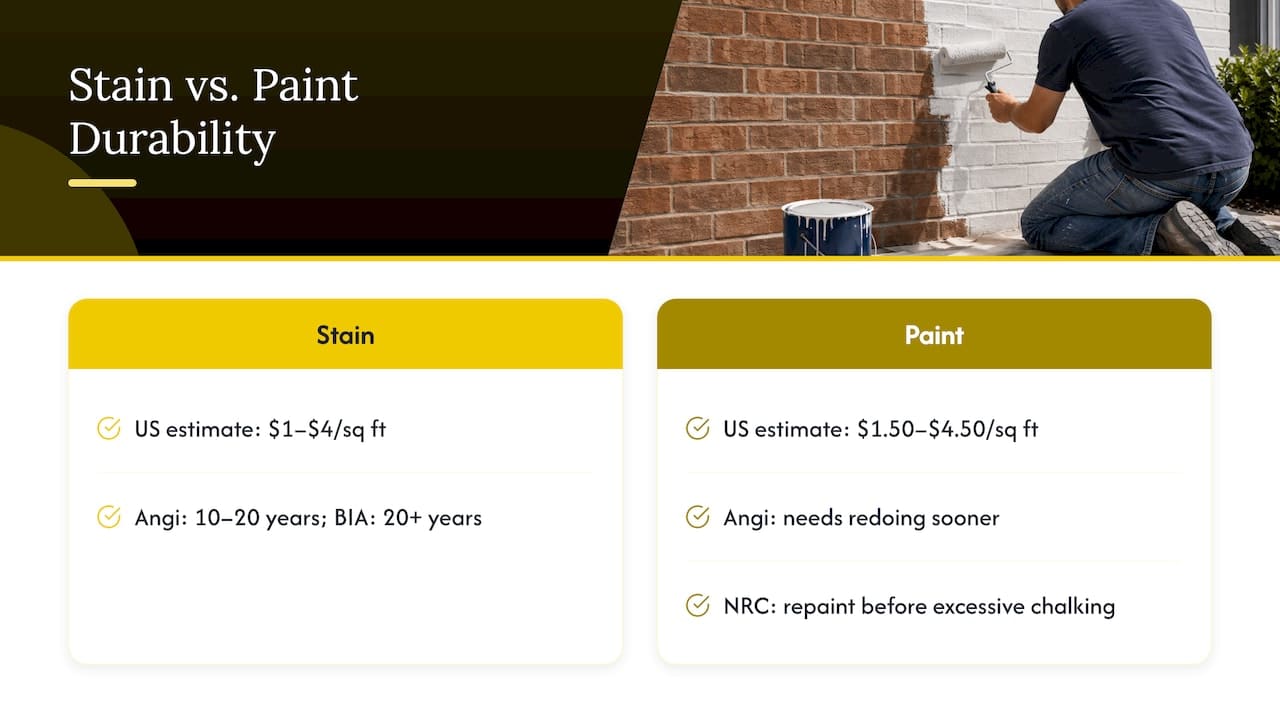
Lifespan figures vary a lot by product, exposure and prep, so treat any number as a range. The BIA reports a history of stained projects lasting 20 years or more and says stain needs no maintenance. For paint, the NRC advises repainting latex paint before the previous coat chalks excessively, which means planning for recoats rather than treating paint as a one-time job.
For a consumer-side view of the numbers, Angi’s 2026 data is for the US and in US dollars, so use it for the shape of the comparison and not as a Canadian price. It puts stain at roughly $1 to $4 per square foot against $1.50 to $4.50 for paint, with a quality exterior stain lasting 10 to 20 years while paint needs redoing sooner. The pattern is what matters: paint can look cheaper on day one and costs more as repaints add up, plus the work of scraping and re-prepping a failing film.
For your own number, get a written quote based on the actual wall: square footage, height (scaffolding or lifts add cost), the amount of repair needed and the condition of the brick. Prices in Durham Region differ from downtown Toronto and from the US, and HST applies on top.
Which one fits your situation
Homeowners with sound brick who like the character of the brick. Stain is usually the better fit. It keeps the texture and avoids the film that can peel.
Mismatched or patched brick. Stain can blend repairs into the original. A preservation specialist quoted by a heritage group in Memphis notes that stain changes the colour of brick rather than coating it, and that it can cost less than hunting for exactly matching bricks.
Glazed, previously painted or sealed brick. Stain will not take. Paint, done with the right surface preparation, is the realistic route, and it needs a wall that is dry and sound.
You want a white or light, modern look. That is a paint finish. Commit to the repaint schedule and fix moisture issues first.
Property managers and landlords. Think in cycles. A finish that does not need recoating every few years reduces repeat disruption to tenants and repeat scaffolding costs. Whatever you pick, fix envelope leaks first and document the work.
Builders and developers. Brick on new builds is typically left as it is. On renovations and resales, the question is usually patched brick and mismatched mortar, which is repair-first work.
Concrete stain on brick?
A common question is whether a concrete stain will do the job on brick. Don’t assume so. Concrete stains are formulated for denser, smoother surfaces and may rely on reactions with concrete components. Brick is more porous. Check that the manufacturer lists brick as an approved substrate, and use a stain made for masonry walls.
Our perspective
After 25 years of working on brick around Oshawa and Durham Region, the pattern is consistent. The finish is rarely what fails first. The water gets in somewhere else: a joint that was never resealed, a window head with dried-out caulk, a crack nobody wanted to look at. Then the stain or paint takes the blame.
We would rather you spend the first dollars on the envelope. Sound mortar, sealed joints, caulking that moves with the building through a January cold snap and a July heat wave. Do that and either finish has a fair chance. Skip it and neither one will last.
If you are choosing between the two, ask what you want the wall to look like in ten years. If you want it to still look like brick, stain is the straightforward answer. If you want a solid colour, paint can do it, and you should plan the repaint and the prep honestly.
We handle the work that sits underneath: caulking, expansion joints, brick and masonry repairs, and painting. Doing the repairs and sealing in the right order, by the same crew, keeps the job accountable from start to finish.
Felix
Get the wall ready first
Kettle Contracting is a caulking specialist serving residential and commercial properties across the GTA, with brick and masonry repairs and home painting among our services. If your brick has open joints, cracked sealant or spalling, we can look at it and tell you what has to happen before any finish. See our brick and masonry, caulking and painting services, or learn how building envelope sealing protects the wall behind the finish.

For windows and doors, start with residential window caulking or door caulking and weather sealing. Property managers and commercial owners can look at commercial window caulking.
FAQ
Is it a mistake to paint brick?
Not always, but it is a bigger commitment than staining. The BIA says paint is often very difficult to remove without damage and needs recurring repainting. It also says moisture problems must be fixed first and that painted brick should generally be severe-weathering grade. On sound, dry brick with proper prep, paint is a reasonable choice.
Can you stain brick that has already been painted?
Stain needs bare, unsealed brick to penetrate. A painted or sealed surface blocks it, so the old coating has to come off first, or you repaint instead. Test a small area with water to see whether the brick absorbs.
Does brick stain peel?
Stain bonds in the pores and does not form a surface film, so it has nothing to peel the way a paint film can. Absorption varies from brick to brick, so expect some natural variation in tone rather than a flat, uniform colour.
Is concrete stain the same as brick stain?
No. Concrete stains are made for denser, smoother surfaces, while brick is more porous and needs a stain formulated for masonry walls. Confirm that the product’s approved substrates include brick.
Sources
- Changing the Appearance of Brick Masonry, BIA Technical Note 6 (2025)
- Brick… Paint or Don’t Paint? Masonry Advisory Council (2019)
- Coatings for masonry surfaces, Natural Resources Canada
- A guide to the repair of old brick walls, SPAB
- How To Paint Masonry, Professional Painter Magazine
- How Much Does It Cost to Stain a Brick Exterior? Angi (2026)
- Painted & Tainted: why painting exposed brick can damage a historic home, StoryBoard Memphis