

A building condition report is a formal assessment of a property’s physical state, and caulking condition is one of its most telling indicators of envelope health. The building condition report caulking factors that assessors examine include material quality, installation workmanship, environmental exposure, and maintenance history. Together, these factors determine whether a building’s sealants are protecting the structure or quietly allowing water and air to infiltrate. For property owners, managers, and contractors in the Greater Toronto Area, understanding these factors is the difference between proactive maintenance and expensive emergency repairs.
1. What are the primary building condition report caulking factors?
Caulking assessments in condition reports examine several distinct factors. Each one influences how long a sealant lasts and how accurately an inspector can forecast future repair costs.
Material selection is the starting point. Not all caulks perform equally in Ontario’s climate. Silicone sealants handle temperature swings and UV exposure better than acrylic latex products. Polyurethane caulks bond well to concrete and masonry but require careful surface preparation. Using the wrong product for a substrate or exposure zone is one of the most common causes of premature failure.
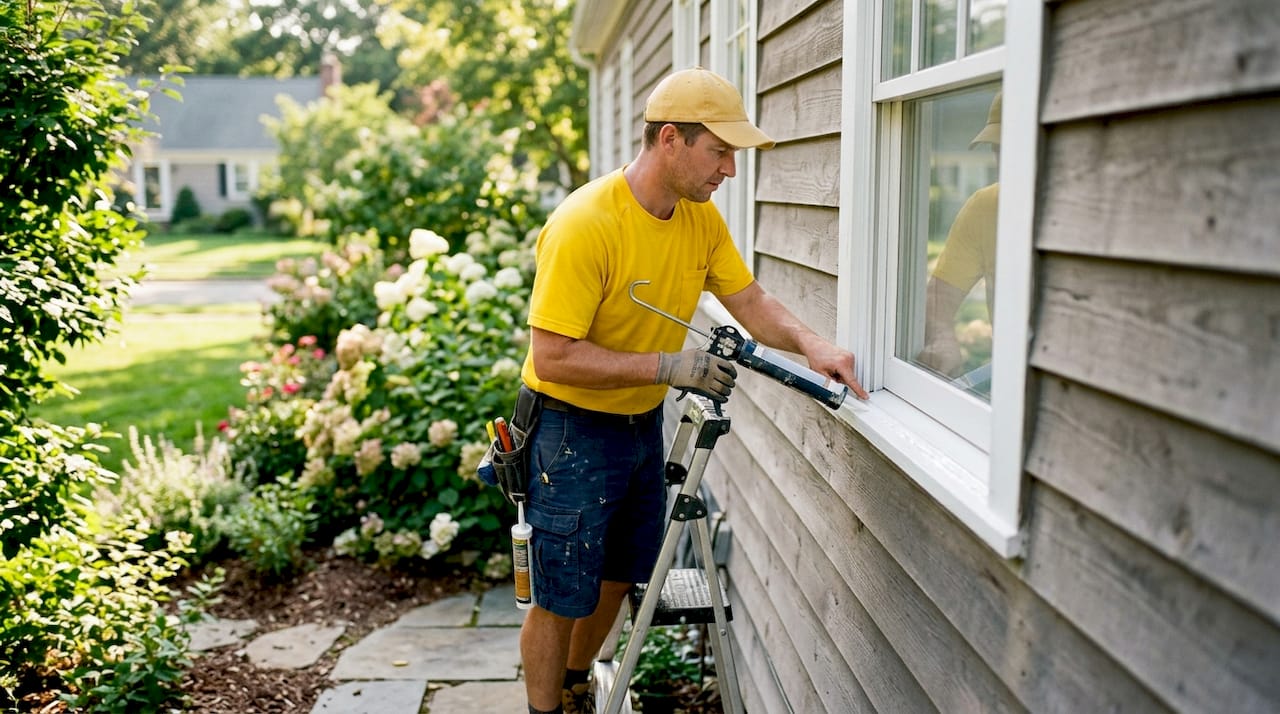
Installation workmanship shapes the outcome just as much as material choice. Common errors include applying caulk over dirty or damp surfaces, failing to back-rod deep joints, and tooling the bead incorrectly. These mistakes reduce adhesion and shorten service life significantly, regardless of product quality.
Environmental stressors in the GTA are severe. Façade service life varies from 4.3 to 31.8 years depending on pollution and water ingress exposure. That range reflects how dramatically local conditions affect sealant durability.
The main factors an assessor evaluates include:
- Caulk type and suitability for the substrate and climate zone
- Surface preparation quality at time of installation
- Joint width, depth, and movement accommodation
- UV degradation, chalking, and surface cracking
- Adhesion loss at the sealant-to-substrate interface
- Water staining or efflorescence near sealed joints
- Evidence of prior repairs or incompatible re-caulking over failed material
Pro Tip: Check the perimeter of window frames and expansion joints first. These areas experience the most movement and are the earliest to show adhesion failure, making them reliable indicators of overall sealant condition across the building.
2. How caulking condition shapes building condition reports
Caulking is the primary barrier against moisture and air infiltration at every joint, penetration, and transition in a building envelope. When it fails, water finds a path inward. That water does not always show up immediately on interior surfaces, which is exactly why condition reports must assess caulking directly rather than relying on visible water damage alone.
Masked envelope failures are a well-documented problem. Interior repairs often conceal chronic water intrusion behind failed exterior sealants. A property can look fine inside while moisture is accumulating in wall assemblies, corroding fasteners, and degrading insulation. Condition reports that miss this connection produce inaccurate maintenance forecasts.
Thermal imaging and drone inspections detect hidden moisture and air leaks that visual inspections miss entirely. These tools reveal the true extent of sealant failure and give assessors the data they need to assign accurate repair urgency and cost estimates.
The table below shows how caulking condition typically translates into report findings and repair timelines.
| Caulking condition | Report finding | Repair urgency | Estimated action |
|---|---|---|---|
| Sound, flexible, fully adhered | No deficiency noted | None required | Monitor at next cycle |
| Minor surface cracking, no adhesion loss | Low-priority deficiency | 2–4 years | Budget in reserve fund |
| Adhesion loss at one substrate face | Moderate deficiency | 1–2 years | Schedule recaulking |
| Full adhesion failure, open joint | High-priority deficiency | Immediate | Emergency repair |
| Failed caulk with visible water staining | Critical deficiency | Immediate | Envelope investigation |
Ontario’s Condominium Act reserve fund studies are required every 3 years and project capital expenditures over a 30-year horizon. Caulking condition directly feeds into these projections. An inaccurate assessment of sealant health leads to underfunded reserves and unexpected special assessments for condo owners.
3. Best practices for caulking inspections in condition reports
Reliable caulking inspections follow a consistent process. Skipping steps produces incomplete data, which weakens the entire condition report.
Ontario Regulation 198/98 requires landlords to maintain walls and roofs in sound, weathertight, and damp-proofed condition. This legal standard applies directly to caulking and sealants at all building penetrations. Inspectors and property managers need to treat caulking maintenance as a compliance obligation, not just a cosmetic concern.
Drone-assisted infrared thermography is becoming the standard for high-resolution envelope analysis. These non-destructive methods identify moisture trapped behind cladding and air leakage paths that a visual walk-around will never catch. For multi-storey buildings in the GTA, this technology is now a practical necessity rather than a premium add-on.
A thorough caulking inspection checklist covers:
- All window and door perimeters, including sill and head conditions
- Expansion and control joints across the full façade
- Penetrations for mechanical, electrical, and plumbing services
- Parapet caps, copings, and roof-to-wall transitions
- Balcony slab edges and guardrail base connections
- Flashing terminations and counterflashing laps
- Any previously repaired areas where incompatible products may have been applied
Documenting installation history matters as much as the physical inspection. Knowing when a joint was last sealed, with what product, and by whom helps assessors predict remaining service life and flag areas at elevated risk.
Pro Tip: Schedule caulking inspections in late spring, after the freeze-thaw season has finished. Joints that survived winter intact are easier to evaluate accurately, and any failures caused by thermal cycling will be clearly visible before summer heat masks hairline cracks.
4. How GTA climate affects caulking longevity and maintenance schedules
Ontario’s freeze-thaw cycles are the single greatest environmental stressor on building sealants in the GTA. Water expands when it freezes. Any moisture that has infiltrated a joint or a micro-crack in the caulk bead will expand during a freeze event, widening the gap and accelerating adhesion failure. This cycle repeats dozens of times each winter in the Toronto region.
Urban pollution compounds the problem. Airborne particulates and acid rain accelerate surface degradation in silicone and polyurethane sealants. Buildings near major roads or industrial areas show faster chalking and surface breakdown than comparable structures in lower-pollution zones. Environmental conditions can cut façade service life from over 30 years down to as few as 4.3 years in high-exposure locations.
Regulatory context for GTA property owners
Ontario’s Condominium Act and the Residential Tenancies Act both create legal obligations around building envelope maintenance. Under O. Reg. 198/98, weathertight conditions are a landlord’s legal responsibility. Failing to maintain caulking is not just a maintenance lapse. It is a potential regulatory violation.
Coordinating your caulking maintenance schedule with reserve fund study cycles makes financial sense. A reserve fund study completed in the same year as a thorough caulking inspection produces the most accurate capital expenditure projections. Misaligned timing leads to stale data and funding gaps.
Spring condo maintenance inspections of building penetrations and expansion joints help prioritise repairs and support long-term financial planning. This seasonal approach aligns well with Ontario’s climate, giving property managers a clear window to assess winter damage before summer construction season begins.
5. Common mistakes that produce poor caulking outcomes in condition reports
The most frequent cause of poor caulking outcomes is incorrect material selection. Applying an interior-grade acrylic latex product to an exterior expansion joint, for example, produces a sealant that fails within one or two seasons. The condition report then flags a deficiency that was entirely preventable.
Poor surface preparation is the second most common error. Caulk applied over dust, oil, old sealant residue, or damp concrete will not bond properly. The joint may look acceptable immediately after installation but will peel away from the substrate within months. This type of failure is particularly damaging to condition report outcomes because it suggests systemic installation problems rather than isolated wear.
The table below links common symptoms to their typical causes, which helps assessors and property managers identify root problems rather than just treating visible defects.
| Symptom observed | Typical cause |
|---|---|
| Caulk peeling from one substrate face | Inadequate surface preparation or primer omission |
| Caulk tearing through the centre of the bead | Joint too deep, no backer rod, three-point adhesion |
| Surface chalking and brittleness | UV-degraded product, wrong material for exposure |
| Caulk pulling away at corners | Insufficient movement accommodation in joint design |
| Bubbling or blistering in the bead | Moisture present during application |
| Incompatible layers visible | Re-caulking applied over failed existing material |
Flashing integration failures are less visible but equally damaging. Caulk applied at a flashing termination without proper lap and counterflashing design will fail under hydrostatic pressure. The sealant is not designed to be the primary water management element. When it is forced into that role, it fails quickly and the resulting water intrusion is difficult to trace. You can see detailed examples of these installation errors in construction defect caulking cases that Kettlecontracting has documented from GTA properties.
Key takeaways
Caulking condition is a direct indicator of building envelope integrity, and accurate assessment of sealant factors is the foundation of reliable maintenance planning and capital expenditure forecasting in Ontario.
| Point | Details |
|---|---|
| Material and workmanship drive outcomes | Wrong product choice or poor installation causes premature failure regardless of maintenance frequency. |
| Condition reports depend on accurate sealant data | Missed or masked caulking failures lead to underfunded reserves and unexpected repair costs. |
| Non-destructive testing improves accuracy | Infrared thermography and drone inspections reveal hidden moisture that visual checks miss. |
| GTA climate demands a seasonal inspection cycle | Schedule inspections in late spring to capture all freeze-thaw damage before summer obscures it. |
| Regulatory obligations are real | Ontario Regulation 198/98 and the Condominium Act require weathertight conditions as a legal standard. |
What 25 years of GTA inspections have taught me about caulking reports
The pattern I see most often is this: a property looks well-maintained on the surface, but the condition report reveals sealant failures that have been quietly allowing water in for years. The interior has been patched and painted. The exterior caulking has never been touched. By the time the report flags it, the remediation cost is three or four times what a proactive recaulking programme would have cost.
Property managers who treat caulking as a cosmetic item consistently end up with the worst reserve fund surprises. The ones who schedule regular caulking inspections tied to their reserve fund study cycles almost never face emergency envelope repairs. The data from a good inspection feeds directly into accurate capital planning. That is the whole point.
The other thing I would tell any GTA property owner is this: documentation is as important as the work itself. Knowing what product was used, when it was installed, and what the substrate conditions were at the time gives the next inspector a baseline. Without that history, every assessment starts from scratch.
— Felix
Kettlecontracting’s caulking services for accurate condition reporting
Property owners and managers across the GTA trust Kettlecontracting for professional caulking assessments and installations that hold up through Ontario winters and support accurate building condition reporting.

Whether you need a pre-inspection caulking review, a full building envelope recaulking, or documentation to support your reserve fund study, Kettlecontracting delivers work that is built to last. Our team understands why caulking is trade-specific work and brings that expertise to every residential and commercial project across the Greater Toronto Area. Contact Kettlecontracting to discuss your property’s caulking needs and get an honest assessment of what your building actually requires.
FAQ
What does a building condition report say about caulking?
A building condition report rates caulking by adhesion, flexibility, and signs of water infiltration, then assigns a repair urgency and estimated cost. Failed or deteriorated sealants are flagged as deficiencies that affect the reserve fund forecast.
How does caulking condition affect a home inspection report?
Failed caulking at windows, doors, or penetrations signals potential moisture intrusion to inspectors. This finding can affect a property’s assessed condition rating and trigger recommendations for immediate or near-term repair.
How often should caulking be inspected in GTA buildings?
A spring inspection after the freeze-thaw season is the minimum standard for GTA properties. Buildings with older sealants or known water intrusion history benefit from annual assessments tied to their building maintenance analysis cycle.
What is the legal standard for caulking maintenance in Ontario?
Ontario Regulation 198/98 requires landlords to keep walls and roofs weathertight and damp-proofed. This obligation covers all sealants and caulking at building penetrations and envelope transitions.
Can failed caulking affect a condo reserve fund study?
Failed or deteriorated caulking directly influences reserve fund projections under Ontario’s Condominium Act, which mandates reserve fund studies every 3 years. Inaccurate sealant condition data produces underfunded reserves and potential special assessments.