

Caulking is defined as a primary contributor to LEED certification through its direct impact on indoor air quality and building envelope performance. The role of caulking in LEED certification falls under the Low-Emitting Materials credit within the Indoor Environmental Quality (IEQ) category, governed by standards including SCAQMD Rule 1168 and CDPH Standard Method v1.2. Under LEED v4 and v4.1, architectural sealants applied inside the weatherproofing boundary must meet VOC content limits of 250 g/L or less. LEED v5, which is the current framework as of 2026, shifts the focus from VOC limits to full emissions compliance testing. For construction professionals and architects working on certified projects, getting caulking right is not optional. It affects credits, audit outcomes, and long-term building performance.
What are the LEED requirements for caulking materials and emissions?
LEED sets specific material thresholds for sealants applied inside a building’s weatherproofing boundary. Under LEED v4 and v4.1, architectural sealants must not exceed 250 g/L VOC content, while fireproofing sealants are held to a stricter limit of 100 g/L. Primers used with these sealants carry a separate threshold of 775 g/L. These limits exist because sealants applied indoors off-gas into occupied spaces, directly affecting indoor air quality.
LEED v5 changes the compliance model. Rather than meeting a VOC content number on a product label, sealants must now pass emissions testing per CDPH Standard Method v1.2. This is a more rigorous standard because it measures what actually enters the air in a room, not just what is listed on a technical data sheet. A product can have low stated VOC content and still fail emissions testing if it releases harmful compounds during curing.
The Indoor Environmental Quality credit also requires verification through independent laboratory testing. Labs perform chemical fingerprinting to detect TVOCs and formaldehyde, and can trace elevated readings back to specific materials, including sealants. This means a non-compliant caulk product applied weeks before testing can still trigger a credit failure.
| Sealant type | LEED v4/v4.1 VOC limit | LEED v5 compliance method |
|---|---|---|
| Architectural sealants | 250 g/L | CDPH Standard Method v1.2 emissions test |
| Fireproofing sealants | 100 g/L | CDPH Standard Method v1.2 emissions test |
| Primers | 775 g/L | CDPH Standard Method v1.2 emissions test |
Pro Tip: Request the CDPH Standard Method v1.2 test report directly from the manufacturer before specifying any sealant for a LEED project. A product’s marketing claims are not sufficient for audit documentation.
How does caulking contribute to building envelope performance?
Proper caulking improves airtightness and prevents thermal bridging, which directly contributes to LEED energy efficiency credits. Gaps at windows, doors, and expansion joints allow conditioned air to escape and outside air to enter, increasing HVAC load and reducing occupant comfort. Sealing these gaps with the right product and technique is one of the most cost-effective ways to improve a building’s energy performance score.

The weatherproofing boundary concept is central to LEED compliance for caulking. This boundary defines the line between conditioned interior space and the exterior environment. Sealants applied inside this boundary are subject to VOC and emissions requirements. Sealants applied entirely on the exterior face are often exempt, but the distinction must be clearly documented to avoid audit complications.
Caulking’s contribution to building envelope performance covers several measurable outcomes:
- Reduced air leakage: Sealed joints at windows, curtain walls, and penetrations lower the air changes per hour (ACH) rate, which feeds directly into energy modelling for LEED credits.
- Thermal performance: Gaps in the building envelope create cold bridges. Caulking eliminates these pathways, supporting better insulation continuity.
- Moisture control: Water infiltration through failed joints causes mould growth and structural damage. Proper sealing protects both the building and its occupants.
- Occupant comfort: Drafts and temperature inconsistencies near poorly sealed openings reduce comfort ratings, which affect LEED credits tied to occupant satisfaction.
In Ontario’s climate, where freeze-thaw cycles stress every joint in a building, airtight caulking is not just a certification requirement. It is a durability requirement.
What best practices should professionals follow for LEED caulking?
Specifying the right product is the first decision. Neutral-cure MS polymer sealants balance high performance with inherently low VOC levels, and they meet ASTM C920 standards for joint sealants. They outperform legacy polyurethane and acetic-cure silicones in green building compliance because they do not release acetic acid during curing and maintain flexibility across a wide temperature range. For most LEED projects, MS polymer sealants are the specification of choice among facade engineering professionals.
Follow these steps when selecting and applying caulking for LEED projects:
- Confirm the weatherproofing boundary. Identify which joints fall inside the boundary and which are exterior-only. Only interior-boundary sealants require VOC and emissions compliance documentation.
- Specify by standard, not by brand claim. Require ASTM C920 compliance and CDPH Standard Method v1.2 test reports in your specification documents. Do not accept a product data sheet as a substitute.
- Request third-party emission test reports. Independent lab data per ISO 16000 or Section 01350 is the only reliable way to verify that a sealant meets LEED emissions requirements. Marketing language on packaging is not auditable evidence.
- Document every product used. Record the product name, manufacturer, lot number, VOC content, and test report reference for every sealant applied inside the weatherproofing boundary. This documentation forms the backbone of your LEED submission.
- Avoid substituting non-compliant exterior products inside the boundary. This is one of the most common errors on LEED projects. A sealant approved for exterior curtain wall use may not meet interior emissions requirements. Always verify before substituting.
- Schedule caulking completion before IAQ testing. All sealants must be fully cured and the site must be thoroughly cleaned before final indoor air quality testing. Residual off-gassing from freshly applied caulk can spike TVOC readings and jeopardise IEQ credits.
Pro Tip: Build a simple sealant compliance log as a running spreadsheet from day one of the project. Tracking products in real time is far easier than reconstructing records during a certification audit.
LEED has also driven a broader shift in how construction materials are selected. Material transparency is now a central concern, with LEED pushing teams to avoid heavy metals and halogenated flame retardants in building products. Sealant specifications on LEED projects should reflect this broader commitment to material health, not just VOC compliance.
What changes does LEED v5 introduce for caulking compliance?
LEED v5 represents the most significant update to emissions compliance for sealants since the programme launched. The shift from VOC content limits to emissions compliance per CDPH Standard Method changes how you specify, document, and verify sealant products. A product that passed LEED v4 requirements based on its VOC content label may not pass LEED v5 without a current emissions test report.
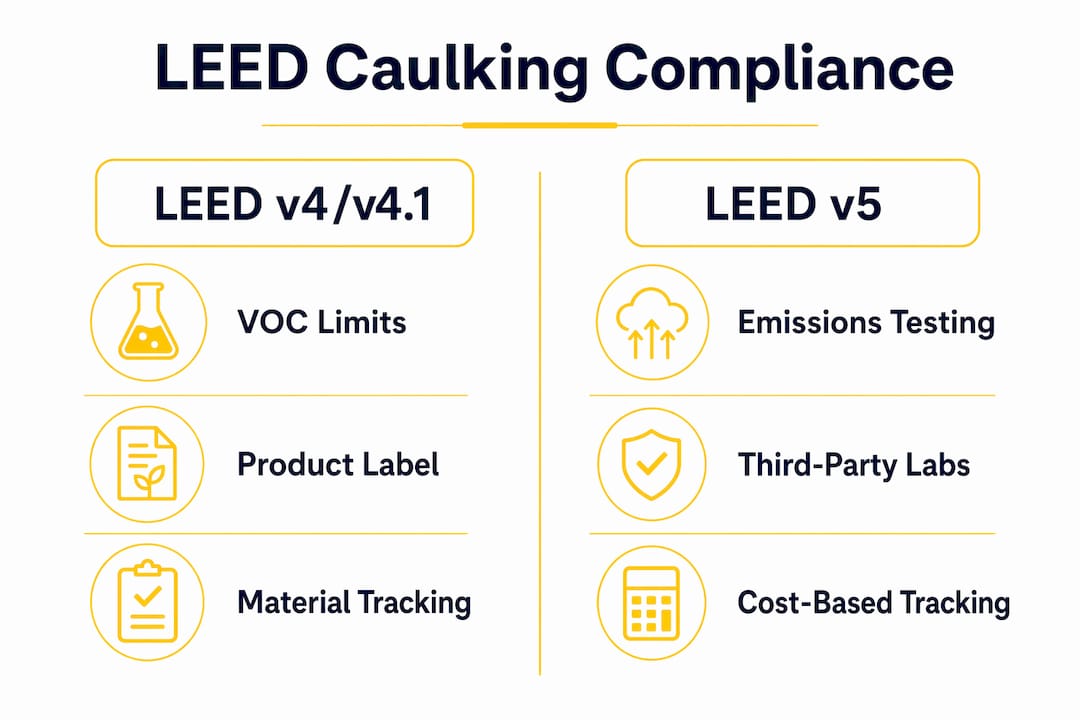
The second major change is how material tracking works. LEED v5 simplifies compliance tracking by project cost rather than by volume. This means you calculate the percentage of compliant materials by their installed cost, not by measuring litres of sealant applied. For large commercial projects with dozens of sealant products, this reduces documentation complexity considerably.
| Compliance area | LEED v4/v4.1 | LEED v5 |
|---|---|---|
| Compliance measure | VOC content limits (g/L) | Emissions testing per CDPH Standard Method v1.2 |
| Tracking method | Volume-based | Cost-based |
| Verification | Product data sheet or VOC content declaration | Third-party emissions test report |
| Exterior sealants | Exempt if outside weatherproofing boundary | Exempt if outside weatherproofing boundary |
The practical implication for architects and project managers is clear. You need to build emissions test documentation into your product approval process from the start of design, not as an afterthought during construction. Manufacturers who cannot provide current CDPH test data should not be on your approved product list for LEED v5 projects.
Key takeaways
Caulking directly determines LEED credit outcomes through its emissions profile, placement relative to the weatherproofing boundary, and the quality of documentation submitted during certification.
| Point | Details |
|---|---|
| VOC and emissions limits apply inside the boundary | Architectural sealants must meet 250 g/L under LEED v4/v4.1 or pass CDPH Standard Method v1.2 under LEED v5. |
| LEED v5 shifts to emissions testing | VOC content labels are no longer sufficient; third-party emissions test reports are required for all interior sealants. |
| Airtightness drives energy credits | Properly sealed joints reduce air leakage and thermal bridging, contributing directly to LEED energy efficiency credits. |
| Documentation is auditable evidence | Product names, lot numbers, and test report references for every interior sealant must be recorded from day one. |
| Timing of IAQ testing matters | All caulking must be fully cured and the site cleaned before indoor air quality testing to avoid TVOC spikes. |
What 25 years of LEED caulking work has taught me
The biggest mistake I see on LEED projects is treating caulking as a finishing trade rather than a compliance trade. Teams spend months specifying structural systems and mechanical equipment, then hand the sealant spec to whoever is cheapest at tender. That approach fails audits.
The second issue is timing. I have seen projects lose IEQ credits because the caulking crew finished the day before the IAQ test. Fresh sealant off-gasses. It does not matter how compliant the product is on paper. If it is not fully cured, the test will catch it. In Ontario, cold temperatures slow cure times significantly, especially in october through march. You need to build that into your schedule.
The third thing I would tell any architect or project manager is to call the manufacturer’s technical rep, not the sales rep. Ask for the CDPH Standard Method v1.2 test report, the Section 01350 data if available, and the cure time at the expected site temperature. Most manufacturers have this data. They just do not lead with it. If a manufacturer cannot provide independent emissions test data, that product does not belong on a LEED project.
For eco-friendly caulking options that meet current standards, the product category to focus on is neutral-cure MS polymer sealants. They perform well in Ontario’s freeze-thaw climate, they cure without releasing acetic acid, and they consistently test below LEED thresholds. That combination is hard to beat.
— Felix
Kettlecontracting’s approach to LEED-compliant caulking
Kettlecontracting works with construction teams and architects across the Greater Toronto Area on projects where caulking compliance is part of the certification plan, not an afterthought.
Our team understands the documentation requirements for LEED submissions, the weatherproofing boundary distinctions that affect which products need compliance data, and the scheduling demands of IAQ testing windows. We supply product-level compliance records for every sealant we apply inside the weatherproofing boundary. If you are preparing a building envelope for certification, our window preparation guide covers the surface prep and product selection steps that protect both your installation and your LEED credits. Contact Kettlecontracting to discuss your project’s caulking scope and compliance requirements.
FAQ
What VOC limits apply to caulking under LEED v4?
Under LEED v4 and v4.1, architectural sealants inside the weatherproofing boundary must not exceed 250 g/L VOC content, and fireproofing sealants must not exceed 100 g/L.
Does LEED v5 still use VOC content limits for sealants?
LEED v5 replaces VOC content limits with emissions compliance testing per CDPH Standard Method v1.2, requiring third-party test reports rather than product label declarations.
Are exterior caulking products exempt from LEED emissions requirements?
Sealants applied entirely outside the weatherproofing boundary are generally exempt from VOC and emissions requirements, but the boundary location must be clearly documented to support a certification audit.
What is the best sealant type for LEED projects?
Neutral-cure MS polymer sealants are the preferred choice for LEED projects because they meet ASTM C920 standards, carry inherently low VOC levels, and consistently pass CDPH emissions testing.
When should caulking be completed before LEED IAQ testing?
All caulking must be fully cured and the building thoroughly cleaned before indoor air quality testing begins. Freshly applied sealant off-gasses TVOCs that can cause IEQ credit failures even when the product itself is compliant.