
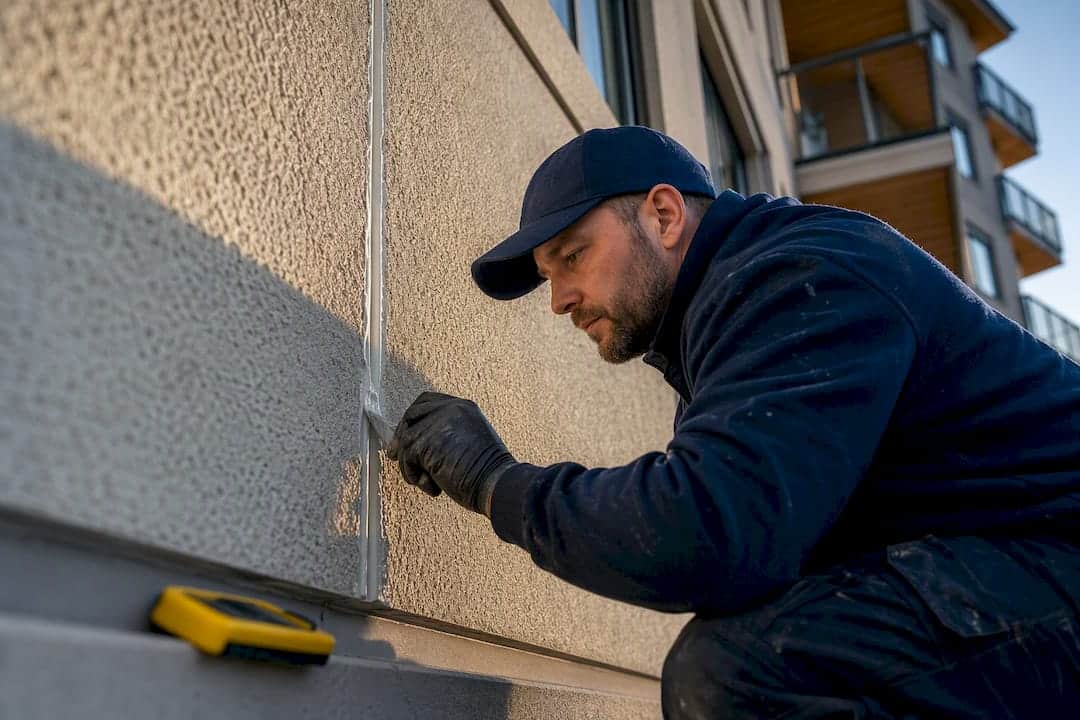
Durable EIFS joint sealing comes down to one core discipline: seal to a back-wrapped base coat, never the finish coat, using closed-cell backer rod and a tested low or ultra-low modulus sealant. Check three numbers before you sign off on any joint: width should be at least 12 mm and preferably over 20 mm, depth should run roughly half the width within the sealant maker’s limits, and the sealant needs adhesion data to ASTM C1382 on file.
TL;DR:
- Proper EIFS joint sealing requires backing to the base coat, not the finish coat, using a closed-cell backer rod and low-modulus sealant tested to ASTM C1382 standards.
- Sealing is mandatory at critical locations such as structural joints, corners, transitions to dissimilar substrates, and around openings, to prevent water infiltration and accommodate movement.
- Sealants must demonstrate adhesion after rigorous ASTM C1382 conditioning and meet movement class requirements specified by ASTM C920, with field adhesion testing every 30 meters.
- Correct joint dimensions are essential, with minimum widths of 12 mm (preferably over 20 mm), depth roughly half the width, and use of appropriately sized backer rods to ensure proper movement and longevity.
- Failures often stem from improper joint sizing, sealant bonding to the finish coat, or open-cell backer rods, making expert installation and post-installation testing crucial for durable performance.
Table of Contents
- Where EIFS joint sealing actually needs to happen
- What sealant performance standards should you actually demand?
- How do you get the joint geometry and installation right?
- How do you diagnose and repair a failed EIFS sealant joint?
- Field notes from Kettle Contracting on EIFS joint sealing
- Why the standard advice on EIFS sealant joints falls short
- Getting your EIFS joints sealed by a specialist crew
- Standards and technical bulletins worth keeping on file
- Sources
- FAQ
Where EIFS joint sealing actually needs to happen
Not every seam in an EIFS wall needs a sealant joint, but the ones that do are non-negotiable. Miss one of these, and you’re not looking at a cosmetic issue down the road, you’re looking at water tracking behind the lamina where you can’t see it until the damage is done.
The CCMC EIFS guidance identifies the mandatory locations, and every one of them ties back to either movement or water management:
- Floor lines in multi-level wood-frame construction — the frame shrinks and settles at each level, and the EIFS has to move with it without cracking.
- Structural expansion joints — these are full breaks through the substrate itself, and the EIFS joint above has to be detailed as a genuine break, not a cosmetic reveal.
- Changes in building geometry — inside corners, offsets, and step-backs concentrate stress differently than a flat wall plane.
- Transitions to dissimilar substrates — EIFS meeting brick, wood siding, or metal panel moves at a different rate than the material next to it.
- Window and door perimeters and other penetrations — every opening is a place water wants to get in, and it’s usually the first place it succeeds; proper winterizing your doors helps maintain effective perimeter seals to prevent infiltration.
That last point about expansion joints is worth repeating on its own: an EIFS expansion joint isn’t a shallow reveal cut into the foam. It’s a full-thickness break down to the substrate, and it needs to be detailed that way from the framing stage, not patched in after the fact.
What sealant performance standards should you actually demand?
Anyone can hand you a tube of sealant and call it “exterior grade.” What you want on paper before it goes on the wall is adhesion data specific to EIFS assemblies, not just general masonry or glazing performance.
ASTM C1382 is the test method that matters most here. It measures tensile adhesion after the sealant has been put through a punishing conditioning cycle: seven days of water immersion, 24 hours of freezing, 24 hours of heat conditioning, and 2,500 hours of UV and condensation cycling. That sequence is designed to simulate years of Ontario weather compressed into a lab test, and the results are read at 10%, 25%, 50%, and 100% elongation.
Statistic callout: A sealant that fails adhesion at 50% elongation after ASTM C1382 conditioning has no business going into an EIFS expansion joint that’s designed to move that much or more over its service life.
In practice, that means you’re looking for no adhesive or cohesive failure up to 50% elongation, and a manageable stress reading at 25% elongation so the sealant isn’t tearing at the lamina every time the wall breathes.
Layer that with ASTM C920, which classifies sealants by movement capability and grade. For EIFS work, you want:
- Grade NS (non-sag) for vertical and overhead application.
- Movement class matched to the joint’s actual anticipated movement, not a generic “good enough” pick.
- Low or ultra-low modulus formulations, since a stiff, high-modulus sealant transfers too much stress into a lamina that was never built to take it.
Then confirm it in the field. ASTM C1521 governs field adhesion testing, and the practical rule of thumb is to test every 30 linear metres for the first 100 linear feet of joint, then periodically after that as conditions or materials change. Keep the records. If a callback ever happens, that paperwork is what separates a five-minute conversation from a drawn-out dispute.
How do you get the joint geometry and installation right?
This is where most failures actually start, not with a bad sealant, but with a joint that was never sized or prepped correctly in the first place.
- Size the joint before you order material. A minimum of 12 mm (1/2 in) is the floor, and many applications, especially where EIFS meets a dissimilar substrate, do better at 20 mm (3/4 in) or wider. Depth runs roughly half the width, but never below 5 mm, and always check the sealant manufacturer’s own limits before you commit.
- Install closed-cell backer rod, sized about 25% larger than the joint opening. This compresses into place and creates the two-sided adhesion the sealant needs to move properly. Skip the open-cell stuff. It soaks up water and does the exact opposite of what you want inside an EIFS wall.
- Use bond-breaker tape only where backer rod genuinely won’t fit, such as shallow joints where rod would bottom out against the substrate.
- Seal to the base coat over a back-wrapped edge, never to the finish coat. The finish coat can soften or re-emulsify, and it simply doesn’t offer the stable bond a moving joint needs. If the edge wasn’t back-wrapped during original installation, cut back the finish, apply base coat and mesh, and let it cure fully before sealant goes anywhere near it.
- Tool the bead into an hourglass profile, thinner in the middle than at the edges, so the sealant can stretch and compress without over-stressing either bond line.
- Watch the temperature. Most sealants have a minimum application temperature, and cold-weather work needs extra cure-time allowance. Rushing a joint in a Ontario November cold snap is how you get adhesion failures by spring.
Pro Tip: Never assume the backer rod you pulled off the truck last job is the right size for this one. A rod that’s too small lets the sealant sag into a three-sided bond, and once that happens, the joint is fighting itself every time the wall moves.
If you want a deeper look at how joint width interacts with movement capacity, our specifier’s guide on joint width and sealant performance walks through the math behind those minimums.
How do you diagnose and repair a failed EIFS sealant joint?
Not every cracked or peeling joint needs the same fix, and guessing wrong here either wastes money on an unnecessary lamina repair or leaves a real problem unresolved behind the wall.
Start by identifying which failure you’re actually looking at:
- Adhesive failure — the sealant has pulled cleanly away from the EIFS surface, usually a sign it was never bonded to a proper base coat in the first place.
- Cohesive failure — the sealant itself has split down the middle, often from a modulus mismatch with the actual joint movement.
- Lamina tears — a stiff, high-modulus sealant has pulled at the base coat hard enough to crack the lamina around the joint.
- Finish delamination — the finish coat has separated where sealant was mistakenly bonded to it instead of the base coat.
- Water staining behind the lamina — the most serious sign, meaning water has already tracked past the joint and needs a full envelope inspection, not just a resealed line.
Once you know what you’re dealing with, the repair sequence is straightforward: remove the old sealant carefully without gouging the base coat, inspect the lamina underneath, back-wrap or patch any torn areas, reinstall with correctly sized backer rod, and run a field adhesion check before calling it done. When there’s any uncertainty about compatibility with the original EIFS system, it’s worth a call to the manufacturer before you reseal, not after.
Field notes from Kettle Contracting on EIFS joint sealing
After 25 years doing this work across the Greater Toronto Area, the patterns repeat themselves. Almost every callback we get on EIFS joints traces back to one of two things: sealant bonded to the finish coat, or open-cell backer rod that held onto moisture until it had nowhere left to go but into the wall.
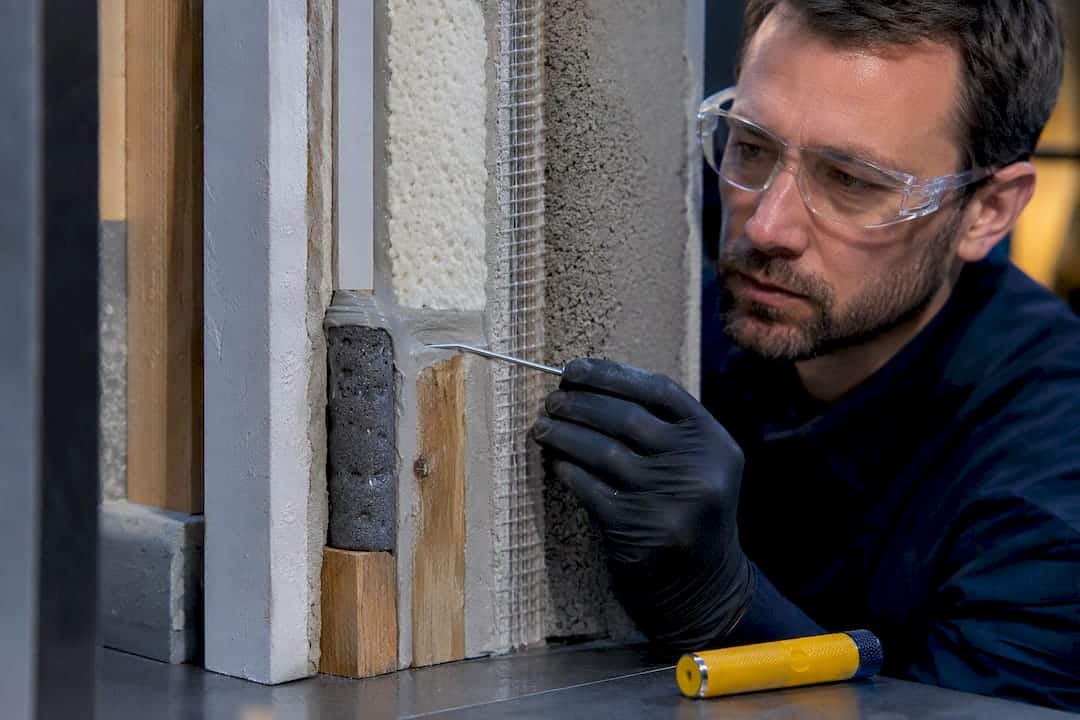
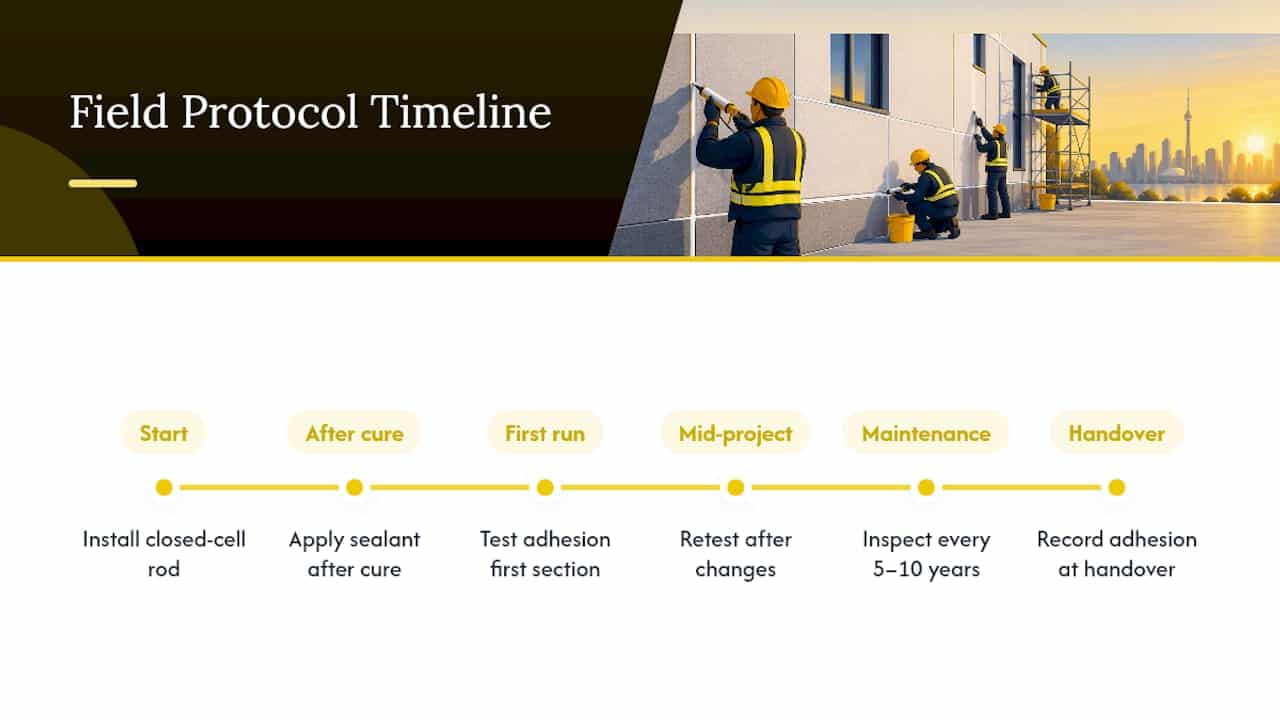
A few things we do on every job regardless of the property size: closed-cell backer rod is the default, full stop, especially on anything exposed to our winters. We sequence sealant application after the base coat has fully cured, never on top of a still-green repair. And we test adhesion on the first section of every joint run, then again anytime the material batch or the weather shifts mid-project. For maintenance, we recommend checking perimeter and expansion joints every 5 to 10 years depending on sun and weather exposure, and we document field adhesion results at handover so property managers have a paper trail, not just our word.
Why the standard advice on EIFS sealant joints falls short
Most guidance on EIFS joint sealing treats it like a caulking gun problem: pick a decent product, run a bead, move on. That’s the gap. The standards exist precisely because sealant selection and joint geometry are engineering decisions, not maintenance chores, and treating them casually is how a five-year-old building starts showing water stains behind the cladding.
What’s overrated in this trade is brand loyalty to a single sealant chemistry. What matters far more is matching modulus and movement class to the actual joint, backed by real ASTM C1382 data, not a spec sheet claim nobody checked. What’s underrated is the field adhesion test. A lab result from a manufacturer tells you what the product can do under controlled conditions. An ASTM C1521 pull test on your actual wall, in your actual weather, tells you what it’s actually doing.
If you take one thing from this, prioritize the back-wrapped base coat detail above everything else. Get that wrong, and no amount of premium sealant will save the joint. Get it right, along with correct joint sizing and closed-cell backer rod, and you’re dealing with a repair cycle measured in decades, not seasons.
— Felix
Getting your EIFS joints sealed by a specialist crew
If you’ve read this far, you already know EIFS joint sealing isn’t a weekend fix, it’s a system, and getting one detail wrong (like bonding to the finish coat instead of the base coat) undoes everything else you did right. A specialist crew handles this work with the same standards laid out above: closed-cell backer rod, tested sealants matched to joint movement class, and field adhesion checks documented at handover, not skipped to save time.

Our building envelope sealing service covers EIFS-specific joint work from perimeter seals to full expansion joint reseals, and our expansion joint sealing page walks through what a proper reseal project looks like on multi-unit or commercial properties. Before you hire anyone for EIFS work, ask three things: can they show EIFS-specific project experience, what sealant and test plan are they proposing, and can they give you references from a similar building type. If you’re ready to get a joint inspected or quoted, reach out through our services page and we’ll walk the property with you before anything gets scheduled.
Standards and technical bulletins worth keeping on file
- ASTM C1382 sealant test methods
- ASTM C920 and related standards
- EIMA technical bulletin on sealants used with EIFS
- CCMC EIFS guidance
Sources
FAQ
What is the best sealant for EIFS?
There’s no single “best” product, the right choice is a low or ultra-low modulus sealant that meets ASTM C920 grade NS requirements and has adhesion data to ASTM C1382 specific to EIFS substrates. Always confirm the manufacturer’s own compatibility list for the base coat you’re working with before ordering.
Do expansion joints need to be sealed?
Yes. EIFS expansion joints are full breaks through to the substrate and need sealant with backer rod to manage water and movement, otherwise the joint becomes a direct path for water into the wall assembly, as outlined in CCMC EIFS guidance.
What is the best sealant for control joints?
Control joints on EIFS need the same movement-rated, low-modulus sealant used at expansion joints, sized to the joint’s width and depth with closed-cell backer rod behind it. The key is matching the sealant’s movement class to how much that specific joint is expected to open and close.
Can you recoat EIFS?
Yes, EIFS finish coats can be recoated, but any sealant joints nearby should be inspected and likely replaced first, since old sealant bonded to a finish coat that’s about to be recoated is a common source of future delamination. If you’re unsure whether your joints need attention before a recoat, Kettle Contracting can assess the building envelope as part of that project.