

Caulking is a flexible sealing material that forms a critical part of the continuous air barrier system required under ANSI/ASHRAE/IES Standard 90.1-2022, directly supporting ASHRAE guidelines compliance and energy performance in commercial and residential buildings. When joints, transitions, and penetrations go unsealed, air infiltration undermines insulation, overloads HVAC systems, and pushes buildings out of compliance. Understanding how caulking supports ASHRAE compliance is not a technical luxury for engineers. It is a practical necessity for every building owner and manager responsible for energy costs, occupant comfort, and code requirements in 2026.
How caulking supports the continuous air barrier under ASHRAE 90.1
ASHRAE 90.1 §5.4.3 requires a continuous air barrier assembly across the entire building envelope, with all joints and transitions sealed to minimise air leakage. No single material spans every gap in a building. Caulking fills the role of secondary sealant, connecting primary barrier materials at the points where they meet, overlap, or terminate.
Think of the air barrier as a chain. The primary membrane, sheathing, or spray foam forms the main links. Caulking seals the connections between those links, at window frames, door rough openings, expansion joints, and penetrations for pipes and conduit. Without those connections, the chain breaks, and air moves freely through the building envelope.
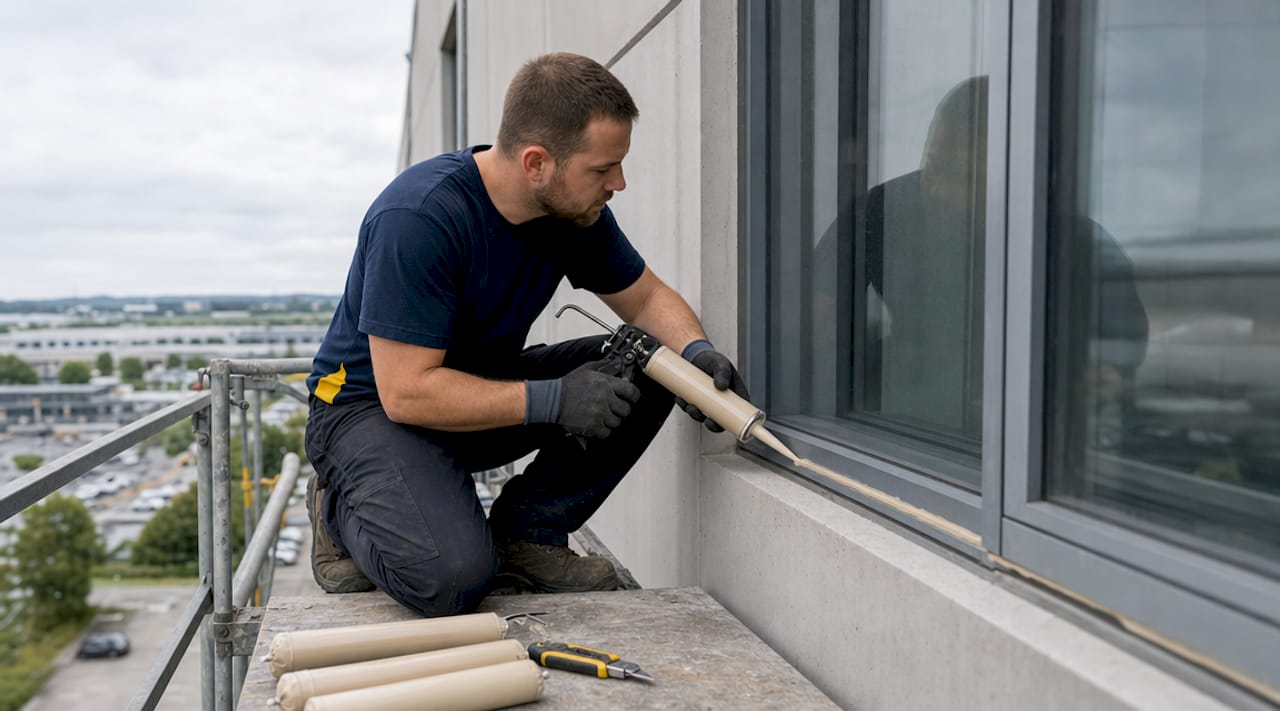
ASHRAE 90.1 compliance is rarely achieved through a single material. Caulking acts as a flexible connector that bridges air barrier materials, but it requires precise detailing and installation to avoid failure during blower-door testing. That last point matters more than most building managers realise. A blower-door test pressurises the building and measures how much air escapes. Poorly detailed caulking at transitions is one of the most common reasons buildings fail that test.
Material selection is equally important. Water-based interior sealants designed for flexibility help meet ASHRAE 90.1 §5.4.3 by maintaining pressure boundaries where exterior sealing is difficult or impractical. These products maintain adhesion even as the building moves through seasonal temperature cycles.
Pro Tip: Specify caulking materials and application locations in your project documentation before construction begins. Leaving sealant details to the discretion of individual trades on-site is one of the most reliable ways to end up with gaps at critical transitions.
Key locations where caulking must be detailed to support a continuous air barrier include:
- Window and door perimeters, where framing meets rough openings
- Sill plates and foundation transitions
- Penetrations for electrical, plumbing, and mechanical services
- Expansion joints and control joints in the building envelope
- Connections between different cladding or sheathing materials
What energy savings can building managers expect from proper air sealing?
Professional air sealing that includes caulking with blower-door verification can achieve 15 to 25% HVAC energy savings in leaky buildings. That range represents real dollars on your operating budget, not a theoretical figure. DIY caulking, by contrast, typically yields only 1 to 5% savings because it addresses visible gaps without the diagnostic tools needed to find hidden leakage paths.
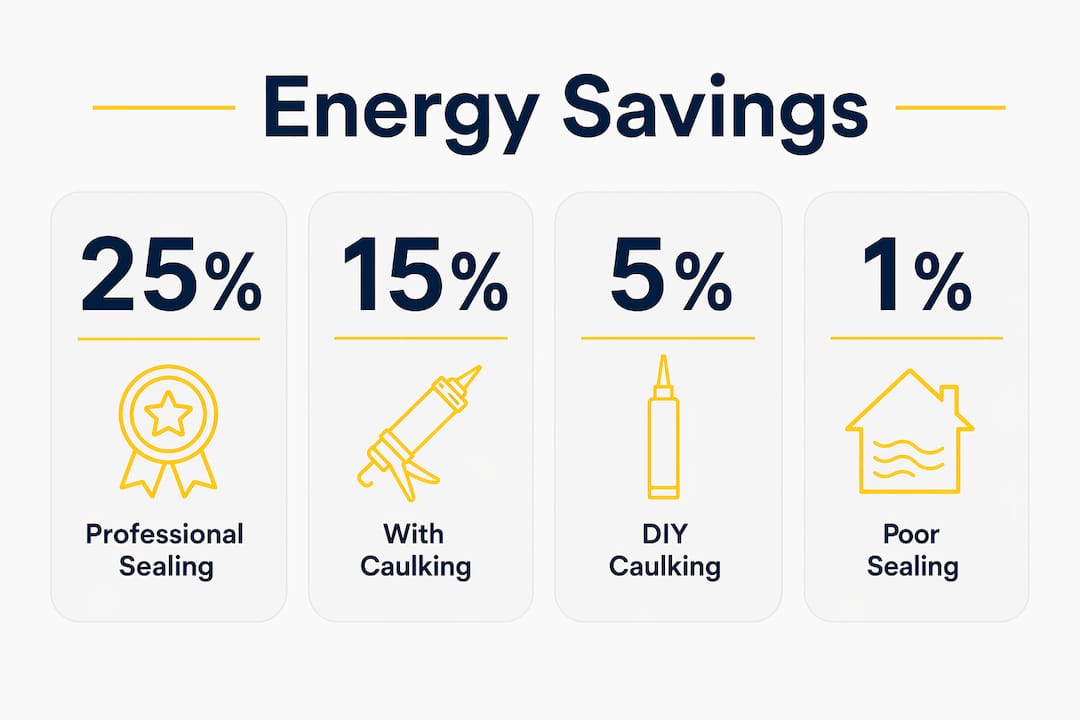
The gap between those two numbers comes down to method and materials. A professional sealing programme uses blower-door diagnostics to locate air leakage before applying sealant, then verifies the result with a post-installation test. That process finds the gaps that are not visible to the naked eye, including those behind wall assemblies, at mechanical penetrations, and along floor-to-wall transitions.
Failing caulking allows moisture infiltration that degrades insulation effectiveness and causes HVAC systems to overcompensate, undermining energy performance. Moisture reduces the R-value of insulation and creates conditions for mould growth, which compounds both health and cost problems over time. The HVAC system then runs longer cycles to compensate for the heat loss, driving up energy consumption.
Here is a practical sequence for understanding the cumulative impact of caulking failure on building performance:
- Caulking at window perimeters cracks or loses adhesion due to thermal cycling.
- Air infiltration increases at those joints, carrying moisture into the wall assembly.
- Insulation R-value drops as moisture content rises.
- The HVAC system works harder to maintain set-point temperatures.
- Energy costs rise and occupant comfort declines.
- The building falls below the performance threshold required for ASHRAE 90.1 compliance.
The seal-then-insulate sequence is critical. Without effective air sealing, even top-tier insulation will not meet energy compliance targets due to convective heat loss. Caulking is not an afterthought to insulation. It is the prerequisite.
Common mistakes that undermine ASHRAE compliance
Most caulking failures in commercial buildings are not random. They follow predictable patterns that building managers can learn to recognise and prevent. Many property managers overlook caulking maintenance until it fails, despite its significant impact on energy consumption and building envelope integrity.
The most common errors include:
- Failing to document caulking requirements. When sealant locations and material specifications are not written into project documents, trades make their own choices. Those choices are often based on cost rather than performance.
- Using low-quality or wrong-type sealants. Consumer-grade caulking products lose elasticity faster than commercial-grade alternatives. In Ontario’s climate, where buildings experience significant freeze-thaw cycling, that matters enormously.
- Ignoring building movement. Temperature changes demand flexible, durable caulking materials to maintain airtight joints over time. Rigid sealants crack as the building expands and contracts, creating new leakage paths within a few seasons.
- Skipping ventilation assessment before sealing. Aggressive air sealing without ensuring adequate ventilation risks indoor air quality issues by reducing fresh air exchange below ASHRAE 62.1 standards. Sealing a building tightly without a mechanical ventilation plan traps pollutants and moisture indoors.
- Reactive rather than proactive maintenance. Waiting until caulking is visibly cracked or missing means the damage to insulation and the building envelope has already begun.
Pro Tip: Before any sealing project, assess your building’s ventilation system against ASHRAE 62.1 requirements. Tightening the envelope without confirming adequate mechanical ventilation can create indoor air quality problems that are more expensive to fix than the energy savings are worth.
The ventilation point deserves emphasis. Excessive caulking without proper ventilation assessment can reduce indoor air quality by trapping pollutants and moisture. ASHRAE 90.1 and ASHRAE 62.1 work together. Meeting one standard while violating the other is not compliance.
Best practices for building managers to seal for compliance
Achieving and maintaining ASHRAE compliance through caulking requires a structured approach, not a one-time application. The following practices reflect what actually works in Ontario’s climate over the long term.
-
Select materials based on movement and exposure. Commercial-grade silicone or polyurethane sealants handle thermal cycling far better than acrylic latex products. For exterior joints on a multi-storey building in the Greater Toronto Area, specify a sealant rated for the expected joint movement range, typically 25% to 50% of joint width.
-
Schedule inspections before problems appear. Annual inspections of caulking at windows, doors, expansion joints, and roof-to-wall transitions catch failures before they allow moisture infiltration. Spring and autumn are the best times in Ontario, following the most demanding thermal cycles.
-
Follow the seal-then-insulate sequence. Air sealing must be completed and verified before insulation is installed. Insulation installed over unsealed gaps does not stop air movement. It only slows it slightly.
-
Document everything. Caulking specifications, application locations, material data sheets, and inspection records should be part of your building’s maintenance file. This documentation supports compliance verification and simplifies future resealing work.
-
Verify with blower-door testing. Blower-door testing verifies air barrier effectiveness post-installation. This is the only reliable way to confirm that caulking and other air sealing measures have achieved the performance required by ASHRAE 90.1.
The table below compares DIY caulking against professional-grade sealing for building managers evaluating their options:
| Factor | DIY caulking | Professional sealing |
|---|---|---|
| Energy savings | 1 to 5% | 15 to 25% |
| Diagnostic method | Visual inspection | Blower-door testing |
| Material quality | Consumer-grade | Commercial-grade |
| Documentation | Typically none | Specifications and records |
| ASHRAE compliance support | Partial, at best | Verified performance |
For window air sealing specifically, the difference between consumer and commercial materials becomes clear within two or three Ontario winters. Professional-grade products maintain their elasticity and adhesion through repeated freeze-thaw cycles. Consumer products do not.
Key takeaways
Caulking is the flexible connector that completes the continuous air barrier required by ASHRAE 90.1, and without it, no amount of insulation or primary membrane will achieve verified compliance.
| Point | Details |
|---|---|
| Caulking completes the air barrier | It seals transitions and joints between primary barrier materials where air leakage is most likely. |
| Professional sealing outperforms DIY | Verified professional sealing achieves 15 to 25% HVAC energy savings versus 1 to 5% for DIY. |
| Material selection is critical | Commercial-grade sealants flex with building movement and last through Ontario’s freeze-thaw cycles. |
| Ventilation must be assessed first | Sealing without a ventilation plan risks indoor air quality violations under ASHRAE 62.1. |
| Documentation supports compliance | Specifications, inspection records, and blower-door results are the evidence base for ASHRAE compliance. |
Why caulking gets overlooked until it costs you money
After 25 years working on building envelopes across Ontario, the pattern I see most often is this: caulking gets treated as a finishing detail rather than a performance component. It goes on last, it gets the least scrutiny, and it is the first thing cut when a project runs over budget. Then, two or three winters later, the energy bills climb, the HVAC system starts struggling, and someone calls us to figure out why.
The honest answer is almost always the same. The air barrier was never continuous to begin with. Joints at window frames, sill plates, or expansion joints were either left unsealed or sealed with the wrong product. The insulation is still there, doing its job, but air is moving around it freely through gaps that a proper caulking specification would have caught.
What I find frustrating is that the fix is rarely complicated or expensive when you catch it early. A professional inspection, the right commercial-grade sealant, and a blower-door test to verify the result. That is the whole programme. The cost of doing it right is a fraction of what building owners spend compensating for the energy loss over five or ten years.
The other thing I want building managers to understand is that caulking and passive house standards share the same underlying principle. Airtightness is not a luxury feature. It is the foundation of energy performance. ASHRAE 90.1 codifies that principle for commercial buildings. Caulking is one of the most cost-effective tools you have for meeting it.
— Felix
How Kettlecontracting can help you meet ASHRAE requirements
If you manage a commercial property in the Greater Toronto Area and you are not confident your building envelope meets ASHRAE 90.1 air barrier requirements, Kettlecontracting can help you get there.

Our team specialises in commercial window caulking and full building envelope sealing using commercial-grade materials selected for Ontario’s climate. We work from documented specifications, apply sealants to the transitions and joints that matter most for compliance, and can coordinate with blower-door testing to verify results. Whether you are preparing for a compliance audit, addressing rising energy costs, or planning a building retrofit, we bring the experience and materials to do the job properly. Contact Kettlecontracting to discuss your building’s sealing needs and get an honest assessment of where your envelope stands.
FAQ
What is the role of caulking in ASHRAE 90.1 compliance?
Caulking serves as a secondary sealant that bridges transitions and joints between primary air barrier materials, completing the continuous air barrier assembly required under ASHRAE 90.1 §5.4.3. Without properly detailed caulking at these connections, buildings typically fail blower-door testing.
How much energy can proper caulking save on HVAC costs?
Professional air sealing that includes caulking with blower-door verification achieves 15 to 25% HVAC energy savings in leaky buildings, compared to 1 to 5% for DIY caulking applications.
How often should commercial building caulking be inspected?
Annual inspections are the standard practice, with spring and autumn being the most useful times in Ontario following the most demanding thermal cycles. Caulking at windows, doors, expansion joints, and roof-to-wall transitions should be checked each cycle.
Can sealing a building too tightly cause problems?
Yes. Aggressive air sealing without a ventilation assessment can reduce indoor air quality by lowering fresh air exchange below ASHRAE 62.1 standards. Any sealing programme should be paired with a review of the building’s mechanical ventilation capacity.
What type of caulking is best for ASHRAE compliance in commercial buildings?
Commercial-grade silicone or polyurethane sealants rated for the expected joint movement range are the appropriate choice for exterior applications in Ontario’s climate. These products maintain elasticity through freeze-thaw cycles where consumer-grade acrylic latex products fail within a few seasons.