
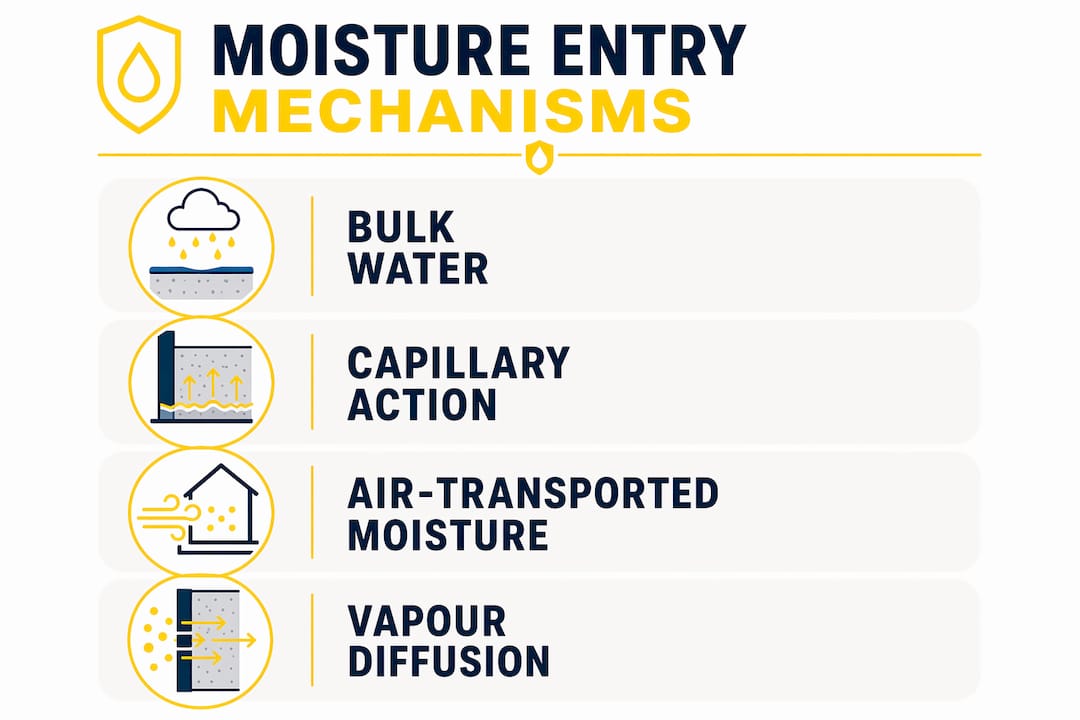
Moisture intrusion in walls is defined as the unwanted movement of water into a wall assembly through one or more of four distinct mechanisms: bulk water, capillary action, air-transported moisture, and vapour diffusion. Moisture-related failures cause over 90% of all building envelope problems. That single figure tells you how central water management is to keeping a home structurally sound. Understanding how moisture enters home walls is the first step toward preventing rot, mould, and costly repairs before they start.
How does bulk water get into home walls?
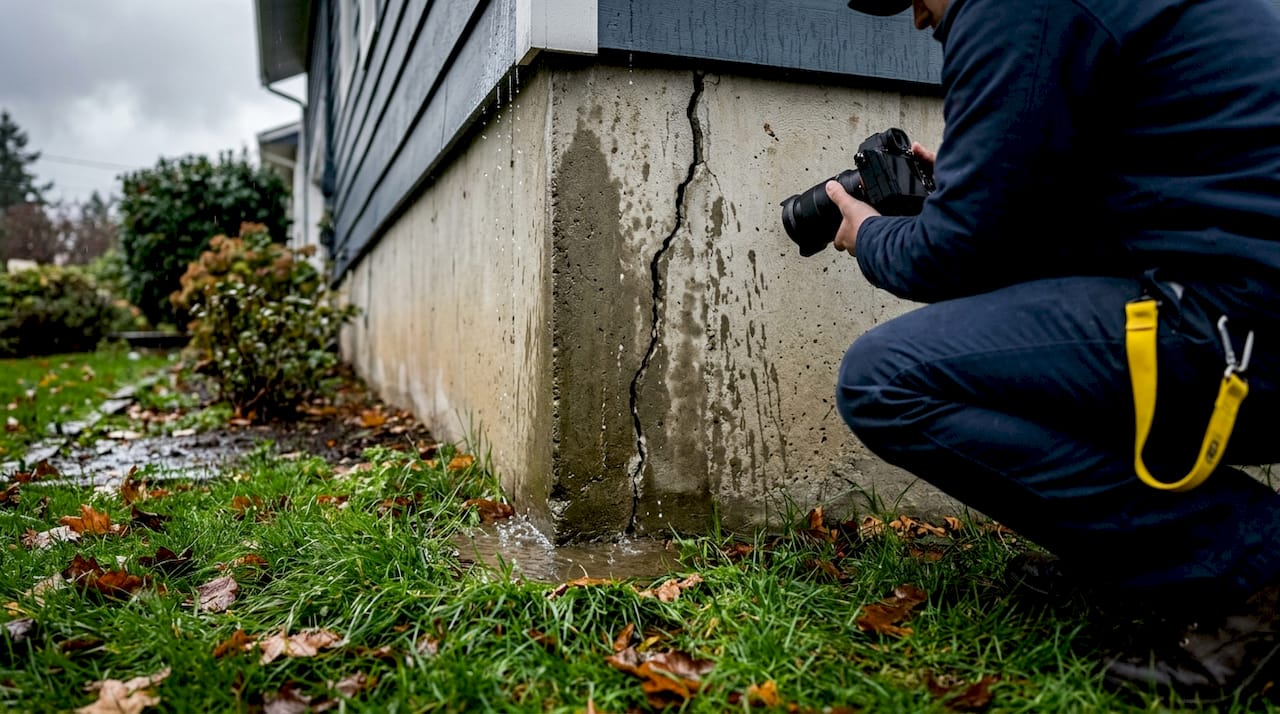
Bulk water is the most visible and highest-volume source of moisture intrusion in walls. It includes rain, snowmelt, plumbing leaks, and surface flooding. When water reaches your wall assembly faster than drainage systems can redirect it, it finds a way in.
The most common entry points for bulk water include:
- Foundation cracks. Concrete shrinks and shifts over time. Even hairline cracks allow water to seep through under hydrostatic pressure.
- Improperly sealed penetrations. Pipes, electrical conduits, and vents that pass through exterior walls create gaps if not sealed correctly.
- Failed flashing. Flashing at roof-to-wall junctions, window heads, and door frames is the primary barrier against water running down the face of a building. When it lifts or corrodes, water enters directly.
- Blocked or damaged gutters. Gutters that overflow deposit water at the foundation rather than directing it away from the building.
- Negative grading. Ground that slopes toward the foundation channels surface runoff directly against the wall. Proper grading requires a 15 cm slope over 3 metres away from the foundation to redirect water effectively.
About 26% of basement moisture issues arise from surface runoff entering through leaks and cracks. The remaining issues trace back to groundwater pressure and sewer system overload. That breakdown matters because surface runoff is largely preventable with grading and drainage maintenance.
Pro Tip: Grading and flashing are your first line of defence against bulk water, yet they are the two items most homeowners overlook during routine maintenance. Walk the perimeter of your home after a heavy rain and watch where water pools.
What is capillary action and how does it wick moisture into walls?
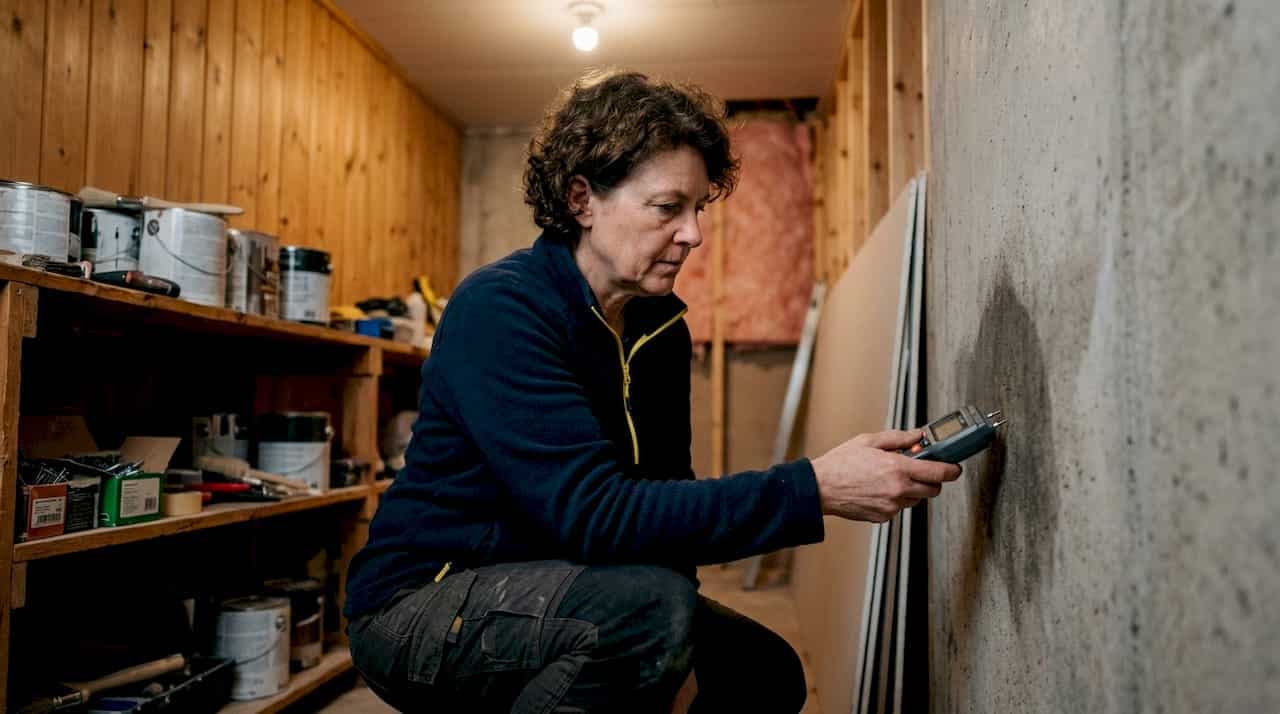
Capillary action is the movement of water through porous materials without any external pressure driving it. Water molecules cling to the surfaces of tiny pores in materials like concrete, mortar, brick, and wood, and the water climbs upward or inward against gravity. This is fundamentally different from bulk water flow, which requires a gap or crack.
Capillary action wicks moisture through porous building materials including concrete, mortar, and wood. The damage it causes is often concealed inside wall cavities, which means rot and deterioration can progress for years before you see any surface sign.
Materials most vulnerable to wicking include:
- Concrete block and poured concrete foundations
- Mortar joints in brick veneer
- Untreated dimensional lumber in contact with concrete
- Fibrous batt insulation that absorbs and holds moisture
The building science solution is a capillary break: a material or layer that interrupts the path water travels through. Common capillary breaks include polyethylene sheeting between a concrete slab and framing, damp-proofing membranes on foundation walls, and back-ventilated rain screens that keep cladding separated from the wall assembly.
| Capillary break type | Where it is used | What it stops |
|---|---|---|
| Polyethylene sheeting | Between slab and wood framing | Moisture wicking from concrete into lumber |
| Damp-proofing membrane | Exterior face of foundation wall | Groundwater absorption through concrete |
| Ventilated rain screen | Behind exterior cladding | Moisture bridging from cladding to sheathing |
| Sill gasket | Under bottom plate on foundation | Direct contact wicking at framing base |
Pro Tip: If you are doing foundation repairs or a basement renovation, install a capillary break before framing. Skipping it to save time is the single most common reason basement walls develop concealed rot within five years.
How does air-transported moisture damage your walls?
Air-transported moisture is the leading cause of moisture accumulation inside wall assemblies, and it is widely misunderstood. Most homeowners focus on vapour barriers, but air leakage transports 100 times more moisture into walls than vapour diffusion does. A gap as small as 6.5 cm² can deposit 30 times more water into a wall cavity than diffusion through an entire sheet of drywall.
The mechanism is straightforward. Warm indoor air carries water vapour. When that air finds a gap in the building envelope, it moves through the gap and into the cooler wall cavity. The air cools, its capacity to hold moisture drops, and water condenses on the cold surfaces inside the wall. This happens continuously during heating season in Canadian homes.
Common air leakage points include:
- Electrical outlets and switch boxes on exterior walls
- Plumbing penetrations through top and bottom plates
- Window and door frame perimeters where caulk has cracked or shrunk
- Service penetrations for cable, gas lines, and ventilation ducts
- Attic hatch perimeters and pot light housings
The stack effect in winter makes this worse in Canadian homes. Warm air rises and escapes through the upper portions of the building, creating a pressure difference that pulls cold outside air in at the bottom and pushes warm moist air into wall cavities throughout the middle and upper floors. This suction is continuous as long as the temperature difference between inside and outside exists.
A continuous air barrier is the correct solution. This means sealed drywall with taped joints, taped and sealed sheathing on the exterior, and spray foam or backer rod with caulk at every penetration. Sealing air leakage points at windows, doors, and service penetrations is one of the highest-return improvements a homeowner can make.
Pro Tip: A vapour barrier is not an air barrier. Polyethylene sheeting stops diffusion but does not stop air movement unless every seam and penetration is taped and sealed. Treat them as two separate systems.
What is vapour diffusion and when does it cause wall damage?
Vapour diffusion is the slow movement of water vapour through solid building materials driven by differences in vapour pressure. Unlike air leakage, diffusion does not require a hole or gap. It moves molecule by molecule through drywall, insulation, and sheathing. Vapour diffusion is slow and less impactful than air leakage, but it still requires management.
The risk from vapour diffusion is condensation inside the wall assembly. When warm, moist air diffuses through the wall and reaches a surface cold enough to drop below the dew point, water condenses. The dew point is the temperature at which air becomes fully saturated and can no longer hold its water vapour. In Ontario basements, warm humid summer air meets cold foundation walls that stay 8–12°C year-round, which creates exactly this condition.
Vapour retarder placement follows a clear rule: install it on the warm side of the insulation. In a Canadian climate, that means the interior side of the wall during winter. The goal is to keep the vapour retarder warm enough that condensation does not form on it.
The two-thirds rule for insulation states that placing the majority of insulation outside the structural sheathing keeps the sheathing warm. A warm sheathing layer stays above the dew point, which prevents condensation from forming inside the wall cavity. Exterior rigid foam insulation achieves this and also allows the wall assembly to dry toward the exterior in summer.
The distinction between a vapour barrier and a vapour retarder matters here. A vapour barrier has zero permeability and blocks all diffusion. A vapour retarder slows diffusion but allows some drying. Most modern wall assemblies use vapour retarders rather than full barriers because walls need to be able to dry in at least one direction.
Practical steps to prevent moisture intrusion in home walls
Prevention combines all four mechanisms into one maintenance routine. Addressing each pathway systematically is more effective than reacting to visible damage after it appears.
- Check and correct grading. Walk the perimeter of your home and confirm the ground slopes away from the foundation. Fill low spots with compacted soil and re-establish a positive slope.
- Inspect and clean gutters twice a year. Blocked gutters overflow and deposit water at the foundation. Clean them in late spring and late autumn.
- Audit flashing at every roof-to-wall junction. Look for lifted edges, rust, or gaps where flashing meets cladding. Seal exposed edges with a compatible exterior caulk.
- Inspect caulk at all window and door perimeters. Cracked or missing caulk at these joints is one of the most common ways moisture enters walls. Effective window caulking stops water at the point of entry before it reaches the wall cavity.
- Seal interior air leakage points. Use spray foam or caulk at electrical boxes on exterior walls, plumbing penetrations, and any gap where a pipe or wire passes through a plate.
- Control indoor humidity. Run bathroom and kitchen exhaust fans consistently. Keep indoor relative humidity below 50% during heating season to reduce the vapour load on your walls.
- Insulate basement walls correctly. Use closed-cell spray foam or rigid foam on the exterior face of foundation walls to prevent condensation where warm air meets cold concrete.
Pro Tip: Prioritise exterior drainage and air sealing during any home improvement project. Interior coatings and paints marketed as waterproof do not address the source of the problem. Grading and water load management consistently outperform interior treatments for below-grade moisture control.
Key takeaways
Moisture enters home walls through four mechanisms, and air leakage is the most damaging of them all, transporting far more water into wall cavities than vapour diffusion ever does.
| Point | Details |
|---|---|
| Four entry mechanisms | Bulk water, capillary action, air-transported moisture, and vapour diffusion each require different prevention strategies. |
| Air leakage dominates | A 6.5 cm² gap deposits 30 times more moisture than diffusion through an entire drywall panel. |
| Grading is critical | A 15 cm slope over 3 metres away from the foundation prevents bulk water from reaching the wall. |
| Capillary breaks protect framing | Polyethylene sheeting, damp-proofing, and rain screens stop wicking before it reaches structural lumber. |
| Vapour retarders go on the warm side | Placing insulation and retarders correctly keeps wall sheathing above the dew point and prevents hidden condensation. |
What 25 years on the job taught me about moisture and walls
After two and a half decades sealing buildings across the Greater Toronto Area, the pattern I see most often is this: homeowners spend money on interior solutions while the exterior keeps letting water in.
The biggest misconception I encounter is the belief that a vapour barrier solves the moisture problem. It does not. A vapour barrier with unsealed penetrations is like a raincoat with the buttons undone. The air leaks right past it, and the moisture goes with it. I have opened walls in well-insulated homes and found soaking wet cavities because every outlet box on the exterior wall was an open channel to the outside.
The two-thirds rule for insulation placement is the piece of building science that most homeowners have never heard of, but it is the one that prevents the most concealed damage. Keeping the sheathing warm by placing exterior insulation correctly changes the whole moisture equation inside the wall. I have seen this principle applied correctly on renovations and the difference in long-term wall condition is significant.
The stack effect is something every Canadian homeowner should understand. In winter, your home acts like a chimney. Warm air rises and escapes at the top, pulling cold air in at the bottom and pushing moist air into wall cavities in between. Sealing the building envelope is not just about comfort or energy bills. It is about stopping that continuous moisture load from accumulating inside your walls season after season.
What homeowners most often miss during inspections is the caulk at window and door frames. It looks fine from a distance, but up close it has cracked, pulled away from the substrate, or gone brittle from UV exposure. That gap is a direct path for both air and water into the wall assembly. Professional-grade caulking, applied correctly and to the right substrate, lasts far longer than the DIY tube from the hardware store.
— Felix
Protecting your home starts with the right seal
Moisture damage in walls rarely announces itself early. By the time you see staining, bubbling paint, or soft drywall, the damage inside the cavity is already significant.

Kettlecontracting specialises in professional-grade caulking and sealing for windows, doors, and full building envelopes across the Greater Toronto Area. The team applies the right product to the right substrate, with the preparation and technique that makes the seal last through Ontario’s freeze-thaw cycles. If you want to know whether your home’s envelope is holding up, trade-specific caulking expertise makes the difference between a repair that lasts and one that fails in two seasons. You can also review construction defect caulking examples to identify what failing seals look like before they become a larger problem.
FAQ
What are the four ways moisture enters home walls?
Moisture enters walls through bulk water (rain, snowmelt, leaks), capillary action (wicking through porous materials), air-transported moisture (humid air moving through gaps), and vapour diffusion (water vapour passing through solid materials). Air leakage carries the largest moisture load of the four.
What are the signs of moisture in walls?
Common signs include bubbling or peeling paint, soft or discoloured drywall, a musty odour, visible mould growth, and efflorescence (white mineral deposits) on masonry surfaces. By the time these signs appear, moisture has typically been present inside the wall cavity for some time.
How does air leakage cause more damage than vapour diffusion?
A gap of 6.5 cm² deposits 30 times more water into a wall cavity than vapour diffusion through an entire drywall panel. Air carries moisture in bulk, while diffusion is a slow, molecule-by-molecule process that vapour retarders can effectively slow.
What is the best way to prevent moisture intrusion in home walls?
The most effective prevention combines correct exterior grading, maintained flashing and gutters, sealed air leakage points at windows and penetrations, and properly placed insulation that keeps wall sheathing above the dew point. No single fix addresses all four moisture pathways.
Does caulking stop moisture from entering walls?
Caulking at window frames, door perimeters, and service penetrations stops both air leakage and bulk water entry at the building envelope. It does not address groundwater pressure or capillary action through foundation walls, which require grading, drainage, and capillary break membranes.