

Interior painting cost in Toronto typically runs between low and mid single digits per square foot for a full-scope job, or somewhat less for walls only. A standard three-bedroom house lands most homeowners somewhere between $3,000 and $12,000, depending on prep work and finish quality.
Add repairs, high ceilings, or heavy trim work, and costs increase significantly.
If you want a number you can actually budget against, measure your wall area or book an in-home estimate. A contractor who walks your space before quoting will catch the stuff that changes the price, like old plaster or a stairwell with 18-foot ceilings, before it becomes a surprise on the invoice.
Key Takeaways
Interior painting in Toronto is generally priced within a range per square foot for full-scope work, and the quality of preparation largely explains differences between quotes.
| Point | Details |
|---|---|
| Know your per-square-foot range | Budget $1.80 to $3.00 for walls only, or $3.00 to $4.70 for full scope, before HST. |
| Prep eats most of the labour hours | Expect a significant majority of project time to go toward patching, sanding, and repairs, not painting. |
| Downtown access adds cost | Condo elevator bookings and parking restrictions can add 10 to 15% to the total. |
| Get a written, itemized quote | Confirm coats, paint product, prep scope, timeline, and warranty before signing anything. |
| Seal joints before you paint | Kettle Contracting inspects surfaces in person and recommends caulking failing joints first, since Ontario’s freeze-thaw cycles push moisture into unsealed gaps and shorten a paint job’s lifespan. |
Table of Contents
- What does interior painting cost in Toronto per square foot?
- How much does each room cost to paint?
- What drives interior painting costs up in Toronto?
- How long does an interior paint job take in Toronto?
- How do you get an accurate painting quote in Toronto?
- Can you lower your painting cost without cutting corners?
- Why does caulking matter to your paint job’s lifespan?
- What’s the split between labour and material costs?
- Does a painting warranty affect the price?
- A hands-on take on Toronto’s 2026 painting prices
- Get an accurate quote that accounts for prep, not just paint
- Sources
- FAQ
What does interior painting cost in Toronto per square foot?
Painters in Toronto price jobs two ways, and mixing them up is where a lot of homeowners get confused. Wall-area pricing covers just the vertical surfaces you’re painting. Floor-area pricing (what most people think of when they say “my house is 2,000 square feet”) is a different number entirely, because wall area is usually three to four times larger than floor area once you account for ceiling height.
Here’s how the ranges typically break down before HST:
- Walls only: $1.80 to $3.00 per square foot
- Full scope (walls, ceilings, and trim): $3.00 to $4.70 per square foot
- Broader market range across the GTA: $2.00 to $5.00 per square foot, according to UrbanTasker’s local breakdown
For whole-project totals, HomeStars puts Toronto interior painting at $1.80 to $4.50 per square foot on average. A one-bedroom condo often lands between $1,500 and $3,000. A 1,200 to 1,500 square foot house typically runs $3,500 to $7,000. A 2,000 square foot home with more rooms and trim can reach $6,000 to $11,000. Downtown submarkets tend to sit at the higher end because of access costs we’ll get into below.
How much does each room cost to paint?
Room-by-room pricing helps check a quote before signing. Prices vary by room size and complexity, with powder rooms typically costing less and stairwells more, assuming two coats and standard prep.
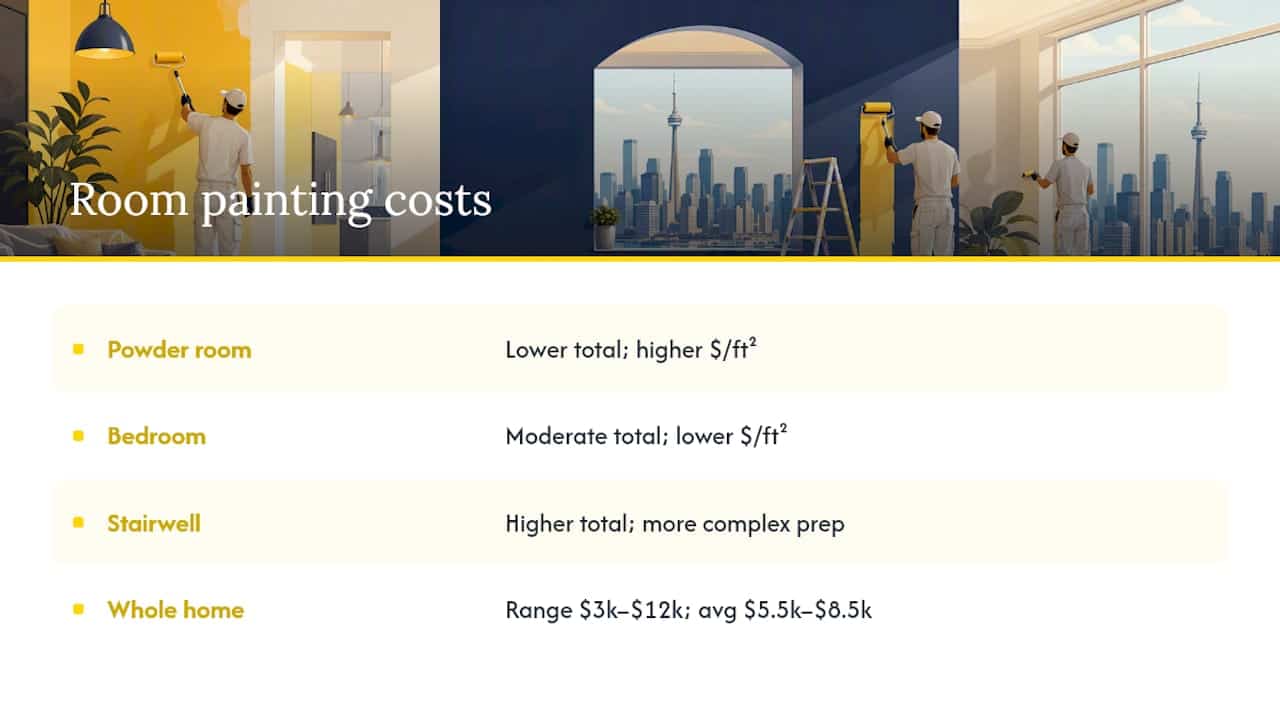
A single powder room often costs proportionally more per square foot than a bedroom. Small rooms still require a full setup, mixing, masking trim, protecting the floor, cutting in corners, before a single roller stroke happens. That setup time doesn’t shrink just because the room does. Contractors reporting whole-home ranges of $3,000 to $12,000 or more usually see the two-storey detached average settle around $5,500 to $8,500 before tax.
What drives interior painting costs up in Toronto?
Prep work is the single biggest lever on your final bill, and it’s not close. Estimators consistently find that prep and repairs consume a significant majority of labour hours on typical jobs, leading to substantial cost differences between similar-sized houses.
- Surface condition. Cracked plaster, peeling old paint, or wallpaper removal adds hours before any painting starts.
- Number of coats and paint quality. Deep and saturated colour bases carry a per-gallon premium that shows up on whole-house projects.
- Trim and mouldings. Detailed casings, wainscotting, and coffered ceilings take longer to cut in cleanly.
- Ceiling height. Stairwells and vaulted living rooms need scaffolding or extension work, which slows the crew down.
- Access and logistics. Downtown condos with elevator booking windows, visitor parking restrictions, or freight elevator fees can add 10 to 15% to the total.
- Hidden add-ons. Masking, debris disposal, and extra caulking around trim and window frames often get missed in a rough quote but should appear as line items in an honest one.
Pro Tip: Ask your estimator to separate “prep” from “paint” on the quote. If those two numbers aren’t broken out, you have no way to tell if you’re overpaying for one to subsidize the other.
How long does an interior paint job take in Toronto?
A good estimator doesn’t quote from a table. They walk your home, measure wall area, count trim linear footage, check for moisture or old caulking failures, and test suspect paint layers before giving you a number. That in-person visit is what prevents a $4,000 quote from becoming a $5,500 invoice halfway through.
Once work starts, the schedule usually breaks down like this:
- Prep and masking: 0.5 to 2 days, depending on repair volume
- Priming: half a day for most rooms, longer for patched drywall
- Two finish coats: 1 to 2 days for the average room set
- Touch-ups and final walkthrough: half a day
A single room typically wraps in one day. A condo (one to two bedrooms) usually takes two to three days on-site. A full detached home runs anywhere from five to ten working days, with prep work often eating more calendar time than the actual painting.
How do you get an accurate painting quote in Toronto?
Get everything below in writing before you sign, not promised verbally during the walkthrough.
- Number of coats the quote includes, and whether that changes for dark colours.
- Exact paint product and sheen (brand, line, and finish, not just “premium paint”).
- Who handles prep, and exactly what’s included (patching, sanding, priming).
- A written timeline, including start date and expected completion.
- A written warranty covering peeling, cracking, or colour fading.
- HST and any parking or access fees, itemized separately.
- Colour codes and tint formulas recorded on the contract for future touch-ups.
- Cleanup and completion criteria, so you both agree on what “done” looks like.
- Leftover paint policy, since you’ll want extra for future touch-ups.
Watch for red flags: a quote that arrives within minutes of a phone call, vague language like “we’ll do what it takes,” or no confirmation of WSIB coverage and liability insurance. If a painter can’t answer questions about their process, that’s worth noting before you compare their number against a professional’s detailed breakdown.
Can you lower your painting cost without cutting corners?
You can trim your bill in a few honest ways without shortening how long the finish lasts.
- Bundle multiple rooms into one job. Per-room setup costs shrink when a crew is already on-site.
- Choose a durable mid-tier paint instead of the cheapest option. Cheap paint often needs a third coat, which erases the savings.
- Limit deep-base accent walls. They look great, but the per-gallon premium adds up across a whole floor.
- Do the low-risk prep yourself. Moving furniture and clearing rooms saves labour hours. Leave caulking, patching, and priming to the pros.
- Book outside peak season. Late fall or early spring bookings can bring modest savings of 10 to 15% compared to summer rates.
Pro Tip: Ask for an itemized quote, then cross off optional line items one at a time. You’ll see exactly what you’re trading for what savings, instead of guessing.
Why does caulking matter to your paint job’s lifespan?
Twenty-five years on the jobers in the GTA teaches you one thing fast: paint fails at the joints first. In Ontario’s freeze-thaw cycles, moisture that sneaks through failing window or trim caulking migrates into the wall assembly, and it shows up months later as bubbling, cracking, or discoloured drywall, even on a fresh paint job.
- We measure and inspect surfaces in person before quoting, not off a floor-area chart.
- Sealing joints before the primer goes on prevents finish failure down the line.
- Homeowners often pair painting with professional caulking services to protect the work they’re paying for.
Skipping this step is one of the more expensive mistakes we see. It’s cheaper the first time around.
What’s the split between labour and material costs?
Labour makes up the bulk of what you’re paying for on an interior repaint. Across the GTA, labour typically runs 60 to 80% of the total bill, with materials filling in the rest. That split surprises a lot of homeowners who assume paint itself is the expensive part.
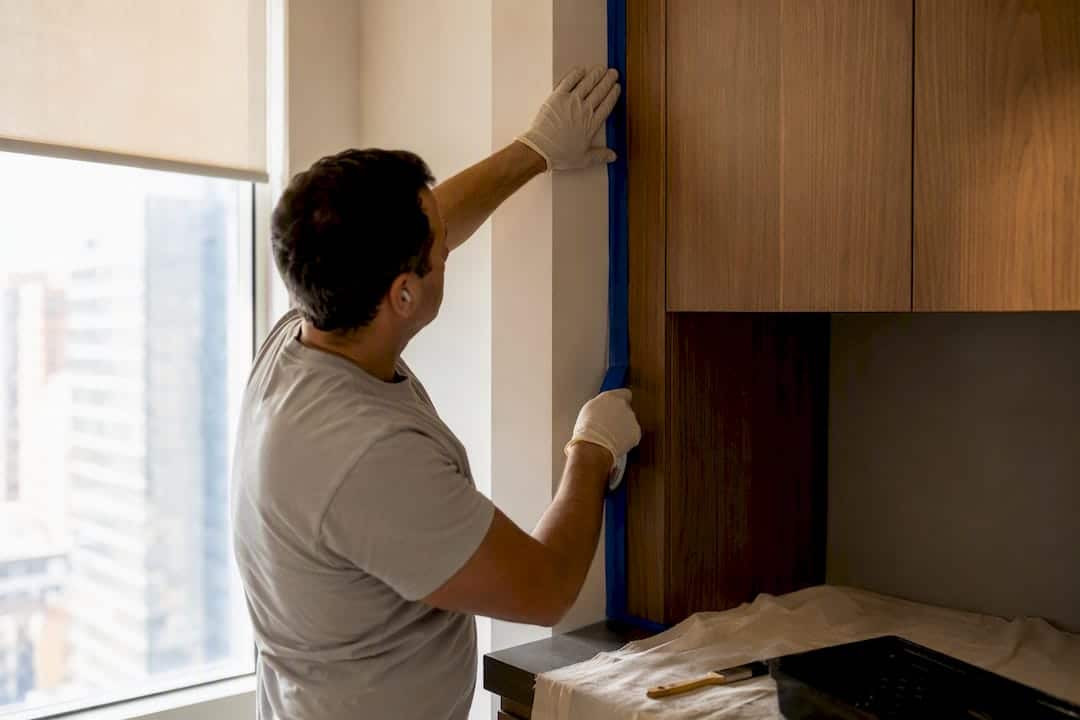
A gallon of quality interior paint in Toronto typically has a moderate cost range, and a typical room requires multiple gallons depending on size and coats. On a $600 room, materials might account for $100 to $150 of the total, with the remaining $450 to $500 covering the crew’s time: setup, masking, cutting in, rolling, cleanup, and touch-ups.
That’s why two quotes for the “same” room can differ by hundreds of dollars even when both painters use the same paint can. One crew might spend four hours on prep and cutting in clean lines; another might rush it in two. You’re not just buying paint. You’re buying the hours it takes to apply it properly, and that’s where quality shows up years later, not on move-out day.
Premium and deep-base colours incur additional per-gallon costs beyond standard paint, which should be confirmed before selection. On a whole-house project with multiple bold colours, that upcharge can add a few hundred dollars to the material side alone.
Does a painting warranty affect the price?
A written warranty signals that a contractor stands behind their prep work and often corresponds to a higher, but more reliable, quote. Painters offering a one to two year warranty against peeling, cracking, or premature fading are typically the ones who did the prep right the first time. That includes proper priming, adequate dry time between coats, and using a paint product rated for the surface and humidity level of the room.
Painters without warranties often compete mainly on price, which may result in reduced prep time or fewer coats than recommended. You might save $200 upfront and end up repainting a bathroom ceiling in eighteen months because the humidity wasn’t accounted for.
When you’re comparing quotes, ask exactly what the warranty covers and for how long. “Satisfaction guaranteed” isn’t a warranty. A written document naming specific failure types (peeling, blistering, colour change) and a coverage period is. That clarity is worth paying a bit more for, especially on rooms with higher moisture exposure like kitchens and bathrooms, where finish failure shows up fastest.
A hands-on take on Toronto’s 2026 painting prices
Most pricing guides treat painting like a commodity, square footage times a rate, done.
The conventional advice tells you to shop by price per square foot. The better advice is to shop by prep transparency. Two contractors quoting the same $4,500 job might be doing completely different amounts of work: one is patching every nail hole and priming bare drywall, the other is rolling two coats over whatever’s already on the wall. You won’t see that difference until eighteen months later when one paint job is still flawless and the other is peeling at the window trim.
If you take one thing from this guide, prioritize the estimator visit over the quote itself. A contractor who spends twenty minutes checking your walls, ceilings, and trim before naming a number is telling you something a phone quote never will: that they plan to do the job right the first time during freeze-thaw season.
— Felix
Get an accurate quote that accounts for prep, not just paint
Kettle Contracting is the straightforward alternative to a rushed, table-based painting quote in the GTA. Because we specialize in caulking and building envelope work, we catch the joint failures, moisture intrusion, and prep issues that cause paint jobs to fail early, before we ever recommend a colour or a coat count.

If your home has aging window caulking, visible drafts, or past water staining near trim, painting over those problems without sealing them first just buys you a shorter-lived finish. We walk the property, flag what needs attention, and explain why caulking is trade-specific work that protects the investment you’re about to make in fresh paint. If you’re planning an interior repaint this year, book an in-home assessment with us first and get a clear picture of what’s underneath the surface before the roller ever comes out.
Sources
- Painting services cost Toronto — HomeStars
- How much do painting services cost in Toronto and GTA (local breakdown) — UrbanTasker
- Interior painting cost Toronto: room-by-room and whole-home pricing — Home Painters Pro
FAQ
How much does it cost to paint the interior of a 2,000 square foot house?
Expect a total cost in the mid-thousands for a 2,000 square foot house, assuming two coats and standard prep. Extensive repairs or high ceilings will increase the cost.
How much does it cost to paint a 1,000 square foot house interior in Canada?
A typical home in the Toronto area can cost several thousand dollars before tax, depending on the number of rooms, trim detail, and how much prep the walls need.
How much would a painter charge to paint a 12×12 room?
A standard 12 by 12 foot bedroom typically costs several hundred dollars for two coats with standard prep, based on wall area measurements.
How much does it cost to paint a 1,500 square foot house interior yourself?
Painting a house yourself mainly involves material costs, while hiring professionals includes labour, prep, and warranty, resulting in higher overall expenses.
Does the interior painting quote include HST?
Not unless it says so explicitly. Ontario’s 13% HST applies on top of most contractor quotes, so a $6,000 job becomes $6,780 unless the paperwork states “tax included.”