
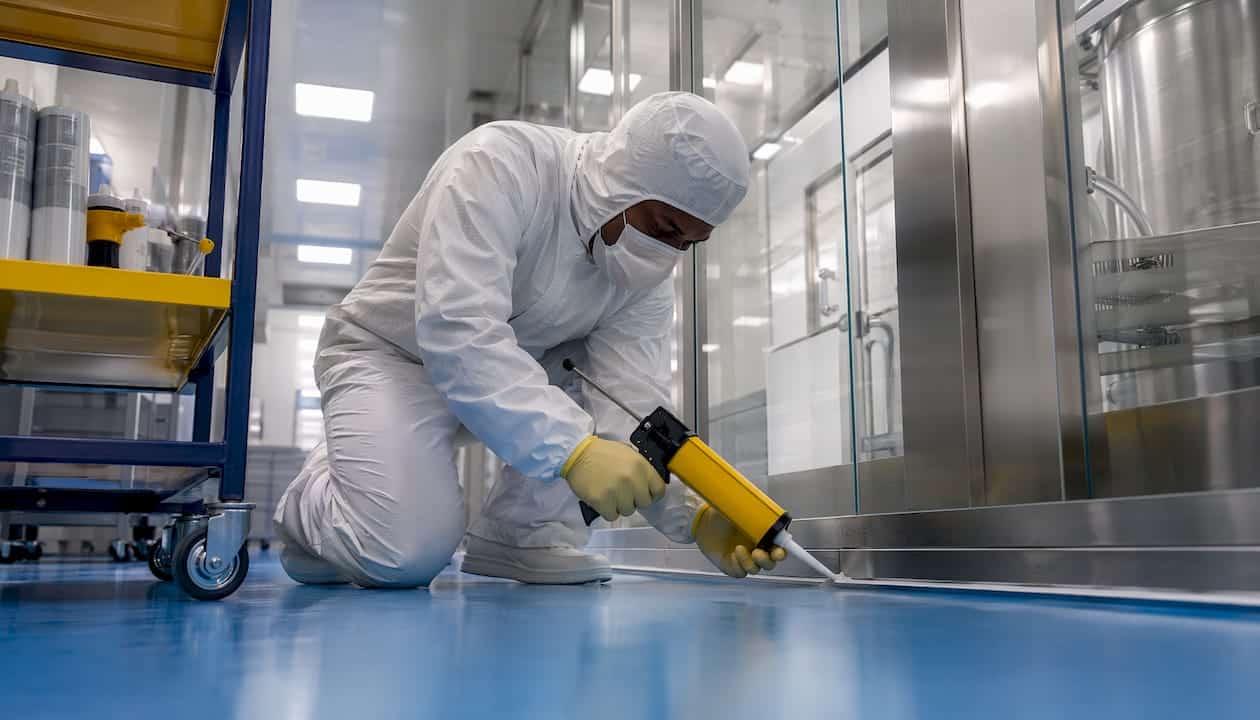
Caulking is the first line of defence against contamination in any cleanroom. It seals the joints, gaps, and penetrations that would otherwise let unfiltered air, particles, and moisture bypass your HVAC filtration entirely. Get it right and your facility holds its ISO 14644 classification. Get it wrong and you are looking at a failed certification test, a costly remediation, and potential product losses in the meantime.
Here is what caulking actually does in a controlled environment:
- Creates airtight seals at panel joints, floor-to-wall transitions, and ceiling penetrations to block particle and microbial ingress
- Maintains positive or negative pressure differentials required for cleanroom classification compliance under ISO 14644
- Prevents microbial, chemical, and particulate contamination pathways between zones
- Supports the structural adhesion of wall and ceiling panels, keeping the envelope intact
- Canadian standards including ISO 14644 and CSA Z317.13 govern both material selection and installation requirements for cleanroom sealants
Sealant choice and skilled application are not secondary concerns. They are what separates a cleanroom that holds its classification from one that fails on the first particle count.
How caulking controls contamination in cleanrooms
Contamination in a cleanroom rarely comes from a dramatic failure. It usually enters through a gap you did not notice or a joint that was never properly sealed. Caulking closes those pathways before they become problems.
A properly sealed joint blocks particle and microbial infiltration at the building envelope level. That matters because even a small unsealed gap can allow uncontrolled air intake that bypasses filtration entirely, undermining your cleanroom classification regardless of how well your HVAC performs.
Beyond blocking infiltration, caulking eliminates the ledges and crevices where contaminants settle and accumulate. Flat, flush-sealed joints give particles nowhere to collect. This is especially relevant at floor-to-wall transitions and around ceiling penetrations, where gaps are common and often overlooked.
- Seals panel-to-panel, panel-to-floor, and panel-to-ceiling joints continuously
- Eliminates crevices that trap particulates and harbour microbial growth
- Minimises cross-contamination pathways between cleanroom zones of different classifications
- Requires non-shedding, low-particulate materials to avoid introducing new contamination during or after application
- Supports panel adhesion to prevent envelope breaches that compromise room integrity
The material you choose matters as much as where you apply it. Silicone contamination spreads as nearly invisible films that interfere with adhesion, bonding, and soldering processes, making standard silicone sealants a serious risk in critical environments.
Why airtight sealing keeps your cleanroom environment stable
Pressure differentials are what separate a cleanroom from the rest of your facility. Typically, adjacent zones maintain a pressure differential designed to ensure clean environment integrity, as referenced in Health Canada’s Good Manufacturing Practices guidance for sterile drug manufacture. Any unsealed joint in the wall or ceiling envelope disrupts that differential and lets unfiltered air in.
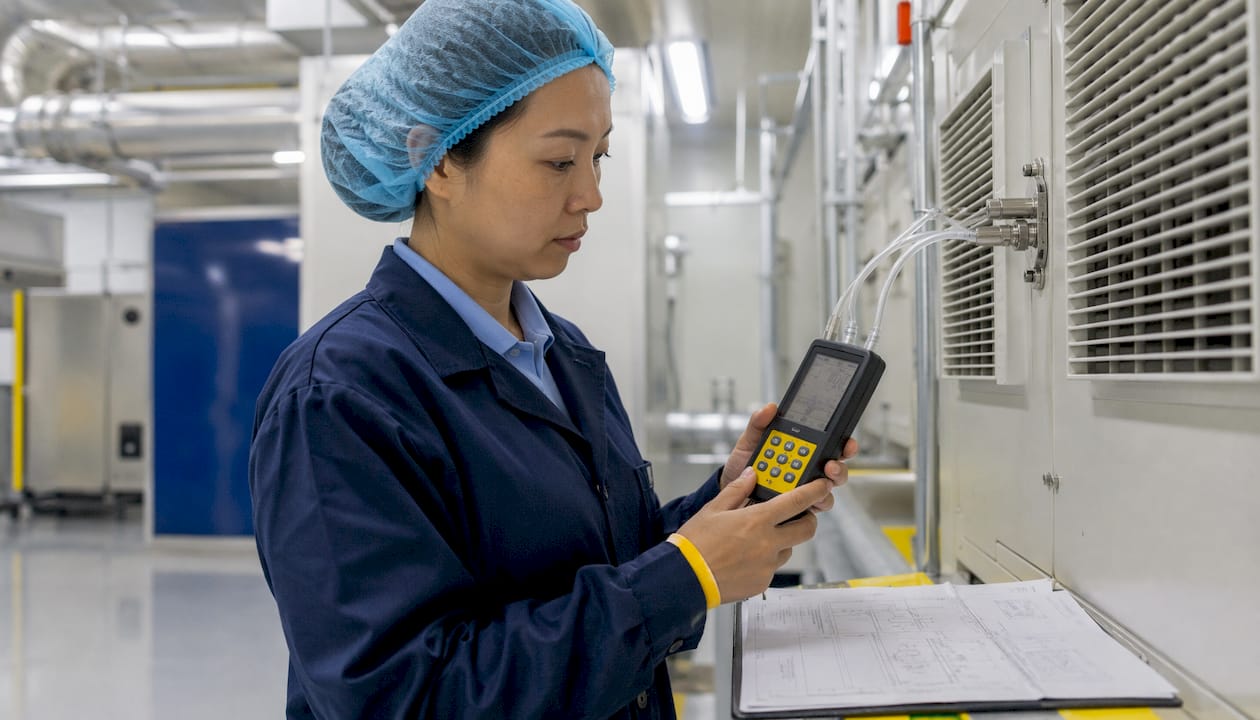
Caulking preserves that pressure balance by eliminating uncontrolled airflows through the building envelope. When the envelope is tight, your HVAC system works as designed. When it leaks, the system compensates by working harder, and your filtration efficiency drops.
Moisture control is the other side of this. An unsealed joint is also a moisture pathway. Moisture ingress promotes microbial growth, degrades panel adhesives, and can cause material swelling that opens further gaps over time. A continuous sealant bead at every joint keeps the moisture barrier intact and supports airtightness testing results that actually reflect your design intent.
Thermal stability follows from the same principle. Uncontrolled air leaks introduce temperature variation that your HVAC has to constantly correct. Tight caulking reduces that load and keeps conditions consistent across the room.
What makes cleanroom caulking last, and what causes it to fail
Durability in a cleanroom sealant is not just about how long it holds. It is about whether it holds without shedding particles, cracking under cleaning chemicals, or shrinking away from the substrate over time.
- Chemical resistance: Cleanrooms use aggressive disinfectants and cleaning agents regularly. Your sealant must resist these without softening, swelling, or breaking down at the surface.
- Flexibility: Building movement, thermal cycling, and vibration all stress sealant joints. A material that cannot flex will crack, and a cracked joint is an open contamination pathway.
- Resistance to shrinkage: Sealants that shrink after curing pull away from substrates and create gaps. This is a common failure mode that goes undetected until a particle count test fails.
- Scheduled inspections: Joint failures rarely announce themselves. Build a regular inspection cycle into your maintenance programme to catch early signs of separation, discolouration, or surface degradation.
- Periodic re-caulking: Even well-applied sealant has a service life. Plan for re-caulking as part of your facility maintenance schedule rather than waiting for a visible failure.
The preventive maintenance approach applies directly here. Catching a failing joint early costs far less than remediating a contamination event or re-certifying a room after a classification failure.
Which caulking materials work in cleanroom applications?
Not all sealants are appropriate for controlled environments. The table below compares the three main categories used in cleanroom construction and maintenance.
| Sealant type | Key properties | Best application | Limitations |
|---|---|---|---|
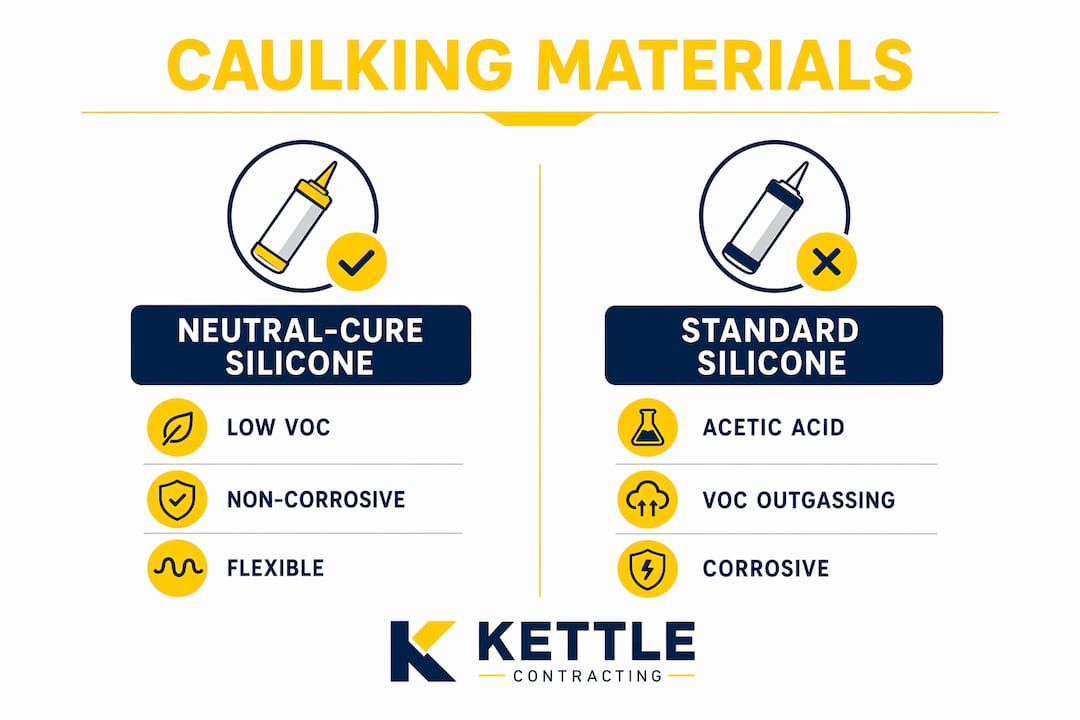
| Neutral-cure, low-VOC silicone (USP Class VI) | No acetic acid outgassing; flexible; ≤1 particle/cm² | Panel joints, ceiling penetrations, pharmaceutical facilities | Must be verified by Certificate of Analysis; not all silicones qualify |
| Polyurethane hybrid sealant | Low particle generation; strong chemical resistance; good adhesion to varied substrates | Multi-zone facilities with aggressive cleaning protocols | Less flexible than silicone at temperature extremes |
| Epoxy-based sealant | High abrasion resistance; excellent chemical resistance | Floor joints, high-traffic zones, areas with chemical exposure | Rigid; not suitable where building movement is expected |
| Standard silicone (acetic acid cure) | Widely available; low cost | Not suitable for cleanrooms | Releases acetic acid during cure, outgasses VOCs, and risks corrosion of sensitive electronics |
Standard silicone is the one sealant you should never use in a cleanroom. It releases acetic acid as it cures, which contaminates surfaces and can corrode electronics. Silicone contamination is also notoriously difficult to remove once present, clinging to surfaces in ways that resist standard cleaning and cause defects in semiconductor and aerospace manufacturing.
Neutral-cure silicone is not the same product. It is selected specifically to avoid outgassing, and its suitability must be confirmed through third-party particle generation testing, not marketing claims alone.
Best practices for applying caulking in cleanroom settings
Application quality determines whether even the right sealant performs as intended. Surface preparation is where most failures start.
Pro Tip: Always verify substrate compatibility before applying any sealant in a cleanroom. A sealant that bonds well to painted steel may fail on anodised aluminium. Test adhesion on a representative sample before committing to a full application.
- Surface preparation: Substrates must be clean, dry, and free of any contamination, including dust, oils, and residual cleaning agents. Follow the sealant manufacturer’s written preparation requirements exactly.
- Joint width: Limit sealant joint width to 3/4 inch (19.5 mm) in aseptic processing areas to reduce exposed sealant surface and improve long-term cleanliness.
- Profile design: Replace L-shaped corner profiles with monolithic coving wherever possible. Monolithic coving reduces perimeter leakage significantly, offering a measurable improvement in airtightness that L-profiles cannot match.
- Nozzle selection: Use a nozzle sized to match the joint profile. An undersized nozzle leaves voids; a nozzle cut at less than 90 degrees wastes material and reduces compaction into the joint depth.
- Curing time: Do not expose a freshly applied sealant to cleaning agents or foot traffic before it has fully cured. Premature exposure compromises adhesion and surface integrity.
- Smoke testing: After application and curing, use smoke testing to verify airtightness at all sealed joints before the room is commissioned or re-certified.
Proper air sealing methods follow the same logic whether you are working on a passive house or an ISO Class 6 pharmaceutical facility: the envelope has to be continuous, and every gap is a liability.
Canadian standards and expert guidance for cleanroom caulking projects
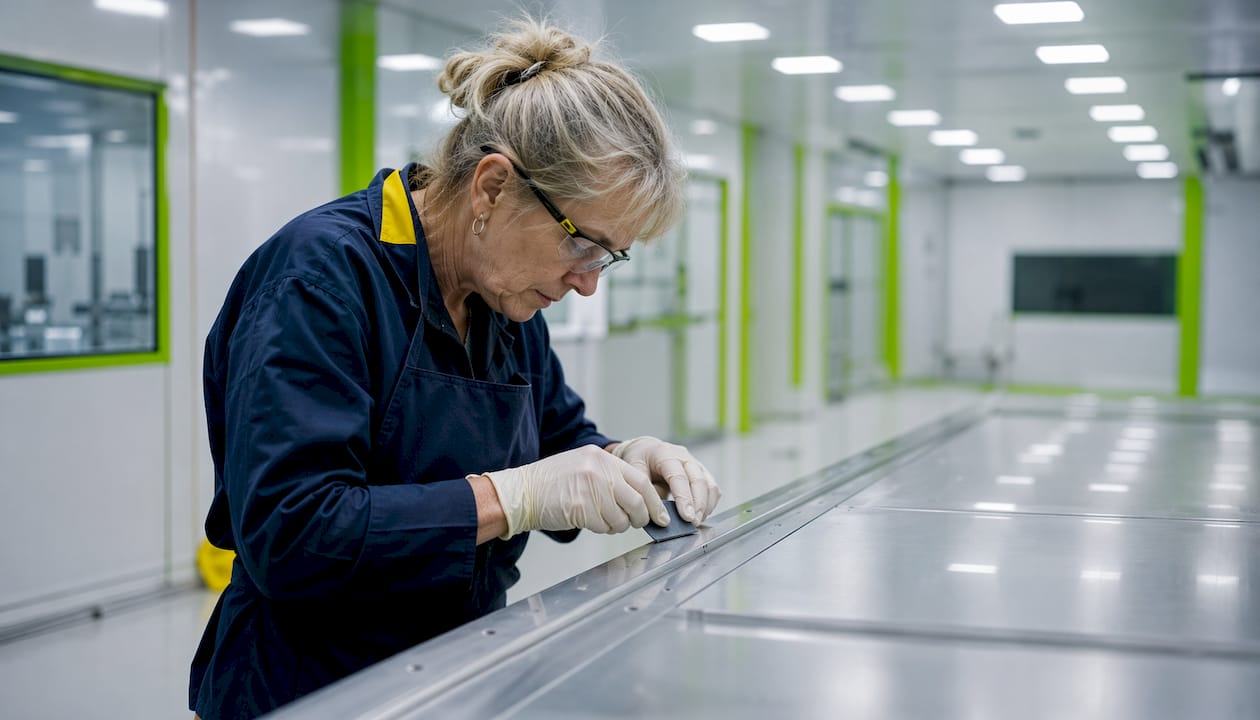
Canadian cleanroom construction operates under a clear regulatory framework. ISO 14644 sets the classification and testing requirements for particle counts, pressure differentials, and air change rates. CSA Z317.13 addresses infection control requirements in health care facilities, including material documentation and contamination prevention protocols. Together, these standards require that every material used in a cleanroom be documented for particle shedding potential and VOC outgassing.
Documentation is not optional. Here is what a well-run cleanroom caulking project requires:
- Certificates of Analysis (CoA): Every sealant batch should come with a CoA confirming particle generation results and material composition. Relying on typical published values rather than lot-specific data is not acceptable for critical applications.
- Third-party particle generation testing: Confirm that sealants meet the ≤1 particle/cm² threshold through independent testing, not manufacturer self-reporting alone.
- Sealant Execution Plan (SEP): A formal SEP documents joint design requirements, materials of construction, installer qualifications, inspection procedures, and acceptance criteria for each joint type. It also ensures conformance with manufacturer warranty requirements.
- Installer qualifications: Minimum qualifications for installers, supervisors, and quality assurance personnel must be defined in the SEP and verified before work begins.
- Inspection and acceptance criteria: Each joint type requires its own inspection protocol. Do not apply a single acceptance standard across all joint locations.
Cleanroom certification failure often originates from poor sealing of the envelope joints rather than HVAC failure. Getting caulking right at construction is far less costly than remediating after a failed classification test. In Canada’s climate, thermal cycling adds additional stress to sealant joints, making material flexibility and scheduled re-inspection even more critical than in more temperate markets.
Experienced practitioners confirm that successful cleanroom caulking depends on thorough surface preparation, substrate compatibility, and consistent professional application. Sealant selection is only one part of the equation.
If your facility is planning a cleanroom build or renovation, post-construction sanitisation is a necessary step after caulking is complete and before commissioning begins.
When your cleanroom project requires trade-specific expertise, Kettlecontracting delivers professional-grade sealing for commercial and sensitive facilities across the Greater Toronto Area. Our team understands the documentation, material selection, and application standards that cleanroom environments demand.

Contact Kettlecontracting to discuss your facility’s sealing requirements and get a clear, honest assessment of what your project needs.
Key takeaways
Caulking is the primary barrier that keeps cleanroom environments classified, contamination-free, and environmentally stable across every ISO classification level.
| Point | Details |
|---|---|
| Airtight sealing is classification-critical | Unsealed joints allow unfiltered air infiltration that destroys pressure differentials and causes ISO classification failures. |
| Material selection determines contamination risk | Only neutral-cure, low-VOC sealants meeting USP Class VI and ≤1 particle/cm² thresholds are appropriate; standard silicone is prohibited. |
| Monolithic coving outperforms L-profiles | Monolithic coving reduces perimeter leakage significantly compared to L-shaped corner profiles. |
| A Sealant Execution Plan is mandatory | An SEP documents joint design, installer qualifications, inspection criteria, and warranty requirements for every cleanroom caulking project. |
| Scheduled maintenance prevents costly failures | Regular inspection and periodic re-caulking catch joint degradation before it becomes a contamination event or certification failure. |
FAQ
Why is standard silicone not allowed in cleanrooms?
Standard silicone releases acetic acid during curing, which outgasses VOCs and can corrode sensitive electronics. Only neutral-cure, low-VOC silicone formulations verified by third-party particle generation testing are appropriate for cleanroom use.
What does caulking actually do in a clean room facility?
Caulking seals joints and gaps in the building envelope to prevent particle and microbial infiltration, maintain pressure differentials, and support HEPA filtration performance. Without continuous sealant coverage, unfiltered air bypasses filtration and compromises cleanroom classification.
What are the key rules governing cleanrooms in Canada?
ISO 14644 sets classification and testing requirements for particle counts and pressure differentials, while CSA Z317.13 covers infection control requirements in health care facilities. Both standards require documented material suitability, including particle shedding and VOC outgassing data.
What should you never do when caulking a cleanroom?
Never use standard acetic-cure silicone, apply sealant to unprepared or contaminated substrates, or skip the Sealant Execution Plan. Applying sealant without verifying substrate compatibility or allowing insufficient curing time before cleaning are equally common failures that compromise joint integrity.
How often should cleanroom caulking be inspected?
Inspection frequency depends on cleaning chemical aggressiveness, thermal cycling, and the room’s classification level, but a scheduled inspection programme is required rather than reactive maintenance. Any sign of cracking, separation, or discolouration warrants immediate assessment and re-caulking.