

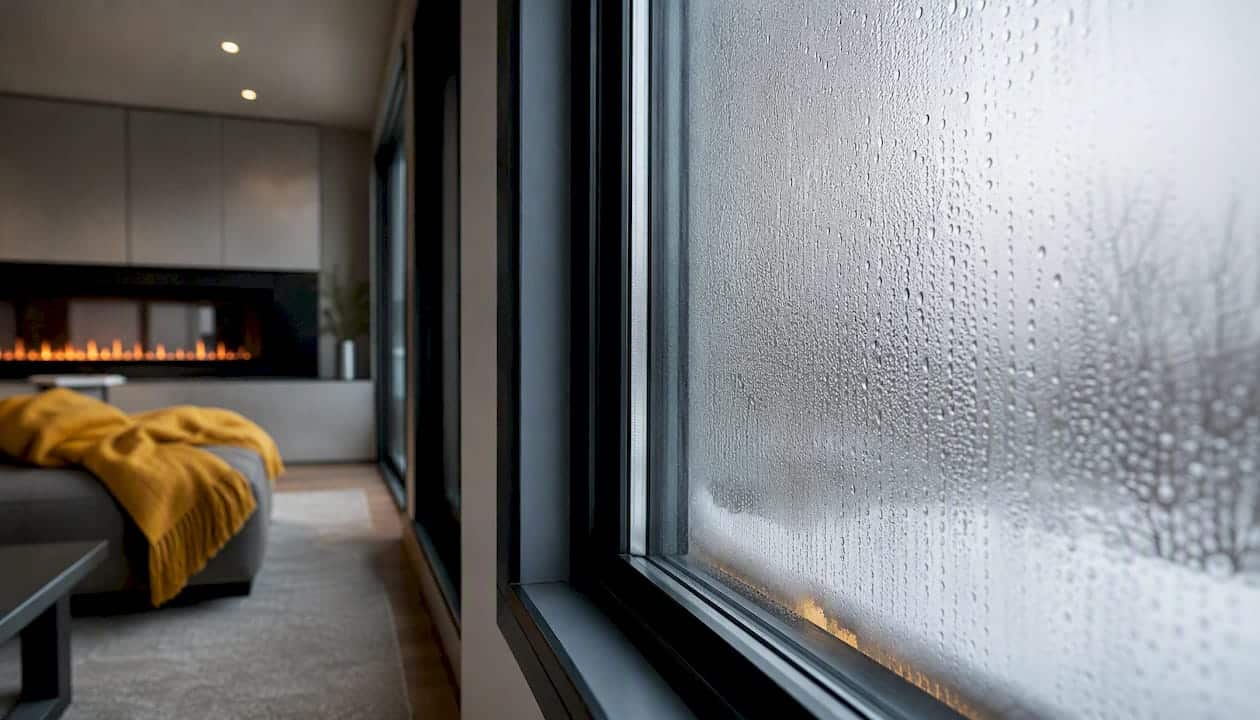
Window condensation forms when warm, moist indoor air contacts glass that is colder than the air’s dew point, forcing water vapour to turn into liquid on the surface. Where that moisture appears tells you almost everything: inside the glass points to a humidity problem you can fix yourself, outside is usually harmless, and between the panes means the sealed unit has failed and needs professional repair.
Start by picking up a basic hygrometer and checking your indoor relative humidity. Then look at where the moisture is forming:
- Inside surface: reduce indoor humidity through ventilation and dehumidification
- Outside surface: no action usually needed; monitor the frame and sill for wetting
- Between the panes: call a contractor to assess IGU replacement
Table of Contents
- What causes window condensation? The physics in plain terms
- Why condensation forms on the inside of your windows
- Why condensation on the outside of windows can be a good sign
- What condensation between the panes actually means
- How to reduce or prevent inside window condensation
- How to manage persistent exterior condensation issues
- How professionals fix condensation between panes
- When to hire a contractor for window condensation problems
- Key takeaways
- The fix most homeowners miss
- What Kettlecontracting can do for your windows
- Useful sources and further reading
- FAQ
What causes window condensation? The physics in plain terms
Glass is the coldest surface in most rooms during winter, which makes it the first place water vapour condenses. The concept behind this is the dew point: the temperature at which air can no longer hold all its water vapour and begins releasing it as liquid.
When you run a hot shower, cook on the stove, or even breathe, you add water vapour to the air. That raises the air’s dew point. If your window glass sits below that dew point temperature, condensation forms on it. Single-pane glass chills quickly because there is no insulating barrier between the cold outside and the warm inside. Double or triple-pane windows keep the interior glass warmer, which is why upgrading glazing reduces interior condensation — though it can shift the problem to the exterior surface, as you will see below.
Why condensation forms on the inside of your windows
Interior surface condensation is almost always a humidity problem, not a window defect. CMHC building science guidance identifies the most common indoor moisture sources:
- Showers and baths
- Cooking and running the dishwasher
- Drying clothes indoors
- Humidifiers set too high
- Houseplants and aquariums
- People and pets simply breathing and perspiring
Modern airtight homes make this worse. Natural Resources Canada notes that upgrades reducing air leakage trap moisture indoors, making consistent mechanical ventilation critical. A well-sealed 1990s renovation can produce more window condensation than a drafty 1960s house, simply because the moisture has nowhere to go. Learning how insulation controls moisture in your home helps you understand why tighter envelopes demand better ventilation strategies.
Seasonal risk is highest in winter. Cold outdoor air holds very little moisture, so when it infiltrates and warms up indoors, it picks up vapour from all those household sources. CMHC recommends keeping indoor relative humidity below 45% during the heating season, and around 30% or lower in very cold weather, to prevent condensation from forming on glass and framing.
Pro Tip: Avoid drying clothes on racks near windows. Run your bathroom and kitchen exhaust fans during and for at least 15 minutes after showers and cooking — that single habit removes a large share of the daily moisture load.
Why condensation on the outside of windows can be a good sign
Exterior condensation surprises a lot of homeowners, but Natural Resources Canada confirms it is common on highly energy-efficient windows. Low-E coatings and well-insulated frames keep the outer pane so thermally isolated from indoor heat that it cools rapidly on clear, calm nights through radiative heat loss. When outdoor air is humid and the glass surface drops below the outdoor dew point, dew forms on the outside.
That is actually a sign your windows are performing well. It clears on its own once the sun warms the glass.
The cases that do warrant attention:
- Persistent pooling of water on the exterior sill or frame
- Paint peeling or staining at the bottom of the frame
- Soft or spongy wood at the sill, suggesting rot has started
- Moisture tracking into the wall cavity around the frame
If dew repeatedly wets the frame and sill, intact caulking and correct sill slope are your first line of defence. Check that the sill drains outward and that the sealant around the frame has no cracks or gaps. Knowing how to spot failed window caulking early prevents a minor maintenance issue from becoming a rot repair.
What condensation between the panes actually means
Fogging inside an insulated glass unit (IGU) is a different problem entirely, and wiping the glass will not help. The moisture is sealed inside the unit.
Diagnostic signs of IGU failure:
- Milky or hazy fog that appears between the two panes
- Fogging that is present regardless of indoor humidity or outdoor temperature
- Streaks, runs, or a film on the inner surfaces of the glass
- White or grey mineral deposits that do not clear
The cause is thermal pumping. Daily solar heating causes the gas inside the IGU to expand, then contract at night; over years, this repeated cycling stresses the edge seals until they fracture. Once the hermetic seal fails, the argon or krypton insulating gas escapes and humid ambient air enters the cavity. Mineral deposits then form on the inner glass surfaces and the unit’s insulating value drops permanently. Older units and south- or west-facing windows that receive the most sun tend to fail first, often showing fogging near the edges before it spreads to the centre.
Repair options:
- IGU replacement: the sealed glass unit is swapped out while the frame stays. Lower cost and disruption than full replacement; restores thermal performance fully when the frame is sound.
- Full window replacement: frame and IGU both go. Necessary when the frame is rotted, corroded, or no longer holds a seal.
- Commercial defogging: a temporary service that drills small holes, injects a cleaning agent, and installs vents. It can clear the visual fogging but does not restore the lost insulating gas or thermal performance.
For most homeowners with a sound frame, IGU replacement is the practical first choice. Check the frame and glazing rebates for corrosion or rot before committing, because a compromised frame negates a new unit. You can also review 5 signs your windows need replacing to decide whether the frame is worth keeping.
How to reduce or prevent inside window condensation
The most effective approach combines measurement, daily habits, and equipment where needed.
Recommended indoor relative humidity by outdoor temperature
| Outdoor temperature | Maximum indoor RH |
|---|---|
| Above freezing | Up to 45% |
| 0°C to –10°C | Up to 45% |
| –10°C to –20°C | Around 30% or lower |
| Below minus 20 degrees Celsius | Around 30% or lower |

Guidance based on CMHC moisture recommendations.
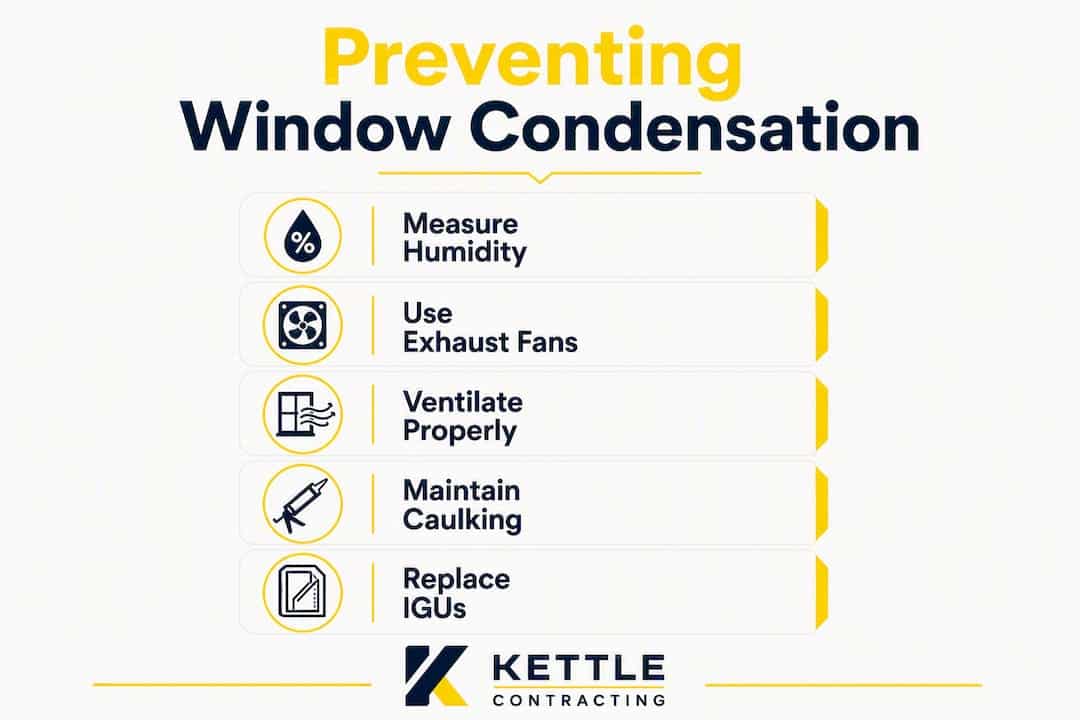
Start here — immediate steps:
- Buy a hygrometer and check your RH daily; compare against the table above
- Run bathroom and kitchen exhaust fans during and after use
- Open a window briefly on a dry, cold day to flush humid air out
- Wipe sills dry and keep curtains open to allow air circulation near the glass
Medium-term upgrades:
- A portable room dehumidifier for high-humidity spaces (basements, laundry rooms)
- A whole-house dehumidifier integrated with your HVAC if RH is consistently high
- Upgraded bathroom and kitchen fans with higher CFM ratings and humidity sensors
- A heat recovery ventilator (HRV) or energy recovery ventilator (ERV) for whole-house fresh air without losing heat
Daily habits to stop:
- Drying clothes on indoor racks, especially near windows
- Running a humidifier beyond the RH targets above
- Leaving pot lids off while cooking
Ventilating your home properly is the single most effective lever for reducing interior condensation in a modern airtight home. If you are also dealing with drafts, fixing drafty windows can help reduce cold spots that make condensation worse.
How to manage persistent exterior condensation issues
Exterior condensation rarely needs active intervention, but the frame and sill around it do need periodic maintenance.
- Check exterior caulking annually for cracks, gaps, or shrinkage, particularly at the corners and where the frame meets the wall
- Confirm the sill has a positive outward slope so water drains away from the wall
- Keep vegetation trimmed back from window frames to allow drying after dew
- Inspect paint and sealant on wooden sills; bare or cracked surfaces absorb repeated wetting and rot faster
- Clear debris from sill drainage channels and weep holes on vinyl or aluminum frames
Weatherproofing your windows with quality caulk is straightforward maintenance that prevents the minor annoyance of exterior dew from becoming a frame repair. If you notice paint failure or soft wood, address it before the next freeze-thaw cycle works moisture deeper into the assembly.
How professionals fix condensation between panes
When an IGU has failed, the repair decision comes down to the frame condition and your budget.
IGU replacement only:
- Pros: lower cost, less disruption, restores full thermal performance, preserves a sound frame
- Cons: requires a contractor to source a matching unit; not viable if the frame is damaged
- Ask: what warranty covers the new sealed unit, and does the contractor check the glazing rebates before ordering?
Full window replacement:
- Pros: addresses frame rot, outdated profiles, or poor original installation all at once
- Cons: higher cost and more disruption; painting or interior trim work may follow
- Ask: will the new window match existing trim profiles, and what is the installation warranty?
Commercial defogging:
- Pros: lowest upfront cost, can improve appearance quickly
- Cons: does not restore argon fill or thermal performance; fogging may return
- Ask: is this a permanent fix or a temporary measure, and what happens if fogging returns?
Before hiring anyone, ask to see before-and-after photos of similar jobs, request a written quote with a clear scope of work, and confirm the warranty covers both materials and labour. Assessing window sealing in aging buildings involves checking more than just the glass, so a thorough contractor will look at the full frame assembly.
When to hire a contractor for window condensation problems
Some condensation issues are DIY territory. Others need a professional on-site.
Call a contractor when you see:
- Persistent pooling on interior or exterior sills that does not dry between weather events
- Paint failure, staining, or soft wood at the window frame or surrounding wall
- Fogging between the panes that has been present for more than a few weeks
- Failed or missing weatherstripping that lets cold air through the sash
- Visible gaps in exterior caulking or cracked sealant at the frame-to-wall junction
- Drafts near the window frame even when the sash is fully closed
Questions to ask before hiring:
- Do you replace IGUs only, or do you also handle full window replacement?
- Can you inspect the frame condition before recommending a repair scope?
- What warranty do you provide on labour and materials?
- Can you show references or photos from similar jobs in the area?
- Do you test for airtightness or check for related moisture issues in the wall assembly?
Kettlecontracting handles window inspections, professional caulking, sill repairs, and IGU replacement coordination for residential and commercial properties across the Greater Toronto Area. Get a written quote that specifies the scope, materials, and warranty before any work begins. Understanding why caulking is trade-specific work helps you ask the right questions and avoid repairs that fail by the next winter.
Key takeaways
Window condensation location is the fastest diagnostic: interior means humidity, exterior means good insulation, and between the panes means the sealed unit has failed and needs professional repair.
| Point | Details |
|---|---|
| Measure humidity first | Use a hygrometer; target indoor relative humidity below 45% during the heating season, and around 30% or lower in very cold weather. |
| Ventilation is the primary fix | Run exhaust fans, stop drying clothes indoors, and consider an HRV for persistent interior condensation. |
| Between-pane fogging needs a pro | IGU seal failure cannot be fixed by wiping; replacement restores thermal performance when the frame is sound. |
| Exterior condensation is usually fine | Dew on the outside surface signals good window insulation; only act if the frame or sill shows wetting damage. |
| Kettlecontracting can inspect and repair | Kettlecontracting provides caulking, sill repair, and IGU replacement coordination across the Greater Toronto Area. |
The fix most homeowners miss
Most people who call about window condensation have already tried wiping the glass and turning up the heat. Neither works for long, and here is why: the glass temperature is a symptom, not the cause. The real problem is almost always the amount of water vapour your home is producing and trapping.
Ontario’s push toward tighter, better-insulated homes is genuinely good for energy bills. But a house that barely breathes accumulates moisture from cooking, showers, and even sleeping. Without mechanical ventilation, that moisture has to go somewhere, and it goes to the coldest surface in the room. The window is just the messenger.
The other mistake I see regularly is homeowners spending money on new windows when the actual problem is a bathroom fan that vents into the attic instead of outside, or a dryer that exhausts indoors. Fix the moisture source first. If condensation persists after you have the humidity under control, then look at the glass and the seals.
And when caulking or IGU work is needed, do it properly. Ontario’s freeze-thaw cycles are hard on sealants; a bead applied in the wrong conditions or with the wrong product will fail within a season. That is not a money-saver — it is a repeat call.
What Kettlecontracting can do for your windows
Persistent condensation that has led to frame wetting, failed caulking, or fogged IGUs is worth a professional look before it becomes a rot repair or a mould problem.

Kettlecontracting offers on-site window inspections across the Greater Toronto Area, covering caulking condition, sill integrity, IGU failure assessment, and airtightness observations. You get photographic documentation of what was found, a written quote with a clear scope, and workmanship backed by a warranty. There are no vague estimates and no pressure to replace what can be repaired. If the frame is sound and only the sealed unit has failed, that is what gets replaced. If the caulking is the issue, preventing water damage with proper window caulking is a straightforward fix that protects the frame through every season. Book an inspection and get a written quote before the next heating season starts.
Useful sources and further reading
- Natural Resources Canada: condensation and energy-efficient windows
- CMHC: moisture and air quality in housing (PDF)
- National Research Council of Canada: condensation between panes of double windows
- NRC Canadian Building Digest CBD-5: condensation between panes
- NACHI: condensation on double-paned windows
- Green Building Canada: condensation in winter
FAQ
How do you stop condensation on windows?
Run exhaust fans during and after showers and cooking, keep indoor relative humidity below 45% during the heating season, and around 30% or lower in very cold weather, and consider a dehumidifier or HRV for persistent problems. Between-pane condensation requires IGU replacement, not humidity control.
Does condensation mean my house is too cold?
Not necessarily. Interior condensation means the glass surface is colder than the indoor air’s dew point, which is more often a sign of excess indoor humidity than insufficient heat. Raising the thermostat slightly can help, but reducing moisture sources is the more effective fix.
Should I wipe condensation off my windows?
Wiping interior surface condensation is fine as a short-term measure to protect sills and frames, but it does not address the underlying humidity. Condensation between the panes cannot be wiped away at all — that moisture is inside the sealed unit and requires professional repair.
Why are my windows covered in condensation every morning?
Overnight, indoor humidity rises as ventilation slows and household activities like breathing add moisture to the air. The glass cools to its lowest temperature by early morning, which is when it is most likely to drop below the dew point. CMHC guidance recommends keeping indoor relative humidity below 45% during the heating season, and around 30% or lower in very cold weather to prevent this pattern.