

Concrete cladding needs caulking because the joints between panels are never static. Temperature swings, wind load, and seasonal moisture cause panels to expand and contract constantly, and without a flexible sealant bridging those gaps, water gets in. Once water is inside the wall assembly, the damage compounds quickly: corroded steel anchors, spalled concrete, mould growth, and repair bills that dwarf what a proper caulking programme would have cost.
Here is what that means for your building in practical terms:
- Water barrier: Caulk seals panel joints and penetrations against rain and meltwater, which is the primary threat to any concrete cladding assembly.
- Movement accommodation: Concrete panels open in winter and close in summer. A properly selected elastomeric sealant stretches and compresses with that movement without cracking or debonding.
- Corrosion prevention: Water reaching the embedded steel anchors and connection hardware causes rust, which expands and fractures the surrounding concrete, eventually threatening panel restraint.
- Mould control: Moisture trapped inside wall cavities creates ideal conditions for mould, which affects indoor air quality and triggers costly remediation.
- Energy efficiency: Gaps in the building envelope allow conditioned air to escape and outside air to infiltrate, raising heating and cooling costs year-round.
- Code compliance: Ontario Building Code section 9.7.6.2 mandates non-hardening exterior sealants that are resistant to weathering and compatible with the substrates they contact.
Why concrete cladding needs caulking at every joint
Joints in exterior cladding experience the most extreme cyclical movement of any part of a building, and they are also the most critical from a sealing standpoint. The National Research Council of Canada is clear on this: the primary principle governing sealant selection is that joint width must never fall below the minimum required for the sealant being used. A joint that is too narrow forces the sealant to strain beyond its movement capability on every thermal cycle, and failure follows predictably.
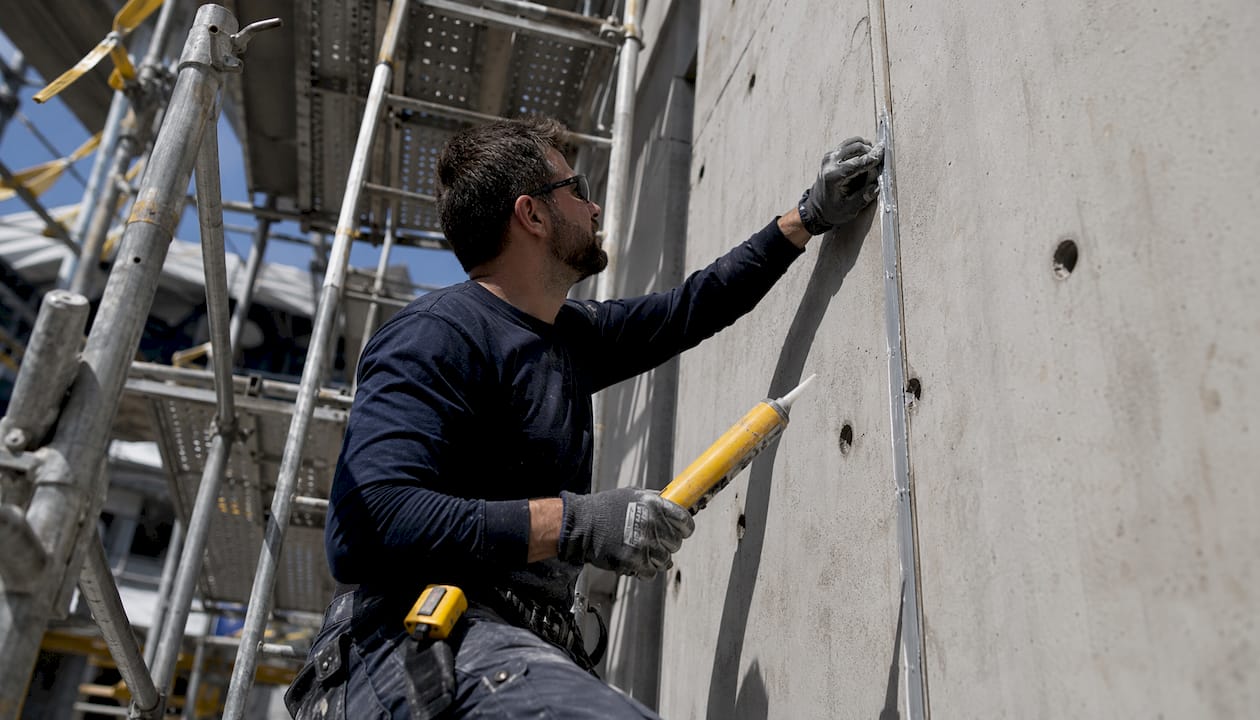
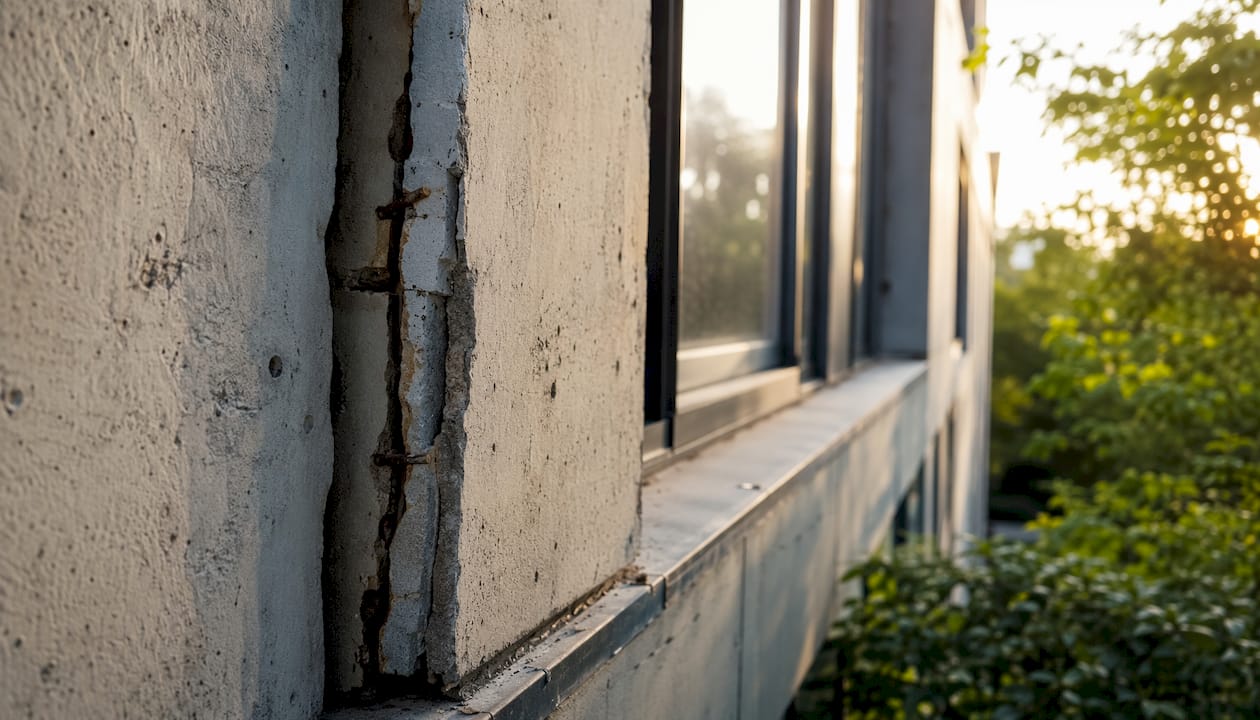
Concrete panels also carry a structural risk that is easy to overlook. When sealants are never replaced, water enters the facade and corrodes the ferrules, dowel bars, and connection hardware holding the panels to the building frame. That corrosion leads to panel restraint failure and spalling, conditions that require expensive emergency repairs and can pose a safety risk to occupants and passersby.
Common mistakes in concrete cladding caulking application
Most caulking failures on concrete cladding trace back to one of a handful of errors made during installation or repair. Recognising them is the first step to avoiding them.
- Skipping substrate cleaning: Dust, oil, old sealant residue, and surface contaminants prevent proper adhesion. A mechanical grinder or wire brush is typically needed to clean concrete substrates; metal surfaces often require a solvent wipe as well.
- Caulking over old sealant: Applying new sealant over old without full removal prevents the joint from achieving the correct depth and hourglass shape. The new material bonds to the old, restricting movement and causing adhesive or cohesive failure.
- Ignoring temperature and weather: Sealants applied in cold or wet conditions cure poorly and bond weakly. Most manufacturers specify an application window of roughly 5°C–40°C with no rain forecast for at least 24 hours.
- Wrong joint geometry: A sealant joint should be twice as wide as it is deep, with adhesion on two sides only. Joints that are too narrow or too deep cannot flex properly.
- Using the wrong product: Not every sealant is rated for exterior concrete exposure or freeze-thaw cycling. Acrylic latex products, for example, are not suitable for high-movement facade joints.
- Misreading the primary seal: Many owners mistake the outer weather seal for the main water barrier. When the primary seal at the face of the concrete panel is missing or failed, water bypasses the secondary seal and enters the building undetected.
Pro Tip: Surface preparation takes longer than the actual sealant application, and that is exactly how it should be. Rushing prep is the single most common reason a caulking job fails within two or three years instead of lasting a decade.
How to choose the right sealant for concrete cladding joints
Sealant selection is an engineering decision, not a shopping trip. The wrong product will fail regardless of how well it is installed.
- Elastomeric sealants are the baseline requirement for exterior concrete joints. They stretch and recover without cracking, which is non-negotiable given the thermal movement concrete panels undergo across a Canadian year.
- Silicone sealants offer a service life of approximately 15–20 years and perform well in UV-exposed locations. Warranties for silicone can extend up to 20 years when installed by a pre-qualified contractor.
- Polyurethane sealants carry a typical service life of 7–10 years and are paintable, which matters on buildings where aesthetics are a priority. Warranties for polyurethane can reach up to 10 years.
- Acrylic latex caulk is a low-movement product suited for interior or sheltered applications. It is not appropriate for exposed concrete cladding joints subject to freeze-thaw cycling.
- Freeze-thaw compatibility is a firm requirement in Ontario. A sealant that becomes brittle at low temperatures will crack during the first hard winter and allow water in at exactly the moment freeze-thaw pressure is highest.
- Joint width and movement capability must match. Wider joints allow better cyclic durability, but practical limits on sag and cost apply. Your sealant specification should be based on a calculated estimate of expected thermal movement, not a guess.
- Sealant compatibility matters. Some products react with certain substrates or with each other, producing discolouration or bond failure. Always verify compatibility before switching sealant types on an existing building.
Proper techniques for applying caulking on concrete cladding
Getting the application right is what separates a seal that lasts from one that fails in two seasons.
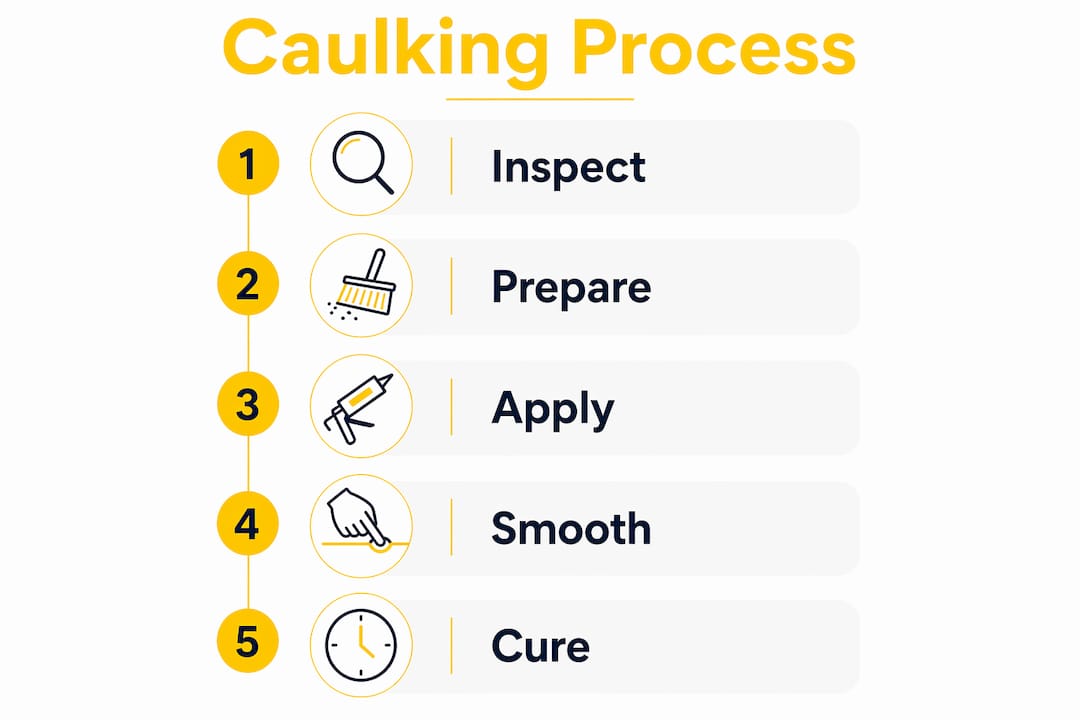
- Full removal of existing sealant is the starting point. Leaving old material in the joint prevents proper bonding and correct joint geometry. Use a grinder, oscillating tool, or utility knife to remove all traces.
- Clean the substrate thoroughly. After mechanical removal, wipe the joint faces with an appropriate solvent to remove residue. Any contamination left behind will compromise adhesion.
- Install a backer rod. A closed-cell polyethylene backer rod placed at the correct depth controls the sealant profile and prevents three-sided adhesion, which would restrict movement and cause tearing.
- Apply sealant in an hourglass shape. This profile allows the sealant to compress and extend freely. It is only achievable with a properly sized backer rod and a clean joint.
- Check ambient conditions before you start. Temperature, humidity, and the forecast for the next 24 hours all affect cure quality. Cold or damp conditions are the most common cause of adhesion problems on site.
- Tool the sealant immediately after application to press it firmly against both joint faces and achieve the correct concave profile.
Pro Tip: Test areas should be installed and adhesion-tested by the sealant manufacturer before full-scale work begins on a large facade. This step is often skipped to save time, but it catches compatibility problems before they become building-wide failures.
How to maintain and inspect caulking on concrete cladding
Maintenance is where most property owners fall short. Waiting until you see a leak inside the building means the sealant has already failed and water has already been working its way through the assembly.
- Annual visual inspections are the minimum standard. Walk the perimeter and look at every joint, window surround, and penetration. Ground-level checks catch obvious failures; a swing stage or lift is needed for a thorough close-up assessment on taller buildings.
- Signs of adhesive failure: the sealant has pulled away from one or both joint faces, leaving a gap along the edge.
- Signs of cohesive failure: the sealant body has cracked or torn through the middle, typically from movement exceeding the product’s capability.
- Hardening and loss of flexibility indicate the sealant has aged past its useful life, even if it looks intact. Press it gently; if it does not spring back, replacement is overdue.
- Schedule detailed inspections at 75% of service life. For polyurethane, that means a close inspection around the 5–7 year mark. For silicone, around 11–15 years. The Canadian Precast/Prestressed Concrete Institute recommends proactive scheduling rather than waiting for visible damage.
- Keep records. Log the sealant type, installation date, and service life for every area of the building. Without records, you are guessing when replacement is due.
- Act on findings promptly. Delaying repairs after visible deterioration is detected allows water to reach structural components, where repair costs far exceed the cost of timely sealant replacement.
What Canadian building codes say about caulking on concrete facades
Ontario’s building code treats exterior sealants as a required component of the building envelope, not an optional finish detail. Section 9.7.6.2 specifies that non-hardening sealants used on exterior assemblies must be weathering-resistant and compatible with the substrates they contact. That is the floor, not the ceiling.
The structural consequences of neglect are well-documented. Precast concrete facades where sealants were never replaced have experienced corrosion of ungalvanised connection hardware, leading to local panel failures requiring emergency shoring and expensive remediation. Repair costs in those cases far exceeded what a scheduled sealant replacement programme would have cost over the same period.
Freeze-thaw cycling compounds the risk. In Ontario, a building envelope can experience dozens of freeze-thaw cycles in a single winter. Each cycle stresses the sealant joint, and a product that is not rated for that exposure will degrade faster than its nominal service life suggests. Matching sealant movement capability to the actual thermal range the cladding experiences is the core of any sound specification.
A rainscreen or drained joint design adds a second layer of protection by directing any water that bypasses the primary seal back to the exterior. The National Building Code of Canada references this approach under Division B, Article 5.6.1.2 for protection from precipitation. Caulking remains the primary line of defence, but integrating it within a complete water management system is the standard for high-performance buildings.
If you manage a concrete-clad building in the Greater Toronto Area and you are not sure when the sealants were last replaced or whether they are still performing, Kettlecontracting can assess the facade and give you a straight answer. We specialise in trade-specific caulking work for residential and commercial properties across the GTA, with the experience to match the right product to your building’s actual movement conditions.

Key takeaways
Concrete cladding joints require flexible, elastomeric sealants installed and maintained correctly to prevent water ingress, structural corrosion, and energy loss across Ontario’s full range of seasonal conditions.
| Point | Details |
|---|---|
| Sealant type determines lifespan | Silicone lasts approximately 15–20 years; polyurethane lasts approximately 7–10 years on exterior concrete joints. |
| Full removal is non-negotiable | Applying new sealant over old prevents correct joint geometry and causes early adhesive or cohesive failure. |
| Inspect at 75% of service life | Schedule close-up facade assessments before sealant reaches end of life to avoid water damage to structural components. |
| Joint width must match movement | Joints that are too narrow force the sealant beyond its movement capability, causing predictable failure regardless of product quality. |
| Codes set the minimum standard | Ontario Building Code requires weathering-resistant, substrate-compatible sealants on all exterior assemblies. |
FAQ
Should you caulk concrete cladding joints?
Yes. Concrete panel joints require a flexible sealant to prevent water infiltration and accommodate thermal movement. Without caulking, water reaches the structural connections and causes corrosion and spalling.
What happens if you don’t seal exterior concrete cladding?
Water enters the wall assembly through open joints, corrodes the embedded steel anchors, and causes concrete spalling and panel restraint failure. Repair costs in those situations far exceed the cost of routine sealant maintenance.
Does a concrete slab need caulking where it meets brick or cladding?
Yes. The interface between a concrete slab and adjacent cladding or masonry is a movement joint that requires a flexible sealant. A rigid filler will crack as the materials move independently under thermal and structural loads.
How often should caulking on concrete cladding be inspected?
Annual visual inspections are the recommended minimum. A detailed close-up assessment should be scheduled once the sealant reaches approximately 75% of its rated service life, which is around 5–7 years for polyurethane and 11–15 years for silicone.
Can you caulk concrete siding yourself?
Surface-level touch-ups on minor gaps are possible for a careful property owner, but full joint replacement on a concrete facade requires proper substrate preparation, backer rod installation, and product selection matched to the building’s movement conditions. Improper application typically fails within a few years and can mask underlying water damage.