
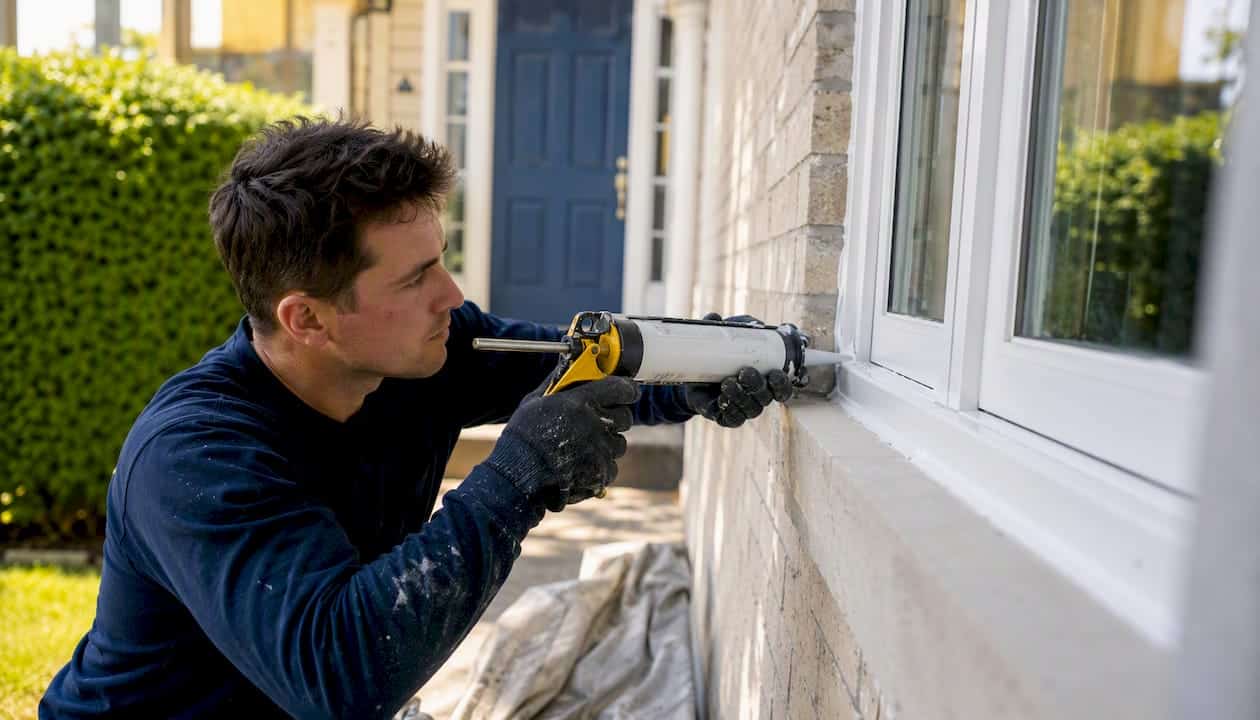
Most Canadian homeowners pay within a moderate range per installed window for a mid-range vinyl or fibreglass unit, according to Homeowner. Budget vinyl retrofits generally start at lower price points per opening installed, while premium triple-pane or custom units typically cost more each. For a typical 10–15 window home, full-house replacement projects range from roughly $12,000 to $36,000 depending on province, window type, and installation method.
Before you order a single window, check two things:
- Supply-only vs. installed price: A window quoted at $350 from a retailer is not a $350 installed window. Labour, rough-opening repairs, flashing, and disposal commonly add $200–$600 per opening on top of the unit cost.
- Retrofit vs. full-frame: Retrofit inserts drop into the existing frame and cost less. Full-frame replacement removes the entire assembly down to the rough opening and typically adds 15–20% to the total, but it is the right call when frames are rotted, out of square, or when you are upgrading to a larger size.
- Labour share: Labour usually accounts for roughly 10–20% of a total installed invoice on a standard retrofit job, though that share rises sharply when structural repairs or custom sizing are involved.
Check ENERGY STAR certification and your provincial rebate pre-approval before you buy or book installation. Most rebate programmes require a pre-renovation energy assessment and a registered contractor. Ordering first is the single most common way homeowners lose eligibility.
Key takeaways
Most Canadian homeowners pay $600–$1,200 per installed window, with full-house projects ranging from $12,000 to $36,000 depending on province, installation method, and glazing spec.
| Point | Details |
|---|---|
| Per-window installed cost | Budget $600–$1,200 for a mid-range unit; premium windows reach $1,500–$2,000 each. |
| Full-house project range | A 10–15 window home typically costs $12,000–$36,000 installed, varying by province and spec. |
| Retrofit vs. full-frame | Full-frame replacement adds roughly 15–20% over retrofit; choose based on frame condition, not cost alone. |
| Rebate pre-approval first | Most provincial programmes require a pre-renovation assessment before purchase; skipping this step loses the rebate. |
| Kettlecontracting sealing | Kettlecontracting provides post-installation caulking and air barrier work across the Greater Toronto Area, backed by a written warranty. |
This article is general information, not a substitute for advice from a qualified financial advisor. Consult a qualified financial professional about your own circumstances before acting on anything here.
Table of Contents
- What does window installation cost in Canada by type and material?
- How do prices vary across Canadian provinces and cities?
- What factors change a window installation quote the most?
- What rebates and incentives are available in 2026?
- What do typical window replacement projects actually cost?
- What does labour cost and how long does installation take?
- How do glazing specs and installation quality affect long-term costs?
- When do window projects get significantly more expensive?
- How do you collect and compare window installation quotes?
- How do you lower the net cost without cutting corners?
- How this guide’s price ranges were developed
- What installers see go wrong, and what you should insist on
- Kettlecontracting handles the sealing work your new windows need
- Sources
- FAQ
What does window installation cost in Canada by type and material?
The installed price you pay depends on three overlapping variables: the window style, the frame material, and the glazing package. Getting a quote that separates these three line items is the only way to compare bids fairly.
Common window styles and typical installed price ranges
| Window style | Typical installed range (CAD) |
|---|---|
| Single-hung | $200–$600 |
| Double-hung | $200–$600 |
| Slider (horizontal) | $200–$600 |
| Casement | $550–$1,200 |
| Awning | $200–$600 |
| Picture (fixed) | $200–$600 |
| Bay or bow assembly | $2,500–$6,500+ |
Bay and bow windows sit at the high end because they require structural header work, custom flashing, and often interior finishing. A single casement or double-hung in a standard rough opening is the most common replacement scenario and the most price-competitive.
Frame material upcharges
- Vinyl: The baseline. Lowest unit cost, good thermal performance, minimal maintenance. Most mid-range quotes are vinyl.
- Fibreglass: Typically adds $150–$400 per unit over vinyl. Dimensionally stable in extreme cold, holds paint, and lasts longer in harsh climates. Worth the premium in Alberta or northern Ontario.
- Aluminum-clad wood: Adds $300–$700+ per unit. Interior wood finish with an aluminum exterior shell. Common in higher-end renovations and heritage restorations.
- Wood or wood-clad: Highest unit cost. Requires ongoing maintenance. Rarely specified for full-house replacements unless heritage bylaws require it.
Glazing: what actually determines thermal performance
Double-pane is the market standard, but the label alone tells you almost nothing useful. The real performance comes from the glazing package: the type of Low-E coating, the gas fill (argon is standard, krypton is higher performance), and the spacer system between panes.
Pro Tip: Ask every contractor to quote the U-factor and Solar Heat Gain Coefficient (SHGC) of the unit, not just “double-pane Low-E.” A U-factor below 1.22 W/m²·K is the ENERGY STAR Canada threshold for most Canadian climate zones, and that spec is what most rebate programmes check. “Double-pane” is a marketing label; U-factor is the number that matters.
Triple-pane glazing adds a modest premium per unit over a comparable double-pane package. In Manitoba, Saskatchewan, and northern Alberta, that premium is increasingly treated as the baseline rather than an upgrade.
How do prices vary across Canadian provinces and cities?
Regional variance in window installation prices in Canada is real and significant. Labour markets, building codes, climate requirements, and provincial tax rates all push local costs up or down from the national average.
Sample city price ranges (installed, per window, mid-range unit)
City-level data consistently shows that Vancouver and Toronto sit above the national average while smaller markets tend to run below it. The gap between a Halifax retrofit and a Vancouver full-frame replacement on the same window type can easily reach $400–$600 per opening.
Province-by-province notes
- British Columbia: Vancouver’s tight labour market and the prevalence of older “Vancouver Special” housing stock (many with non-standard rough openings) push costs up. CleanBC Better Homes rebates can offset $500–$2,000 per project for qualifying upgrades.
- Alberta: Winter surcharges are common from November through March. Heated enclosures and extended labour protocols add cost. Triple-pane is increasingly standard in new builds, which affects replacement pricing expectations.
- Manitoba: Efficiency Manitoba runs active rebate programmes. Winnipeg’s extreme temperature swings make glazing performance critical, and contractors here are accustomed to specifying higher-performance units.
- Ontario: HST at 13% applies to the full installed price. On a $20,000 project, that is $2,600 in tax alone. The Ontario Home Renovation Savings Programme (Save on Energy) offers per-opening rebates for qualifying windows.
- Quebec: Combined QST and GST totals approximately 14.975%, the highest combined rate in the country. Rénoclimat offers pre-renovation assessments and rebates for certified products, but the programme requires a registered energy advisor before work begins.
- Atlantic provinces: Lower labour costs generally keep installed prices below national averages, though smaller contractor pools can mean longer lead times.
Tax differences alone can shift a $20,000 project total by $2,000 or more depending on province, so always confirm whether a quote includes applicable taxes.
What factors change a window installation quote the most?
Two contractors quoting the same window in the same house can come in $400 apart per opening. Here is why, and what to look for on each line item.
- Installation method (retrofit vs. full-frame): Retrofit inserts are faster and cheaper. Full-frame work adds 2–4 hours of labour per opening and commonly adds $300–$800 per window to the total. The condition of the existing frame determines which method is appropriate, not which is cheaper.
- Glazing package: Moving from a basic double-pane to a triple-pane unit with warm-edge spacers and krypton fill can add $150–$350 per window. That cost is real, but so is the long-term energy reduction in a cold climate.
- Frame material: As noted above, fibreglass over vinyl adds $150–$400 per unit. Wood-clad can add $500 or more.
- Rough opening condition: Rot, out-of-square framing, or water damage discovered during removal adds unpredictable labour and material costs. A $200 contingency per window is a reasonable buffer on older homes.
- Permits and heritage requirements: Most standard window replacements in Canada do not require a permit if the opening size is unchanged. Enlarging an opening, adding egress, or working on a heritage-designated property changes that. Permit fees vary by municipality but typically run $150–$500 per project.
- Accessibility and height: Upper-floor windows, difficult exterior access, or work requiring scaffolding adds labour time and sometimes equipment rental costs.
- Disposal of old windows: Some contractors include this; many do not. Disposal of 10 windows can add $150–$300 to a project if it is not in the quote.
- Warranties: A 10-year labour warranty is a reasonable expectation on a quality installation. Shorter warranties or labour-only coverage (no product warranty pass-through) are a cost-cutting signal worth questioning.
Supply-only pricing is not comparable to installed pricing; the installation method and site repairs often make the largest difference between competing bids. Always ask for a fully installed, all-in price before comparing.
What rebates and incentives are available in 2026?
Federal and provincial rebate programmes can meaningfully reduce the net cost of window replacement, but they come with rules that catch many homeowners off guard. Most programmes require pre-renovation energy assessments and registered contractors; ordering or installing before completing these steps is the most common way homeowners lose rebate eligibility.
Major programmes to check
- CleanBC Better Homes (British Columbia): Offers rebates on qualifying window and door upgrades. Requires ENERGY STAR-certified products and, for higher rebate tiers, a pre-renovation energy assessment. Check BC Hydro and FortisBC for utility-specific top-ups.
- Efficiency Manitoba: Provides per-opening rebates for qualifying windows meeting performance thresholds. Income-qualified streams offer higher amounts. Registered contractor requirement applies.
- Rénoclimat (Quebec): Requires a pre-renovation energy assessment by a registered energy advisor before any work begins. Rebates are tied to certified product performance and the scope of the upgrade. Missing the pre-assessment step disqualifies the entire application.
- Ontario Home Renovation Savings Programme / Save on Energy: Per-opening rebates for ENERGY STAR-certified windows. Requires programme registration before purchase in most cases. Check current programme terms directly, as funding availability changes.
- Natural Resources Canada (NRCan) / Canada Greener Homes: The federal Greener Homes Grant programme has evolved; check NRCan’s current listings for active federal incentives and the ENERGY STAR certified product list to confirm your chosen window qualifies before purchase.
Per-opening rebates across these programmes range from modest amounts around $30–$150 to substantially higher amounts in income-qualified streams. The exact amounts change as programmes are renewed or restructured, so always verify current terms directly with the programme administrator.
How rebates reduce your net cost: sample calculations
These are illustrative ranges based on published programme parameters. Actual rebate amounts depend on product performance ratings, household income, and current programme funding.
Always verify product certification on the NRCan ENERGY STAR product list before purchase. A window that looks like it qualifies but is not on the certified list will not trigger a rebate, regardless of what the retailer says.
What do typical window replacement projects actually cost?
Knowing the per-window range is useful, but most homeowners are budgeting for a specific scope. Here are realistic installed totals for common project sizes.
| Project scope | Installed range (CAD) | Notes |
|---|---|---|
| Single window retrofit | $600–$1,500 | Standard size, vinyl, double-pane |
| 4-window update | $2,400–$5,500 | Mix of styles, mid-range material |
| 10-window average home | $7,000–$15,000 | Full retrofit, vinyl/fibreglass |
| Full house (15–20 windows) | $12,000–$36,000 | Varies widely by province and spec |
| Egress or basement window | $3,000–$15,000 | Foundation work, drainage, code compliance |
The high end of the full-house range reflects premium fibreglass or wood-clad frames, triple-pane glazing, and full-frame installation in a high-labour market like Vancouver or Toronto. A straightforward vinyl retrofit in a mid-sized Ontario city will land well below the midpoint.
A few situations that reliably push projects toward the top of the range:
- Custom or non-standard rough opening sizes requiring modified units
- Heritage properties with specific material or profile requirements
- Bay or bow window assemblies with structural header work
- Significant rot or water damage discovered during removal
- Basement or egress windows requiring foundation cutting and drainage work
When a contractor gives you a supply-only quote, ask specifically what is excluded. Flashing, interior trim, vapour barrier work, and disposal are commonly omitted line items that add up quickly on a multi-window project.
What does labour cost and how long does installation take?
Labour is not the largest line item on most window invoices, but it is where project timelines and seasonal conditions create the most variance.
Typical timeline from measure to completion
- Measure and quote: 1–3 days after initial contact
- Order and manufacturing lead time: 4–12 weeks for custom or special-order units; stock sizes can be faster
- Delivery and site preparation: 1–3 days before install
- Installation: 1–3 hours per window for a standard retrofit; 3–5 hours for full-frame
- Final inspection and remediation: Same day or within 48 hours for minor touch-ups
A 10-window retrofit on a standard house typically takes one to two full days on site. Full-frame work on the same house could stretch to three or four days.
Labour cost estimates
Labour on a standard retrofit runs roughly $150–$300 per window. Full-frame installation adds to that range, commonly reaching $300–$600 per opening when rough-opening repairs are included. National cost guides estimate labour at roughly 10–20% of a total installed invoice on a straightforward retrofit job, though that share rises when structural work is involved.
Pro Tip: *Scheduling installation in late spring or early fall gives you the best combination of mild temperatures, dry conditions, and contractor availability. Winter installation in cold-weather provinces requires heated enclosures, protected material storage, and additional labour protocols to prevent moisture problems and adhesive failures.
How do glazing specs and installation quality affect long-term costs?
The window you choose today affects your heating and cooling bills for the next 20–30 years. The upfront premium for better glazing is real, but so is the payback in reduced energy loss.
Glazing and performance specs to ask for
- U-factor: Measures heat loss through the entire window assembly. Lower is better. ENERGY STAR Canada requires U-factor ≤ 1.22 W/m²·K for most climate zones; northern zones require lower still.
- Solar Heat Gain Coefficient (SHGC): Controls how much solar heat enters. In cold climates, a moderate SHGC on south-facing windows can reduce heating loads.
- Low-E coating type: Soft-coat Low-E (sputtered) outperforms hard-coat in most Canadian applications. Ask which type is specified.
- Gas fill: Argon is standard and effective. Krypton offers better performance in thinner profiles but costs more.
- Warm-edge spacer: Reduces condensation and heat loss at the glass edge. Foam or thermoplastic spacers outperform aluminum. Ask specifically whether the unit uses a warm-edge spacer system.
Triple-pane vs. double-pane: the cost and payback question
Triple-pane glazing adds a modest premium per unit over a comparable double-pane package. In cold-climate provinces, triple-pane is increasingly common as a baseline, and the higher upfront cost can be offset by lower heating demand and some provincial incentives. On a 10-window home in Winnipeg or Calgary, the incremental cost of triple-pane over double-pane might run $1,000–$2,500 for the full project. That premium tends to pay back through reduced heating costs over a 10–15 year horizon in a cold climate, though actual payback depends on your heating fuel type and local energy rates.
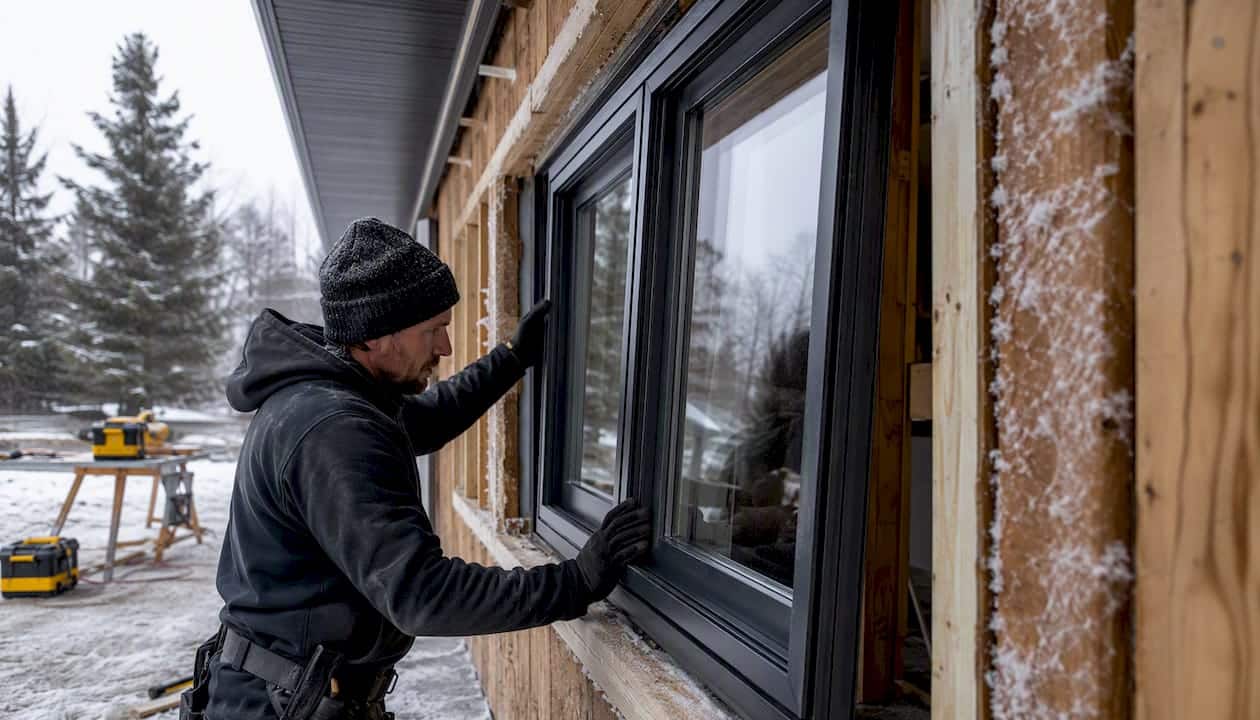
Proper caulking and energy efficiency around the installed window matters as much as the glazing spec. A high-performance triple-pane unit installed with gaps in the air barrier will underperform a well-sealed double-pane unit. The glass and the seal work together.
When do window projects get significantly more expensive?
Some scenarios reliably produce quotes two to three times higher than a standard retrofit. Knowing them in advance prevents sticker shock and helps you budget a realistic contingency.
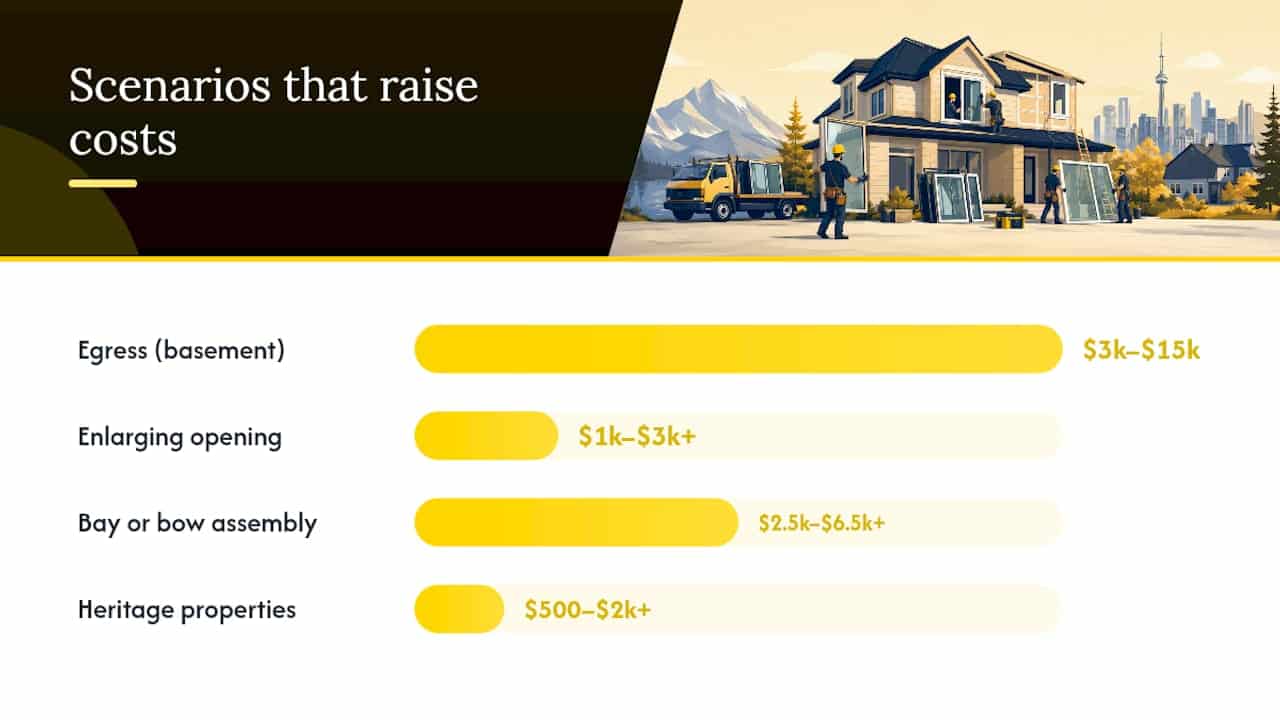
- Egress windows (basement): Adding or enlarging a basement egress window requires foundation cutting, drainage work, and window well installation. Costs commonly run $3,000–$15,000 per opening depending on foundation type and municipal code requirements. See the Canada code guide for basement window dimensions for the minimum size requirements that trigger egress classification.
- Enlarging an existing opening: Structural header work, potential load-bearing modifications, and permit requirements add $1,000–$3,000+ per opening beyond the window cost itself.
- Bay or bow window assemblies: These are not single-unit replacements. Structural support, custom flashing, interior finishing, and the multi-unit assembly typically push total costs to $2,500–$6,500 or more.
- Heritage-designated properties: Municipal heritage bylaws may require specific profiles, materials, or glazing bar patterns. Custom fabrication and heritage consultant fees can add $500–$2,000+ per opening, and some municipalities require heritage permit approval before work begins.
- Hidden rot and masonry repairs: Older brick homes frequently have deteriorated lintels, sills, or framing around windows. Discovering rot or failed masonry during removal adds unpredictable repair costs. A 10–15% contingency on older homes is not excessive.
When any of these scenarios apply, get a structural engineer’s assessment before finalizing a quote. A contractor who prices egress or structural work without an engineering review is either very experienced with that specific scenario or is underquoting.
How do you collect and compare window installation quotes?
Three quotes is the minimum. The problem is that three quotes for “window replacement” can describe three completely different scopes. Here is how to make them comparable.
Questions to ask every contractor
- Is this a retrofit insert or full-frame replacement, and why?
- What is the U-factor and SHGC of the unit you are quoting?
- Is the window ENERGY STAR certified? Can you provide the certification number?
- What glazing package is included (Low-E type, gas fill, spacer system)?
- What frame material are you quoting?
- Does the price include disposal of old windows?
- Does the price include interior and exterior trim, caulking, and finishing?
- What permits are required, and who pulls them?
- What is the labour warranty, and what does it cover?
- What is the product warranty, and who administers it if the manufacturer changes?
- What is the lead time from order to installation date?
- What happens if rot or structural damage is found during removal?
Red flags on cheap quotes
- No mention of installation method (retrofit vs. full-frame)
- Supply-only price presented as an installed price
- No glazing specs beyond “double-pane Low-E”
- Labour warranty shorter than 2 years or absent entirely
- No line item for disposal, trim, or finishing
- Pressure to sign before a site visit or rough-opening inspection
Choosing the right window caulking contractor involves the same due diligence as choosing an installer. Ask for references from projects completed in the last 12 months, and ask specifically about how they handled unexpected rough-opening conditions.
How do you lower the net cost without cutting corners?
Cost reduction on a window project is mostly about timing, bundling, and rebate sequencing. Cutting the glazing spec to save $80 per window is rarely worth it over a 20-year product life.
Tactics that actually work
- Bundle the project: Replacing 8 windows in one visit costs less per window than two separate 4-window visits. Mobilisation, disposal, and site setup are fixed costs that spread across more openings.
- Schedule off-season: Late fall (October to November) and early spring (March to April) often bring better contractor availability and, in some markets, modest pricing flexibility. Avoid peak summer scheduling if you can.
- Choose retrofit when the frame is sound: If the existing frame is square, dry, and structurally solid, a retrofit insert is a legitimate choice that saves $300–$800 per opening compared to full-frame. Do not let a contractor push full-frame work on a sound frame without a clear reason.
- Confirm ENERGY STAR certification before purchase: A window that does not appear on the NRCan certified product list will not qualify for most rebates, regardless of what the retailer claims.
Rebate pitfalls that cost homeowners money
- Buying before pre-approval: Most programmes require a pre-renovation energy assessment before purchase. Buying first disqualifies the application entirely in programmes like Rénoclimat.
- Using a non-registered contractor: Many rebate programmes require the installer to be registered with the programme. Confirm contractor registration before signing anything.
- Missing the application deadline: Some programmes require the rebate application within 90 days of installation. Missing that window means losing the rebate on an otherwise qualifying project.
- Assuming all ENERGY STAR windows qualify equally: Programmes often specify minimum performance tiers within the ENERGY STAR range. A window that meets the basic ENERGY STAR threshold may not meet the programme’s higher performance requirement.
When DIY makes sense and when it does not
Supply-and-install DIY on a retrofit insert is feasible for a handy homeowner on a standard opening. The risk is in the air barrier and flashing details. A poorly sealed window that passes a visual inspection can allow moisture infiltration for years before visible damage appears. For full-frame work, structural repairs, or any project where rebate eligibility is on the line, a registered contractor is the right call.
How this guide’s price ranges were developed
The cost ranges in this guide draw on multiple sources: national market surveys and reporting from Canada Construction Network, city-level pricing data from CostCanada, market analysis from homeowner.ca and RenoQuotes, and provincial programme documentation from CleanBC, Efficiency Manitoba, Rénoclimat, and the Ontario Home Renovation Savings Programme. Installed prices reflect full-service quotes including labour, basic finishing, and disposal unless otherwise noted. Supply-only prices are excluded from installed ranges.
Regional ranges reflect contractor market conditions as of 2026 and will vary by project scope, local labour availability, and material costs at time of purchase.
What installers see go wrong, and what you should insist on
After 25 years working on windows and building envelopes across Ontario, the problems I see most often are not about the glass. They are about what happens around the glass.
The most common shortcut is skipping a proper rough-opening inspection before the window goes in. A contractor who measures from the outside, orders the unit, and installs it without checking the framing condition is betting that nothing is wrong. When they lose that bet, you pay for it. Insist on a rough-opening inspection as a line item in the quote, not an afterthought.
The second issue is the air barrier. A window can be perfectly plumb and square and still leak air at the perimeter if the gap between the frame and the rough opening is not properly sealed. Expanding foam alone is not an air barrier. The correct approach uses a combination of backer rod, low-expansion foam, and a compatible sealant or membrane tape at the interior perimeter. Ask your contractor specifically how they seal the rough-opening gap. If the answer is “we use foam,” push for more detail.
Third: labour warranties. A one-year labour warranty on a window installation is not confidence-inspiring. A contractor who stands behind their work offers two to five years on labour. Ask for it in writing before you sign.
Three things to insist on during the quote and on install day:
- Rough-opening inspection before ordering: Confirm the framing is square, dry, and structurally sound. Any rot or damage should be quoted as a separate line item, not discovered as a surprise on install day.
- Sealed air barrier at the perimeter: Ask how the gap between the window frame and the rough opening will be sealed, and what materials will be used. This is where most long-term performance problems originate.
- Written labour warranty of at least two years: Get it on the quote document, not just a verbal assurance.
When you are talking to a contractor, you can say it plainly: “Can you walk me through how you seal the rough-opening gap, and what labour warranty do you offer in writing?” A contractor who cannot answer that clearly is not the right contractor for the job.
Kettlecontracting handles the sealing work your new windows need
New windows are only as good as the seal around them. That is where Kettlecontracting comes in.

Kettlecontracting is a caulking and sealing specialist serving residential and commercial properties across the Greater Toronto Area. After your windows are installed, the perimeter caulking, air barrier detailing, and interior finishing seal work is what determines whether your new windows actually perform to spec. We handle window caulking and sealing, rough-opening air barrier work, and post-installation inspections for homeowners who want the job finished properly. Our work is backed by a written warranty, and we use sealants suited to Ontario’s freeze-thaw cycles, not whatever is cheapest on the shelf.
Before your installer arrives, preparing your windows for caulking is a step most homeowners skip and most installers do not mention. We can walk you through what to have ready and what to check after installation is complete. To book a site inspection or get a quote for sealing work on your window project, contact Kettlecontracting directly through our website.
Sources
FAQ
What is the average labour cost to install a window in Canada?
Labour on a standard retrofit window typically runs $150–$300 per opening, rising to $300–$600 per window when full-frame replacement and rough-opening repairs are included.
Is it cheaper to replace all windows at once?
Yes. Replacing all windows in a single project reduces per-window cost because mobilisation, disposal, and site setup are fixed costs that spread across more openings. Bundling also improves rebate eligibility, since many programmes have minimum project thresholds.
How much does it cost to replace four bedroom windows in Canada?
A four-window update using mid-range vinyl or fibreglass units typically runs $2,400–$5,500 installed, depending on window style, installation method, and province. Adding triple-pane glazing or fibreglass frames pushes that range toward the higher end.
How much does a standard 4×8 window cost installed?
A standard fixed or casement window in that size range typically falls in the $550–$1,200 installed range for a mid-range vinyl unit. Custom sizing, fibreglass frames, or triple-pane glazing will push the cost higher, and full-frame replacement adds $300–$800 over a retrofit insert on the same opening.
Recommended
- When Is the Best Time to Caulk Windows? | Seasonal Guide for Canadian Homes – Kettle Contracting
- Basement window dimensions: Canada code guide for homeowners
- What’s the Best Window Caulk for Canadian Winters? | Survive the Freeze – Kettle Contracting
- Door frame caulking best practices for Canadian homeowners