
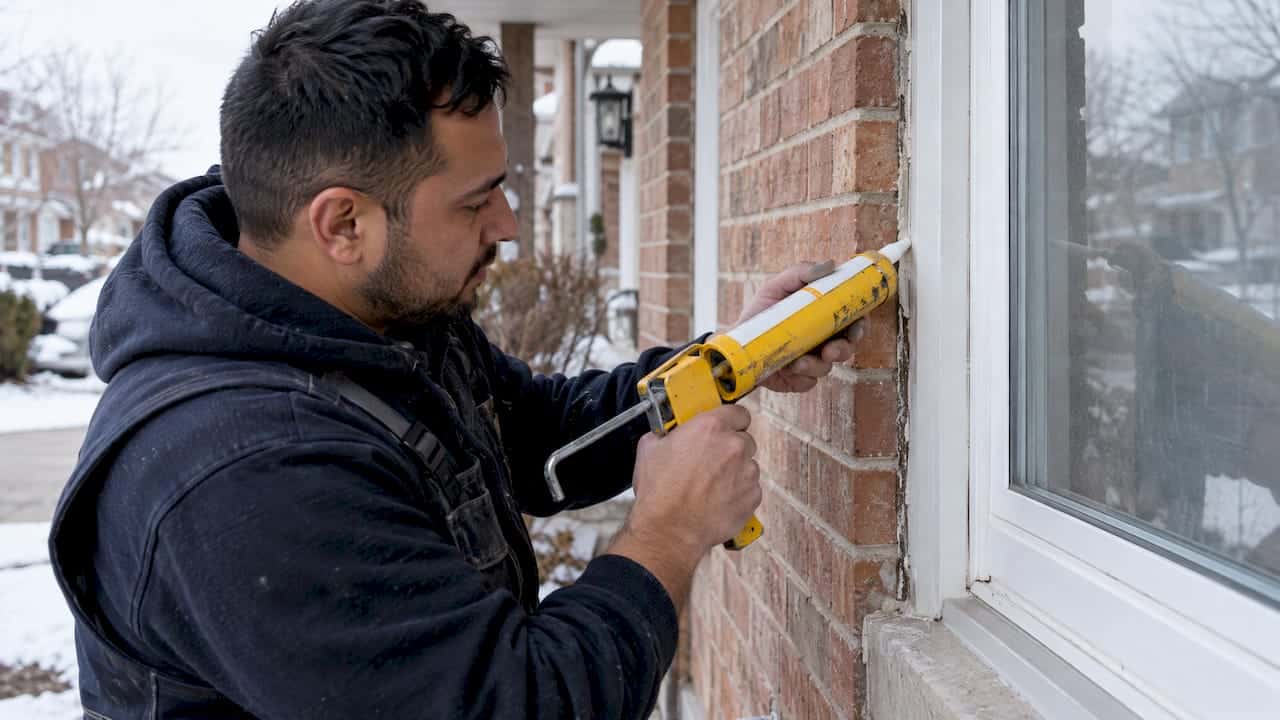
Most winter window drafts come from one of three places: failed caulking where the frame meets the wall, worn weatherstripping where the sash meets the frame, or cold glass that only feels like a draft. The first two are sealing problems, and they are fixed by sealing the right joint with the right material. Done properly, that fix holds through Ontario’s freeze-thaw cycles. After 25 years on Durham Region houses, we can tell you the hard part is not the sealing. It is working out which joint is leaking before you spend money on the wrong fix.
TL;DR
- Test before you fix: a thin tissue or a hand held near the frame on a cold, windy day shows where air is getting in.
- Fixed joints (frame to wall, trim to wall) are sealed with caulk. Moving parts (sash to frame) are sealed with weatherstripping.
- Cold air sinking off the glass, frost on the glass and fogging between the panes are not drafts, and sealing will not cure them.
- Sealing a leaky house raises indoor humidity, so watch condensation and ventilation after the work.
- Kettle Contracting seals windows across the GTA and Durham Region, including Oshawa, Whitby, Ajax, Pickering and Bowmanville.
Table of Contents
- First, work out whether it is really a draft
- How to find where the cold air gets in
- Why caulking is usually where the answer is
- Older windows and sash windows
- Temporary measures for the coldest weeks
- Frost, fog and condensation after you seal
- Do the quick fixes work? A short comparison
- Don’t forget the doors
- Can you caulk in cold weather?
- Our point of view
- Have us look at your windows
- FAQ
- Sources
First, work out whether it is really a draft
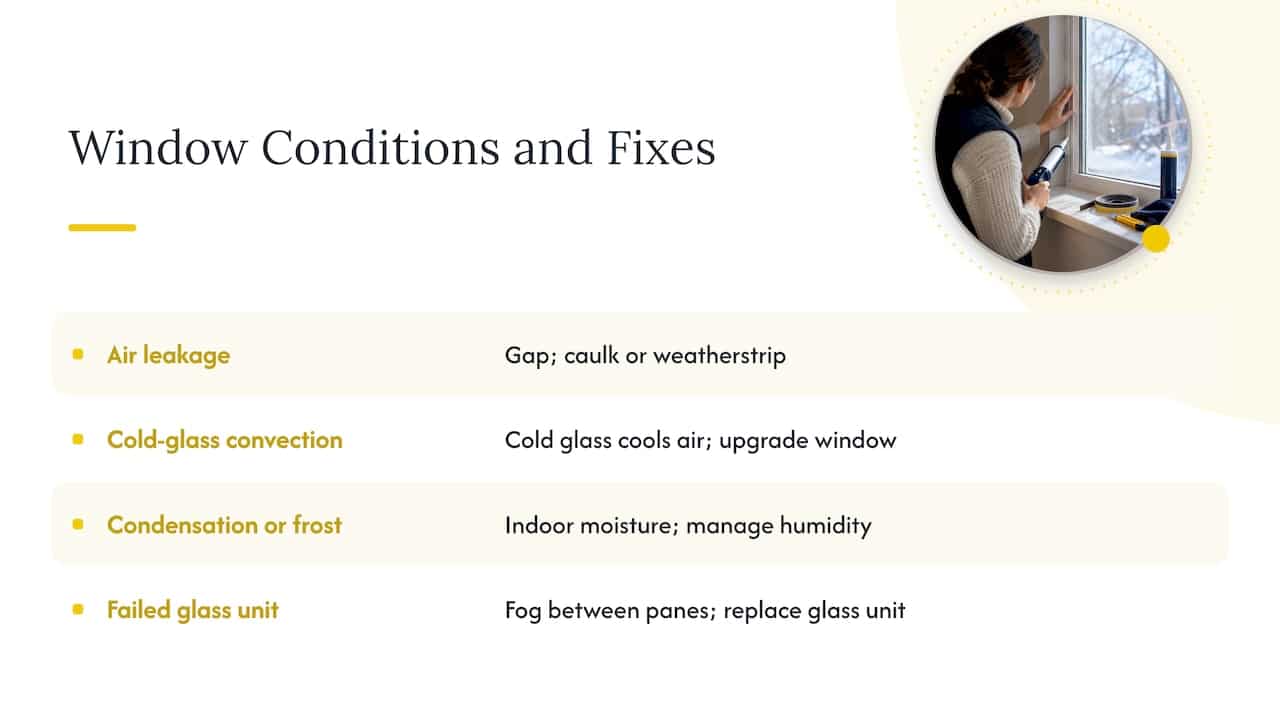
People say “drafty window” for four different problems. Each has a different fix, so it pays to sort them out first.
Air leakage. Outdoor air actually moves through a gap. This is the one caulking and weatherstripping solve.
Cold-surface convection. Room air touches cold glass, cools, and sinks, which feels like a breeze across the floor. The NFRC’s consumer guide points out that on older windows without insulated glazing, what feels like a draft is often just cold air flowing down the glass, and sealing will not change that. Only a more efficient window will.
Condensation or frost. Moisture from indoor air settles on a cold surface. This is a humidity question, not a gap.
A failed sealed glass unit. If fog or moisture sits between the two panes of a thermopane, the unit’s seal has failed. The Government of Québec notes that the glass unit alone can be replaced at a lower cost than the whole window. No caulk will clear it.
If you feel moving air, you have a leak. If the glass is just cold and the air is still, you have a different problem.
How to find where the cold air gets in
Pick a cold or windy day. Leaks are easier to find when there is a pressure difference between inside and outside.
- Tissue test. Natural Resources Canada says to hold thin tissue or plastic near the frame; if it flutters, air is leaking. A lit incense stick works the same way, because the smoke bends toward the draft.
- Hand test, all four sides. Save on Energy points out that a window can be tight on three sides while the fourth leaks, so feel for cool air all the way around the frame, not just where you first noticed it.
- Separate the two joints. Test the joint between the frame and the wall, then the joint between the sash and the frame. The first is a caulking job. The second is a weatherstripping job. The NFRC guide describes passing a flame along each joint in wind to tell them apart. Keep any open flame well away from curtains and blinds, and the smoke or tissue method is safer.
- Check the glass condition. Look for fog between the panes and for failed seals on the glass edges. These show a glass unit problem rather than an air gap.
Also look outside. On brick homes in Durham Region, hairline cracks in old sealant, gaps where the brick meets the frame and dry, shrunken beads are usually visible from the ground. The inside of the house often shows nothing until the cold arrives.
Why caulking is usually where the answer is
When the leak is at the frame-to-wall joint, caulking is the repair. The Government of Québec says that caulking the space between the frame and the wall is often more effective than replacing the windows. That matches what we see. A homeowner is quoted thousands for new windows when the real culprit is a 25-year-old bead of sealant that has split away from the brick.
The same logic applies to the cost of waiting. The Province of British Columbia says windows can account for up to 25 percent of the heat loss in a house and that repairing existing windows is almost always more cost-effective than replacing them. Natural Resources Canada calls sealing air leaks with caulking and weatherstripping one of the quickest and easiest ways to reduce heat loss through windows.
Where the material matters
Not every gap is the same size, and the size decides the method. NRCan’s guidance is that gaps of a quarter inch (6 mm) or less can be insulated and caulked, while larger gaps may need backer rod with caulking or low-expansion foam. ENERGY STAR’s guide to sealing behind window and door trim says the same: caulk for narrow gaps, and non-expanding foam sealant, backer rod or fibreglass insulation for wider ones, without forcing the rod in so hard that it pushes the frame out of square.
This is where an experienced hand makes the difference. A bead that is too thin, applied to a dusty or damp surface, or laid over old failed sealant, will look fine in November and split in February. Ontario’s winters move buildings: frames expand and contract, and sealant has to flex with them. That is why we choose products for the Canadian climate, prepare the joint, and size the gap properly before any sealant goes on. If you want to understand why this is a trade of its own, we explain it in why caulking is trade-specific work. For product choice, see our page on the best window caulk for Canadian winters.
For a closer look at what a seal can and cannot do, our article can window caulking stop drafts goes through it.
Older windows and sash windows
Older wood windows and double-hung sash windows draft for different reasons than newer units, and they are often worth keeping.
- Worn weatherstripping. NRCan recommends good-quality, self-adhesive plastic V-strip for older wood-frame windows, with a combination of V-strip and compression-type weatherstripping on hinged windows. The Québec guidance also names V-shaped or tubular strips for double-hung windows.
- The meeting rail. On a double-hung window, the joint where the two sashes meet in the middle is easy to overlook. This Old House notes a quarter-inch gap along that rail adds up to a hole in the wall of real size, and that locking the sashes tight can fix much of it. Their blower-door testing also found some of the worst leaks at the rope pulley openings above the sash, not at the glass.
- Locks. Latch the windows in winter. A sash that is closed but not locked is not pulled tight against its seals.
- The frame. Even when the sash is fine, the joint between the old frame and the brick or siding may have opened up. That is caulking again.
The BC government’s advice that repairing traditional windows beats replacing them applies here. Before anyone sells you new windows because of drafts, confirm the sash, the weatherstripping and the exterior joint have been properly dealt with.
Temporary measures for the coldest weeks
Sometimes the weather arrives before the repair does. A few stopgaps are recognized by the official sources:
- NRCan says unused operable windows that are not needed as emergency exits can be sealed shut for winter with removable tape or peel-and-strip caulking. Keep bedroom windows usable as an escape route.
- Clear plastic film tightened with a hair dryer improves airtightness on windows you will not open, according to the Québec government’s windows guidance. It is a common option for renters.
- Interior storm windows go further. NRCan says adding them could improve a window’s energy efficiency by up to 50 percent.
- Insulated coverings and shades also cut the chill you feel near the glass. If you are weighing storm windows against film or coverings, this overview of energy-efficient window treatments lays out the choices.
These are bridges, not repairs. They hold the cold back for a season while the actual joint stays open. A sealed frame stays sealed.
Frost, fog and condensation after you seal
This is the part most guides skip, and it matters in a tightly sealed Canadian house.
The National Research Council explains that condensation forms when air cooled by a cold window drops its water vapour as liquid, or as frost below freezing, and that it often shows up first along the bottom, where the glass is coldest. It also says you do not need to measure humidity: if you see objectionable condensation on the inside of a window, cut your moisture sources or increase ventilation.
NRCan adds a point that belongs in every sealing plan. Sealing air leaks can increase condensation because moist air stays in the house. Its guidance on air-leakage control says that as a building tightens, humidity rises, so whole-house ventilation and combustion air supply have to be addressed.
In practice, after window sealing:
- Run bathroom and kitchen exhaust fans, and use the ventilation system you have.
- Check that dryer and humidifier use is not pushing moisture levels up.
- If you have fuel-burning appliances, make sure they have a proper air supply. A heating contractor or your gas utility can confirm this.
- If condensation or mould keeps returning, NRCan points readers with moisture problems to publications from NRCan and CMHC, and a ventilation specialist can assess the house.
Fog trapped between the panes is a different case entirely, covered above: the glass unit’s seal has failed.
Do the quick fixes work? A short comparison
| Problem | What fixes it | Where it applies |
|---|---|---|
| Gap between frame and wall, trim or brick | Caulk, or backer rod and caulk for wider gaps | Fixed joints, inside and outside |
| Leak where the sash meets the frame | Weatherstripping (V-strip, compression type) | Moving parts of operable windows |
| Wide gap behind trim | Non-expanding or low-expansion foam, backer rod | Removed trim, interior |
| Cold air sinking off single or old glass | Storm window, thermal covering, or a more efficient window | Glass surface |
| Fog between panes | Replace the glass unit | Failed thermopane |
| Frost or fog on the room-side glass | Lower indoor moisture, ventilate | Whole house |
A tube of caulk from the hardware store can seem like the same thing as a professional job. It is not, because the work is in diagnosing the right joint, preparing the surface and using a sealant that suits the substrate and the temperature swings. A bead over the wrong joint, or over an unprepared one, is how people end up resealing the same window every year. If you have a quote for a window replacement and the main complaint is drafts, ask whether the existing frame joints have been looked at first.
Don’t forget the doors
If the draft is at floor level near an entry, the culprit may be the door, not the window. The same diagnosis applies: the frame-to-wall joint takes sealant and the moving slab takes weatherstripping. Our guide to door caulking for extreme weather covers that side.
Can you caulk in cold weather?
Yes, with the right product and preparation. Surfaces must be clean and dry, and the sealant has to be rated for the temperature it is applied in. Frost on the joint is a reason to wait or to warm and dry the area first, not to push ahead. We explain how this works in can you caulk windows in winter and walk through the sequence in how to caulk windows for winter. Many exterior jobs are better done in milder weather, so the best time to book is often early fall, and a leak found now can be planned for the first mild stretch.
Our point of view
After 25 years on the tools around Oshawa, Whitby and Ajax, the pattern is consistent. Most people call about drafts when the cold finally gets to them in November or January. By then the sealant has been failing for years.
The right order is simple. Find out which joint is open. Prepare it properly. Use a sealant that moves with the building, because this climate moves buildings every single winter. Then check that the house can breathe afterwards, because a tighter envelope changes how moisture behaves.
We would rather fix the joint you have than sell you a new window you may not need. We handle windows, doors, expansion joints and full building envelopes, for single homes and multi-unit buildings alike, so the same crew can look at the whole picture: the window, the brick around it and the joint between them.
Felix
Have us look at your windows
We seal windows for homeowners, landlords, property managers and commercial owners across the GTA and Durham Region. Our residential window caulking service covers the frame-to-wall joints where most winter drafts start. Our team is fully insured and focused on honest pricing and clear communication, and we follow up to make sure results last.

Managing a larger property? We also do commercial window caulking and building envelope sealing for multi-unit and commercial buildings. If you are not sure where the cold air is coming from, contact us and we will help you work it out.
FAQ
How do I stop window drafts in winter?
First locate the leak with a tissue or your hand on a cold, windy day. Seal fixed joints, such as the frame to the wall, with caulk, and seal moving sashes with weatherstripping. If you want it done once and done right, we handle the sealing for you.
Why do my windows feel cold even when there is no moving air?
Cold glass cools the air next to it, and that air sinks, which feels like a draft. The NFRC’s guidance says this is common on older windows without insulated glazing. It points to glass performance, not a gap.
Why do my windows frost in winter?
Frost forms when warm, moist indoor air meets cold glass below freezing. The National Research Council says to reduce moisture sources or increase ventilation. It is more common after a house is sealed, which is why ventilation matters.
Can I draft-proof old or sash windows without replacing them?
Often yes. Worn weatherstripping, an open meeting rail and a failed frame joint are the usual causes, and each can be repaired. The BC government notes that repairing traditional windows is almost always more cost-effective than replacing them.
Is there a temporary fix until the repair is done?
NRCan lists removable tape or peel-and-strip caulking for windows you do not need to open, and the Québec government lists clear film shrunk with a hair dryer. Keep at least one usable escape window in each bedroom.
Sources
- Improving Window Energy Efficiency, Natural Resources Canada
- Keeping the Heat In, Section 4: Comprehensive air leakage control, Natural Resources Canada
- Weather strip your windows and doors, Save on Energy
- Frequently Asked Questions, NFRC Consumer Guide
- Doors and windows, Gouvernement du Québec
- Practical Air Sealing Techniques for Windows, This Old House
- Sealing Behind Window & Door Trim, ENERGY STAR
- The condensation problem: causes and cures, National Research Council Canada
- The 2026 Guide to Energy-Efficient Window Treatments