

If your energy bills keep climbing despite a relatively new furnace or air conditioner, the problem likely isn’t your HVAC equipment. It’s your building envelope. Understanding how exterior sealing reduces HVAC load is one of the most practical things a GTA homeowner or property manager can do to cut costs and improve comfort year-round. When conditioned air escapes through cracks, gaps, and unsealed joints, your system runs longer and works harder to compensate. Exterior sealing closes those pathways, and the results show up directly on your utility bill.
Table of Contents
- Understanding how exterior sealing impacts your home’s HVAC load
- Why windows are prime targets for exterior sealing in reducing HVAC demand
- Sequencing exterior sealing and insulation: a practical approach for lasting HVAC savings
- Duct and vent sealing: often-overlooked exterior elements that affect HVAC load
- Evaluating exterior sealing benefits: energy savings and HVAC longevity in Toronto homes
- Why proper sequencing and professional sealing matter more than quick fixes
- Trusted exterior sealing services for Greater Toronto homeowners
- Frequently asked questions
Key Takeaways
| Point | Details |
|---|---|
| Exterior sealing reduces energy loss | Closing envelope gaps means your HVAC uses less energy to keep indoor temperatures stable. |
| Windows are major leak points | Sealing gaps around windows can cut air infiltration and reduce heating and cooling loads significantly. |
| Seal before insulating | Air sealing first prevents conditioned air from bypassing insulation and maximizes HVAC efficiency. |
| Duct sealing lowers HVAC stress | Proper sealing of ducts and vents prevents energy waste and helps your HVAC system last longer. |
| Professional sealing pays off | Durable exterior sealing done right leads to comfort, energy savings, and longer HVAC equipment life. |
Understanding how exterior sealing impacts your home’s HVAC load
Your building envelope is everything that separates the conditioned air inside your home from the outdoor environment: walls, windows, doors, the roof assembly, and the foundation. When that envelope has gaps, conditioned air leaks out and unconditioned outdoor air pushes in. In Toronto, that means losing expensive heated air in January and letting humid summer air infiltrate in August.
Your HVAC system doesn’t know why the temperature dropped. It just runs longer to compensate. The more gaps in your envelope, the more your system cycles, and the higher your energy consumption climbs.
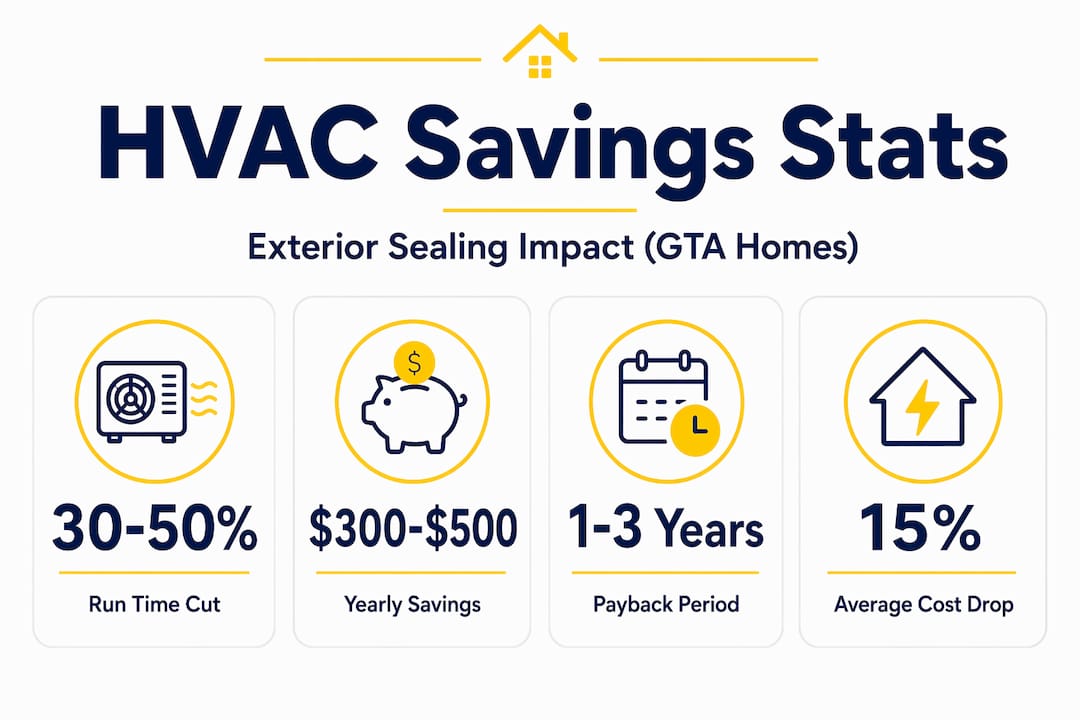
Air sealing plus insulation can reduce heating and cooling costs by about 15% on average, directly lowering HVAC load. That’s a meaningful number for a detached home in Oshawa or a semi in Scarborough where heating seasons run long.
Exterior sealing specifically targets the outside face of your building envelope. That includes:
- Cracks around window and door frames
- Gaps where siding meets trim or foundation
- Joints around exterior penetrations like pipes, vents, and electrical boxes
- Expansion joints along brick or concrete facades
- Gaps at soffits and where different cladding materials meet
The impact of sealing on heating costs is most visible in older GTA homes built before modern airtightness standards, but even homes from the 2000s can have significant air leakage at these points.
Why windows are prime targets for exterior sealing in reducing HVAC demand
Windows are not just a glass and frame issue. The gap between the window frame and the surrounding wall assembly is one of the most common sources of air infiltration in residential buildings. That gap compresses and expands with every freeze-thaw cycle, and in Toronto, we get a lot of those.
Windows contribute up to 40% of envelope heat losses due to air leakage, with sealing yielding average air infiltration reductions of 6.1%. Most people assume the glass itself is the main culprit, but it’s the perimeter gaps that drive the bulk of air leakage.

Here’s a comparison of what sealed versus unsealed windows mean for your HVAC system:
| Condition | Air infiltration level | HVAC impact |
|---|---|---|
| Unsealed window frames | High | System runs longer, higher energy use |
| Partially sealed frames | Moderate | Reduced but not eliminated load |
| Fully sealed exterior frames | Low | Noticeably shorter HVAC cycles |
| Sealed frames plus insulated treatments | Very low | Maximum HVAC load reduction |
Pro Tip: Sealing your window frames on the exterior is only half the equation. Adding curtain lining for heat loss on the interior side reduces radiant heat loss through the glass itself, giving you compounding savings without touching your HVAC system.
The importance of exterior sealing around windows also shows up in comfort, not just cost. Drafts near windows are a sign that your HVAC is fighting infiltration constantly. Seal those gaps properly with a quality exterior-grade caulk, and the drafts stop. Your system doesn’t have to run as often, and the rooms feel more consistent in temperature.
Understanding window caulking and insulation together gives you a clearer picture of why windows deserve attention before you consider any other upgrade.
Sequencing exterior sealing and insulation: a practical approach for lasting HVAC savings
One of the most common and costly mistakes homeowners make is adding insulation before sealing air leaks. It seems logical to add more insulation when a home feels cold, but insulation slows heat transfer through solid materials. It does almost nothing to stop air movement through gaps.
Air sealing should be done before adding insulation because leaks can bypass insulation entirely, reducing its effectiveness. Think of it this way: insulation in a wall cavity with an open gap at the top is like wearing a wool sweater with no zipper in a windstorm. The material is there, but the air moves right through.
Here’s the correct sequence for lasting HVAC load reduction:
- Identify all air leakage points on the exterior, including window and door frames, penetrations, joints, and transitions between materials.
- Seal every gap and crack using appropriate exterior-grade caulk or expanding foam, depending on gap size and location.
- Allow sealants to fully cure before proceeding, especially in cooler temperatures where curing takes longer.
- Add or upgrade insulation in wall cavities, attic spaces, and rim joists after sealing is confirmed complete.
- Re-inspect the exterior after the first full freeze-thaw cycle to catch any new movement or adhesion failures.
Pro Tip: In the GTA, caulk applied in late summer or early fall has the best chance of curing fully before cold weather sets in. Applying caulk below 5°C significantly reduces adhesion and long-term durability.
The benefits of re-caulking windows go beyond comfort. When done in the right order and with the right materials, re-caulking is the foundation that makes every other energy upgrade perform better.
Duct and vent sealing: often-overlooked exterior elements that affect HVAC load
Most homeowners focus on the building shell when thinking about exterior sealing for energy savings. But the ducts and vents that pass through your walls and attic are just as important, and they’re frequently overlooked.
Duct leaks can waste 20-30% of treated air, causing your HVAC to work up to 50% harder and creating uneven heating and cooling throughout the home. That’s not a minor inefficiency. That’s your system running at half its effective capacity while you pay full price for the energy.
Key points to understand about duct and vent sealing:
- Mastic sealant is the preferred material for duct joints. It’s flexible, durable, and far more reliable than standard duct tape, which dries out and fails within a few years.
- Exterior vent caps where ducts exit the building should be sealed around the perimeter with exterior caulk to prevent both air infiltration and moisture entry.
- Bathroom and kitchen exhaust vents are common infiltration points where cold air backdrafts into the home when the fan isn’t running.
- HVAC supply and return registers in exterior walls should be checked for gaps between the register frame and the drywall or wall surface.
- Balanced airflow improves once duct leaks are addressed, meaning your system distributes heat or cooling more evenly and doesn’t have to compensate for pressure imbalances.
Addressing duct leaks also extends equipment life. A system that runs 50% harder than necessary wears out components faster, particularly the blower motor and heat exchanger. Sealing those leaks is one of the more direct HVAC load reduction techniques available without replacing any equipment.
Proper weatherproofing with caulking around exterior penetrations, including where ducts exit the building, is a straightforward step that pays off quickly in reduced run time.
Evaluating exterior sealing benefits: energy savings and HVAC longevity in Toronto homes
Let’s talk numbers, because the exterior sealing benefits are real and quantifiable for GTA properties.
Proper air sealing and insulation upgrades can cut HVAC operation time by 30 to 50%, with costs typically paying back in 3 to 5 years. For a detached home in the GTA spending $3,000 annually on heating and cooling, that’s $900 to $1,500 in annual savings.
| Home type | Estimated sealing cost | Annual savings estimate | Approximate payback |
|---|---|---|---|
| Semi-detached, 1,200 sq ft | $1,500 to $2,500 | $400 to $700 | 3 to 4 years |
| Detached, 1,800 to 2,200 sq ft | $2,500 to $4,000 | $700 to $1,200 | 3 to 5 years |
| Older home, pre-1980 construction | $3,500 to $5,000 | $1,000 to $1,800 | 3 to 5 years |
Toronto’s climate adds a specific consideration. The freeze-thaw cycle here is aggressive. Caulk that isn’t rated for wide temperature swings will crack and pull away from surfaces within a season or two, undoing all the work and letting leaks return. Durability of the sealant material matters as much as the application itself.
Beyond the bill savings, there are additional benefits worth noting:
- Improved indoor comfort: Fewer drafts and more consistent room temperatures
- Quieter HVAC operation: Systems that aren’t constantly cycling run more smoothly and with less noise
- Reduced humidity infiltration: Sealed gaps stop moist outdoor air from entering in summer, reducing the load on your air conditioner’s dehumidification function
- Extended equipment lifespan: Less run time means less wear on motors, compressors, and heat exchangers
Understanding why caulking saves money is the starting point. The actual savings depend on how thoroughly the sealing is done and whether the right materials are used for Ontario’s conditions.
Why proper sequencing and professional sealing matter more than quick fixes
After 25 years in this trade, the pattern I see most often is this: a homeowner notices a draft, picks up a tube of caulk from a hardware store, runs a bead around a window frame, and considers the problem solved. By the following spring, the caulk has cracked, pulled away from the substrate, or never adhered properly in the first place. The draft is back, and the HVAC load never actually dropped.
Quick fixes feel productive, but they rarely address the root issues. The wrong caulk for the substrate, applying over old failed sealant, skipping surface preparation, or working in temperatures that prevent proper curing. These are the mistakes that turn a straightforward job into a repeated expense.
The biggest caulking mistakes aren’t about skill. They’re about sequencing and material selection. A professional approach starts with removing all failed sealant, cleaning and priming the substrate if needed, selecting the correct product for the specific joint type and exposure, and applying it in conditions that allow proper adhesion and curing.
There’s also the matter of hidden leaks. A visible gap at a window frame is obvious. But gaps behind siding, at the rim joist, or where different cladding materials transition are easy to miss without experience. Those hidden leaks are often the largest contributors to HVAC load, and they’re exactly what gets missed in a DIY pass.
Good exterior sealing reduces HVAC cycling stress directly. Every hour your system doesn’t run is an hour of wear it doesn’t accumulate. Over the life of the equipment, that adds up to years of additional service life. The investment in professional sealing isn’t just about energy bills. It’s about protecting a system that costs thousands of dollars to replace.
Trusted exterior sealing services for Greater Toronto homeowners
If you’re ready to stop letting conditioned air escape through gaps in your building envelope, Kettle Contracting is here to help. We specialise in professional exterior sealing and caulking for residential and commercial properties across the GTA, using materials rated for Ontario’s demanding climate.

We start every project with proper surface preparation for caulking to ensure adhesion that lasts through freeze-thaw cycles, not just through the first winter. Our team selects the right sealant for each joint type, whether that’s a flexible polyurethane for window frames, a paintable acrylic for trim transitions, or a high-performance silicone for exposed areas. We also back that up with knowledge of what makes caulk last and how to avoid the failures that send homeowners back to square one. If you’re dealing with cracking, bubbling, or pulling sealant, we can help with fixing common caulking issues before they become bigger problems. Contact Kettle Contracting today for an assessment and a clear plan to reduce your HVAC load through professional exterior sealing.
Frequently asked questions
How much can exterior sealing reduce HVAC energy use?
Air sealing combined with insulation typically reduces heating and cooling costs by about 15% on average, with some GTA homes seeing reductions of 30 to 50% when duct leaks are also addressed.
Why are windows important for exterior sealing?
Windows account for up to 40% of envelope heat loss through air leakage, so sealing gaps around window frames is one of the highest-impact steps you can take to reduce HVAC demand and lower energy bills.
What is the best order to seal and insulate my home?
Always seal air leaks first before adding insulation, because air moving through gaps bypasses insulation entirely, meaning the insulation provides little benefit until those leaks are closed.
Can sealing ducts also reduce HVAC load?
Yes. Duct leaks waste 20-30% of conditioned air, which forces your HVAC to work up to 50% harder. Sealing duct joints with mastic sealant and addressing exterior vent gaps is one of the most direct ways to lower HVAC load and improve comfort.