
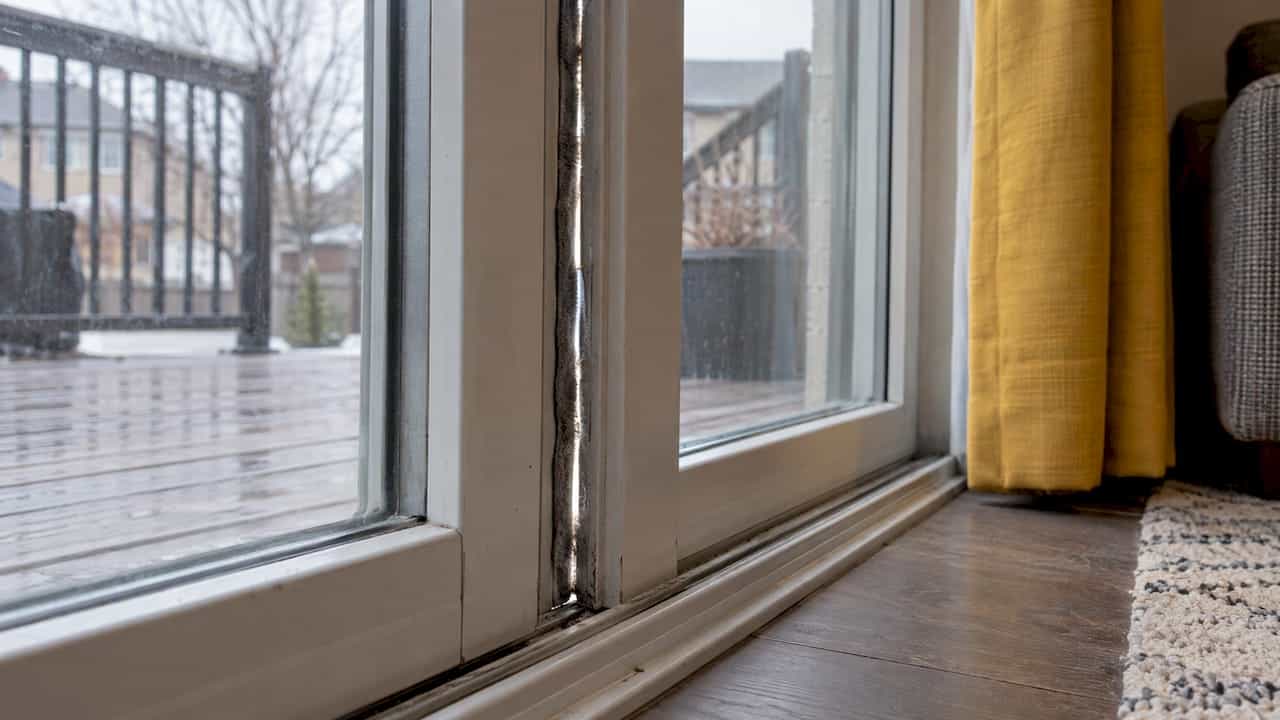
A drafty sliding door is almost never one problem. Air gets in at the centre seam, along the bottom track, around the stationary panel or where the frame meets the wall. Each spot needs a different fix, and the wrong fix can trap moisture or block drainage. Find the exact leak first, then seal it with the right material in the right place. That is how a repair lasts through Ontario’s freeze-thaw cycles instead of failing by February. If you want it done once and done properly, our door caulking and weather sealing service is built for exactly this.
TL;DR
- Close and lock the door, then test one short section at a time. A leak that moves with the panel is a seal or alignment problem. A leak that stays at the wall or trim is a frame joint problem.
- Common causes are worn weatherstripping, a failed bottom sweep, a door knocked out of square, and a failed seal between the frame and the wall.
- Caulk the frame-to-wall joint. Never fill the track or threshold drainage openings, because water needs a way out.
- Fog between the glass panes, a panel that will not close and lock, or a frame pulling away from the wall means a professional assessment, not a tube of caulk.
- Poor air sealing can raise a home’s energy bill by up to 15%, so a sliding door that leaks is costing you every month.
Table of Contents
- Why sliding doors leak more than other doors
- Step one: find where the air is coming in
- What actually causes a drafty sliding door
- Where caulking helps, and where it does not
- Weatherstripping: where it goes and what to look for
- Sealing the sill without causing new problems
- Temporary fixes for the cold weeks
- Repair or replace?
- A quick fall inspection
- Getting it handled
- FAQ
- Sources
Why sliding doors leak more than other doors
A hinged entry door closes against a compression seal. A sliding door works differently. The moving panel travels in a track and meets the fixed panel at a centre seam, and most of its seals are brush-style pile strips that brush against a surface rather than press into it. Those seals wear, fill with grit and flatten over the years.
There is also more that can go wrong mechanically. The panel rides on rollers, the frame is often aluminum or vinyl that moves with temperature, and the whole unit sits in a big rough opening that has to stay sealed to the wall. In the Durham Region, where we work, a door can swing from a humid summer to a minus 20 January. That movement tests every joint.
Step one: find where the air is coming in
Do not buy anything until you know where the leak is. Guessing is how people end up with new weatherstripping on a door whose real problem is the frame joint.
The flutter test
The Government of Québec describes a simple flutter test: move a candle or a sheet of paper slowly along the spots where air might get through, such as patio doors. A flickering flame, drifting smoke or moving paper marks a leak. Running exhaust fans, such as the bathroom fan or the range hood, makes leaks easier to find because the house pulls air in through every gap.
A few practical points from the field:
- Close and lock the door first. The latch pulls the moving panel into its seals, so testing an unlatched door shows you a gap that is not there when it is locked.
- Work one short section at a time: the centre seam where the panels meet, both side jambs, the head (top), the sill, and the edge of the fixed panel.
- Use a strip of tissue or a stick of incense if you are not comfortable with an open flame near curtains. A bare hand works too on a cold day.
- Compare with a spot on an interior wall. If the tissue stays still but the glass feels cold, you are probably feeling cold glass, not a leak.
Read what the leak tells you
Where the air comes in points to the cause:
| Where you feel it | Likely cause |
|---|---|
| Centre seam where panels meet | Worn interlock seal, or the panel is not closing fully |
| Along the bottom | Debris in the track, worn rollers, a worn sweep or a threshold gap |
| Side jambs and top | Weatherstripping that no longer makes contact, or a door out of square |
| Around the frame where it meets the wall | Failed sealant or insulation between frame and rough opening |
| Edge of the fixed panel | Seal or glazing issue that is worth having assessed |
A leak that moves with the sliding panel points to the door’s own seals or alignment. A leak that stays put at the wall or trim points to the frame joint. That one distinction saves a lot of wasted effort.
A blower-door test for stubborn cases
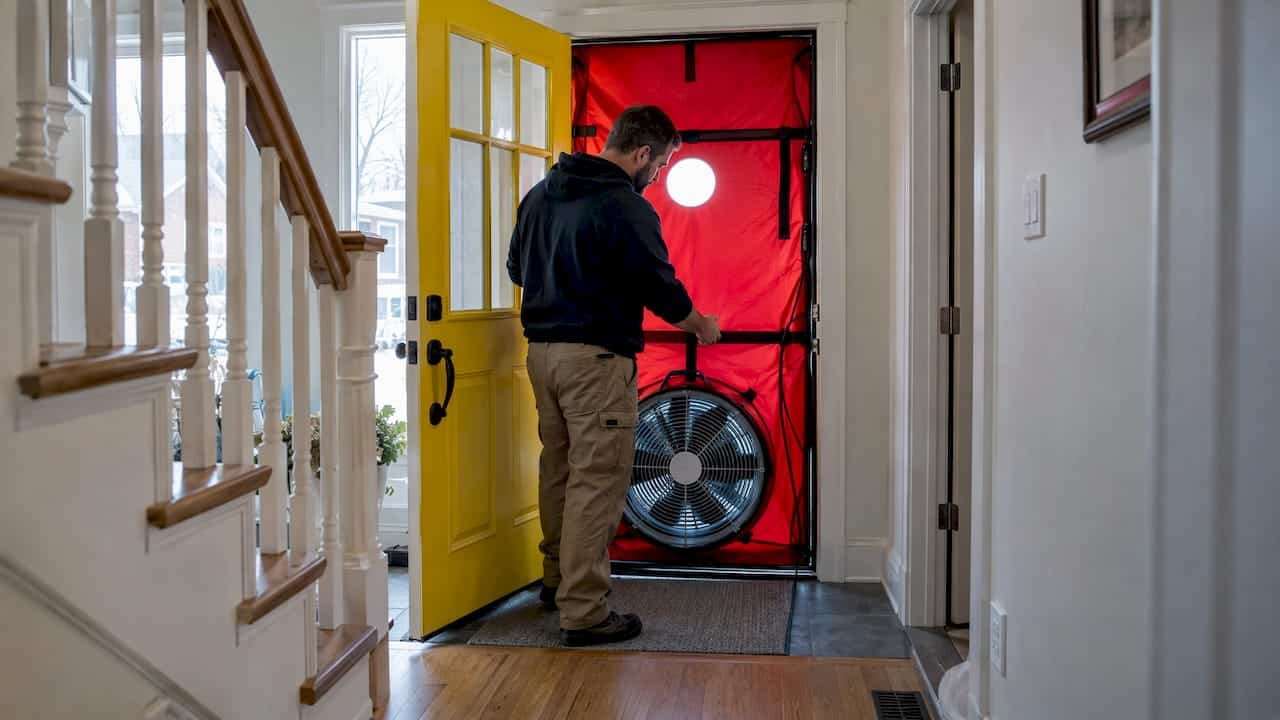
If you cannot find the source, a blower-door test is the more reliable method. A fan depressurizes the house to simulate a strong wind and shows exactly where air is infiltrating, according to the Québec government. For a single sliding door it is usually more than you need, but it makes sense when a whole house is drafty. If you suspect the windows too, our guide to finding and fixing window air leakage covers the same ground.
What actually causes a drafty sliding door
Natural Resources Canada’s guide to keeping the heat in explains that poor installation, years of hard use, shifting foundations and seasonal warping can push sliding glass patio doors out of square with their frames. When a door no longer fits snugly, the door, frame, hardware, gaskets and weatherstripping all need to be checked, and fixed or replaced as needed.
In our experience the usual suspects are these:
- Worn weatherstripping. The pile flattens or pulls out of its slot. This is the most common one, and the easiest to miss because the strip still looks present.
- A failed bottom sweep or threshold seal. The bottom of the door is a major air path, and it also collects dirt, leaves and grit.
- Worn rollers. If the panel sits low, it may not reach the seal at the centre seam even when it looks closed.
- A door out of square. Foundation movement and seasonal warping change the gaps from year to year.
- A failed frame-to-wall seal. Old caulking cracks and pulls away, and the gap behind the trim lets air in. This is where caulking does its real work.
If water is also getting in, the cause may be different from a plain draft. We cover that in our patio door leak guide.
Where caulking helps, and where it does not
Caulking is our trade, so here is a plain answer. It is the right tool in one place: the joint between the door frame and the wall. The Québec government notes that when air leaks around a window or door, the joint between the frame and the house structure is no longer airtight. The fix is caulking where the frame meets the wall. If the trim can come off, the gap is insulated and then caulked, for example with low-expansion urethane foam.
A few rules we hold to on every job:
- Remove the old caulk first. New sealant over cracked, dirty old sealant does not bond. Scraping, cleaning and drying the joint is most of the job.
- Think inside first, then outside. Natural Resources Canada says exterior caulking is the last and weakest defence against rain getting into a wall, and that sealing the outside before the inside is done can trap warm, moist air in the wall and damage it over time.
- Match the sealant to the joint and the climate. A product that handles Canadian temperature swings keeps its flexibility. A cheap one cracks after a couple of winters.
- Never fill the track. The sliding door track and threshold have drainage openings that let rainwater get out. Packing them with caulk, foam or tape pushes water into the wall or the floor. Not every visible gap around a sliding door is a defect.
- Do not caulk moving parts. The panel has to slide, and the lock has to engage. Anything that interferes with that is the wrong fix.
If you want to see how the threshold side is handled, read our walkthrough on caulking around door thresholds. For the choice between sealant and foam in a door gap, see caulking versus foam sealant for doors.
Weatherstripping: where it goes and what to look for
Caulk seals fixed joints. Weatherstripping seals the parts that move. Natural Resources Canada says to weatherstrip the top and sides of the door frame, and that good-quality V-shaped vinyl keeps sealing even when a door warps with the seasons. At the bottom, use something durable, flexible and replaceable, such as a gasketed door-bottom or threshold seal.
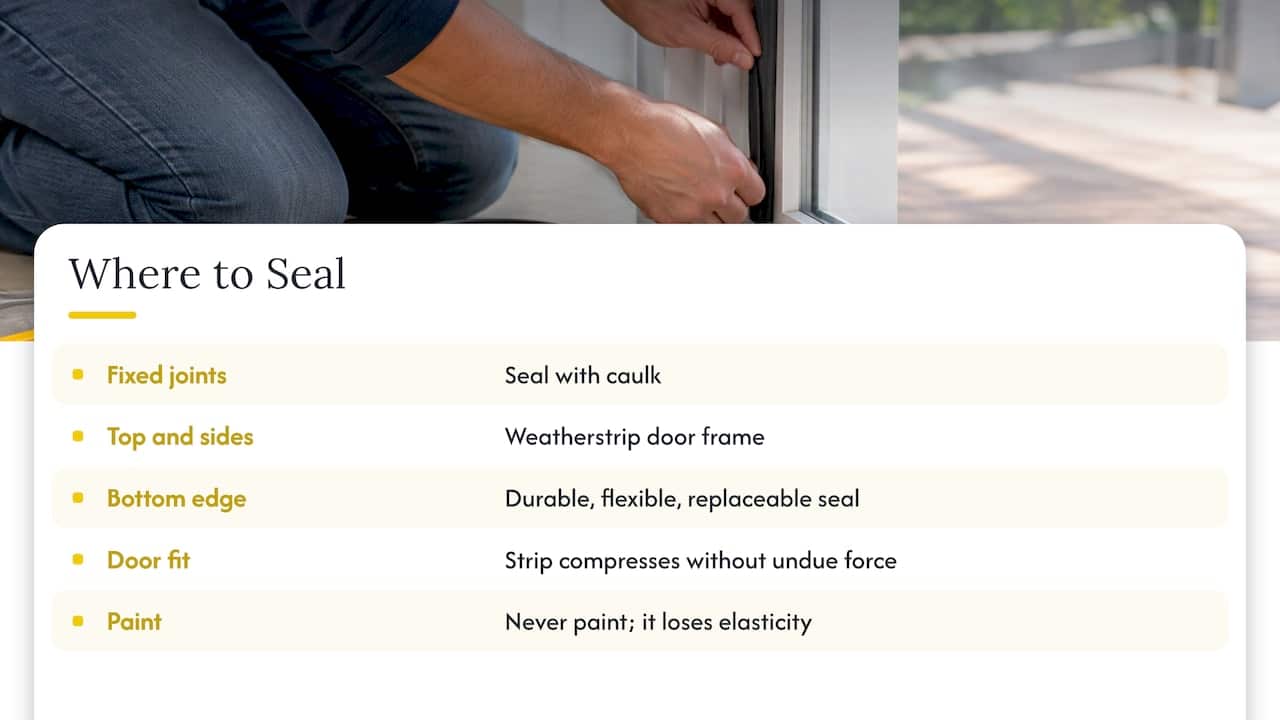
The Québec government adds two details worth knowing. Weatherstripping has to be fitted so the door closes properly and compresses the strip without undue force, and it should never be painted, because paint takes away its elasticity.
That last point matters in rentals and older buildings, where weatherstripping has often been painted over more than once. A painted strip looks fine and seals badly.
When the door is a commercial or multi-unit entrance, the same logic applies, with more traffic. Weatherstripping wears faster, and it is worth checking every fall before heating season. Our commercial window caulking and building envelope sealing work covers the same joints on larger properties.
Sealing the sill without causing new problems
The bottom of a sliding door is where drafts, drainage and moving parts all meet. That is why it is the easiest spot to get wrong. A sweep or threshold seal has to stop air but still let the door slide and the track drain. For a general look at how a door-bottom seal is fitted, fitting weatherstripping on a door shows the principle of testing a sample before committing to a full run.
One caution for Ontario winters: foam strips often fail in the cold, and anything that is stretched while being installed will shrink back and open a gap by January. A seal that fits at 20°C needs to still fit at minus 20°C.
If you manage a building with many sliding doors, standardize on one type of seal and one inspection routine. It makes replacement faster and keeps results consistent from unit to unit.
Temporary fixes for the cold weeks
Sometimes a proper repair has to wait for better weather. Natural Resources Canada suggests that older patio doors that are not used in winter can be sealed with removable sealant or covered with heat-shrink film in the meantime. Worn weatherstripping and hardware should still be replaced when you can.
Think of this as a bridge, not a repair. It buys you a few cold weeks, and then the real work needs to happen. Sealant that is applied in very cold conditions often fails to cure or bond well, which is one reason we recommend booking the repair before the cold sets in. Our guide to door caulking for extreme weather explains the timing.
Repair or replace?
Most drafts are repairable. The question is whether the door around the draft is still sound. A repair makes sense when the frame is in good shape and the problem is limited to weatherstripping, rollers, hardware or the frame-to-wall seal. Replacement is worth discussing when:
- the door is old and several parts are failing at once
- the frame is bent, warped or pulling away from the wall
- the panel will no longer close and lock properly
- there is fog or moisture between the panes of glass
- the draft continues after the seals and threshold have been dealt with
Fog between panes means the sealed glass unit has failed. The gas fill has escaped and moisture has gotten in, and no amount of caulking brings that back. If you are replacing, Natural Resources Canada recommends ENERGY STAR-qualified units. The frame material matters too, and a comparison of fibreglass versus vinyl windows is a good starting point for thinking about it. Our article on signs your windows need to be replaced applies equally to doors.
A door that will not close and lock, a loose or distorted frame, any water coming in, or trim that has to come off are all jobs for a qualified door and building envelope professional. They are not tube-of-caulk jobs. That is a safety and security issue as much as a comfort one.
A quick fall inspection
A check takes less than an hour and is worth doing before the heating season:
- Clean the track and the glass, and look at the rollers for wear.
- Look at the weatherstripping on all four sides. Flat, cracked, painted or missing pile needs replacing.
- Slide the door and lock it. It should move smoothly and latch without force.
- Check the threshold for gaps, staining or any sign of water.
- Look at the frame-to-wall caulk for cracks or gaps.
- Check the glass for fogging between the panes.
Write down what you find. If you own several units, a photo log by suite makes it easy to budget and schedule the work.
Our view from the job site
Most of the sliding door calls we get start with “I need something to stop the draft.” By the time we have walked around the door, the real problem is usually something else: a seal at the centre that has flattened, a frame joint that has opened up, or a track that has been packed with something it should not have been.
After 25 years of working on Oshawa and Durham Region homes, our approach has not changed. Find the exact leak, use the right material for that joint, and do the prep properly. Old sealant gets removed, surfaces get cleaned, and the product is chosen for Canadian winters. That is what keeps the work holding up through freeze-thaw cycles instead of needing a redo.
We are fully insured, we price honestly, and we follow up so the result lasts. We would rather tell you what a door needs than sell you something it does not. Where caulking is the answer, we do it. Where the door needs more than that, we say so and, if you want, handle the replacement through our window and door installation work.
Felix
Getting it handled
If you have found a leak and want it sealed properly, we do door caulking and weather sealing for homes, rental buildings and commercial properties across Oshawa, Whitby, Ajax, Pickering, Bowmanville, Cobourg and the wider GTA. We use premium materials suited to the Canadian climate. If the door needs replacing, we also install windows and doors. You can see the full range on our services page.

To book an assessment of your sliding door, start at our door caulking and weather sealing page.
FAQ
How do I stop a drafty sliding door in winter?
First find the leak with a candle, incense or tissue test, with the door closed and locked. Then seal that specific spot: replace worn weatherstripping, address the bottom seal, or recaulk the frame-to-wall joint. Leave the track drainage openings open.
Can I caulk the track of a sliding door?
No. The track and threshold have drainage paths that let rainwater escape outdoors. Filling them with caulk or foam can push water into the wall or floor. Caulk belongs at the joint between the frame and the wall, not in the track.
Why does my sliding glass door feel cold even when no air is moving?
Glass is a poor insulator compared with a wall, so it can feel cold without any leak. If a tissue stays still but the area is still chilly, it is likely the glass temperature. Fog between panes is a different matter, since it means the sealed glass unit has failed.
When should I call a professional about a sliding door draft?
Call when the panel will not close and lock, the frame is loose or distorted, trim has to be removed, water is coming in, or the draft continues after the seals have been dealt with. These point to alignment, frame or glass problems that need an assessment.
Sources
- Air sealing, Government of Québec
- Doors and windows, Government of Québec
- Keeping the Heat In, Chapter 8, Natural Resources Canada
- Fitting weatherstripping on a door
- Fibreglass versus vinyl windows