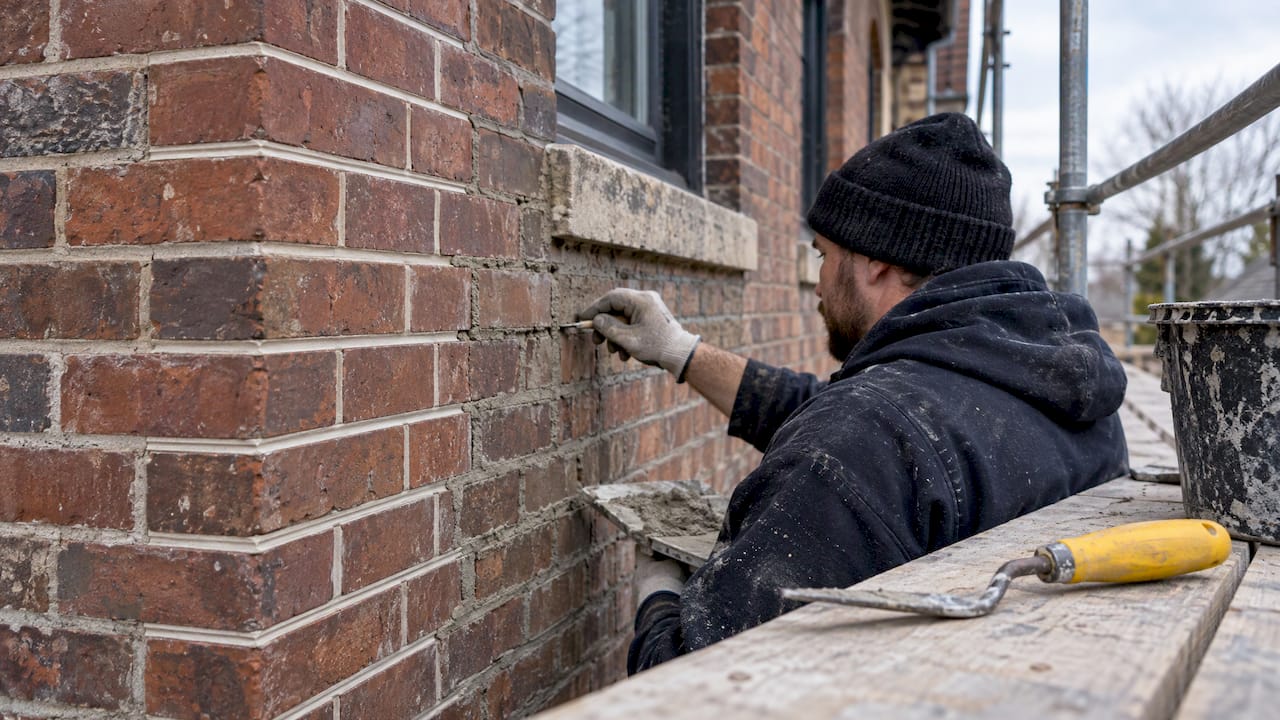
Repointing means raking out failed mortar from the joints between bricks and packing in new mortar. Tuckpointing, strictly speaking, is a finishing style: a thin ribbon of contrasting mortar laid over the joint to make it look crisp. On many job sites in Ontario, though, people use the two words for the same repair. What matters for your wall is not the label on the quote. It is how deep the old mortar is removed, what mortar goes back in, and when the work is done.
We have spent 25 years working on exterior envelopes in and around Oshawa, and the mix-up between these two terms comes up on almost every brick inspection. This guide sorts it out in plain language so you can read a quote properly and know what your house or building actually needs.
TL;DR
- Repointing is the functional repair: remove deteriorated mortar and replace it so the wall sheds water again. Tuckpointing is a detail finish, and in everyday use the word often just means repointing.
- Only repoint joints that are loose, crumbling or cracked. Sound joints should be left alone, even if the colour looks tired.
- The new mortar must be softer or equally soft as the brick. A mortar that is too hard can crack and spall the brick itself.
- Ontario’s freeze-thaw cycles and short work season make timing and mortar mix as important as the labour.
- Ask any contractor how deep they rake, with what tools, and which mortar mix they will use.
Table of Contents
- What is the difference between tuckpointing and repointing?
- How to tell if your brick needs work
- Why mortar choice matters more than the label
- How the work should be done
- Timing: the Ontario factor
- How long does it last?
- What does repointing cost?
- Our perspective
- Where caulking and expansion joints fit in
- Work with us on your brick and sealing
- FAQ
- Sources
What is the difference between tuckpointing and repointing?
Repointing is the renewal of the pointing, the outer part of the mortar joint. The old mortar is removed to a set depth and new mortar is placed. The City of Hamilton’s masonry restoration guidelines describe it this way and note that mortar joints are meant to be a sacrificial element, so historic masonry will need repointing periodically. That is normal wear, not a defect.
Tuckpointing is a specific technique. The joint is filled with mortar matched to the colour of the brick, then a narrow ribbon of a contrasting colour, usually light, is laid on top and trimmed so the joints look very neat. The Society for the Protection of Ancient Buildings covers tuck pointing as its own craft and points out how hard it is to renew in small areas and have it blend in.
In practice:
| Repointing | Tuckpointing | |
|---|---|---|
| Main purpose | Restore the joint so water stays out | Give the joints a refined, uniform look |
| Work involved | Rake out failed mortar, repack, tool the joint | Same base work, plus a contrasting ribbon on top |
| When it applies | Loose, crumbling or cracked mortar | Mostly decorative or heritage-style finishes |
| What people often mean | The repair itself | Often just “repointing” in casual use |
Some websites say tuckpointing is only cosmetic and repointing is only structural. That is a useful rule of thumb for a homeowner reading quotes, but the real world is blurrier. The base work under both is the same: sound, well-packed mortar. A ribbon on top of a poorly prepared joint will look good for a season and then fail.
How to tell if your brick needs work
Start from the wall, not the terminology. The U.S. National Park Service’s Preservation Brief 2 lists the usual signs that repointing is called for: disintegrating mortar, cracks in joints, loose bricks or stones, damp walls and damaged plaster inside. It also says the cause of the deterioration should be dealt with before the work begins.
Walk the wall and look for:
- Mortar you can scratch out with a key. Sound mortar resists. Powdery or sandy mortar does not.
- Joints recessed well behind the brick face. Water sits on the exposed brick edges.
- Hairline cracks along the brick-to-mortar line, especially on south and west walls that take sun and driving rain.
- Loose or shifting bricks, or bricks with the face flaking off.
- Damp patches, efflorescence (white salt deposits) or stained plaster on the inside of exterior walls.
- Gaps at the top of a wall, around windows or at corners, which may be sealant joints rather than mortar. Those need caulking, not repointing.
What not to repoint
This part surprises people. The Hamilton guidelines say to limit repointing to areas where mortar is loose or crumbling, and that if the bond is intact on both sides of a joint and the mortar is firm, the joint is sound and should not be repointed. The SPAB says renewing tuck pointing is premature until the mortar has weathered back to a depth about equal to the joint width, or is very loose, and that a faded ribbon alone does not justify redoing it.
The National Research Council of Canada goes further. Its key considerations for repointing say repointing only to improve appearance is not recommended, and that selective repointing of deteriorated areas is the best approach unless cost, timing and access make a whole-wall job more effective. A good contractor will tell you when a patch is enough.
Check the cause first
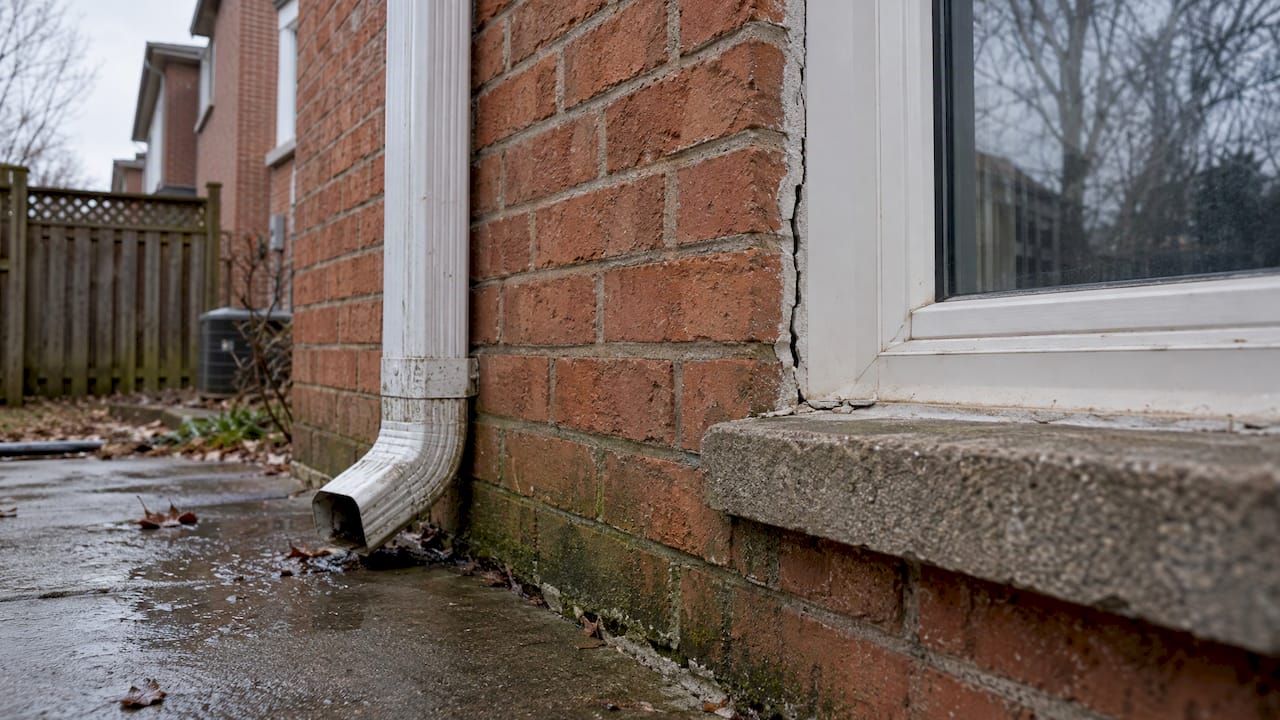
Mortar rarely fails on its own. Before you repoint, look up at the roofline, eavestroughs, downspouts, window sills and grade. A downspout that dumps onto a wall will wreck new mortar in a couple of winters. Caulked joints around windows and doors that have split let water in behind the brick. If spalling bricks are the main issue, our guide to spalling brick repair explains how those are handled differently.
Why mortar choice matters more than the label
This is where most failed repointing jobs go wrong. Many owners assume the harder and stronger the mortar, the better. The reverse is true for most older Ontario brick.
The Hamilton guidelines call it a common error to assume that hardness or high compressive strength means suitability, and warn that a mortar stronger than the masonry units will cause permanent damage such as cracking and spalling. Repointing mortar should be softer or more permeable than the masonry and no harder or less permeable than the historic mortar. For historic masonry the city recommends a mix of lime and white non-staining cement.
The NRC describes the repointing mortar as the sacrificial part of the wall: it should be as durable as possible without causing damage to the existing bedding mortar and bricks, because bricks are much harder to repair or replace than mortar. The Region of Waterloo’s masonry guide for heritage properties makes the same point: match the historic mortar as closely as possible so old and new work together, since replacing mortar is far easier than replacing damaged units.
Typical mixes
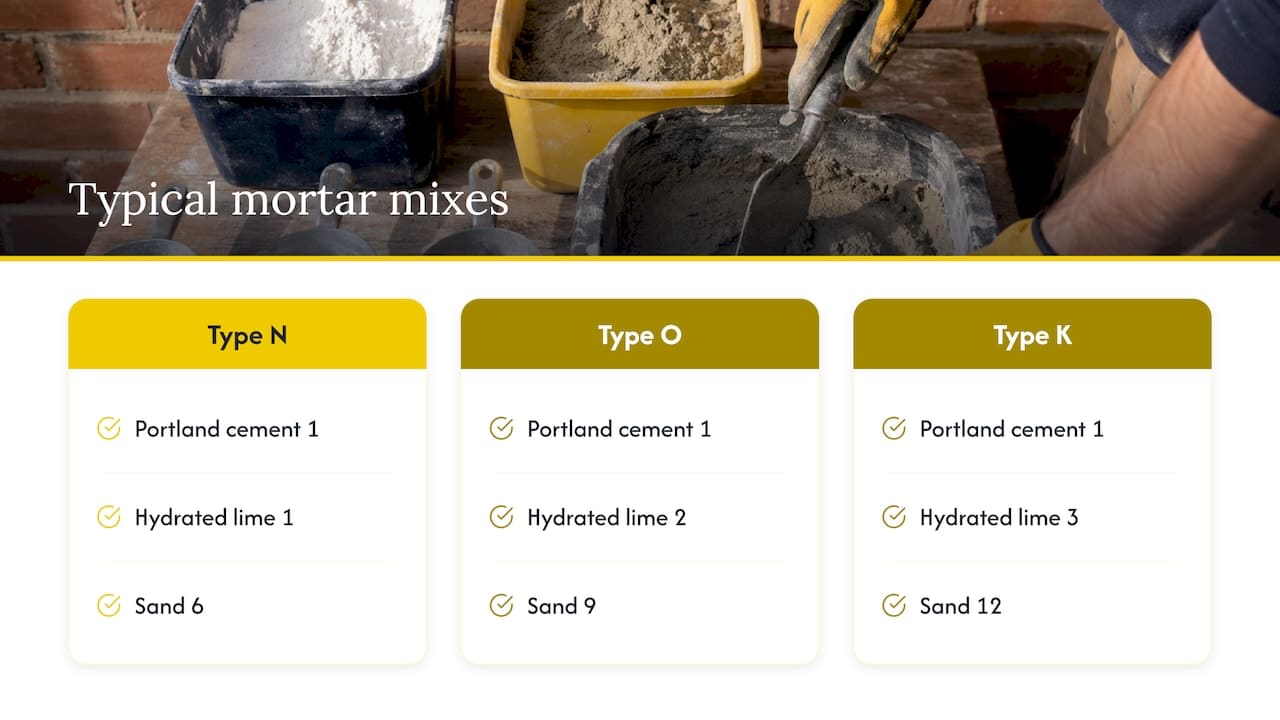
The NRC’s paper on mortars for repair of traditional masonry lists common Portland cement, hydrated lime and sand mixes by volume of 1:1:6, 1:2:9 and 1:3:12, which correspond to types N, O and K in the ASTM and CSA standards. It also recommends air entrainment for mortar exposed to heavy wetting in freezing temperatures. The right choice depends on your brick. Softer, older brick wants a softer mortar; harder modern brick can take a stronger one.
Colour and sand
A match is more than pigment. Sand grain size and colour drive how the finished joint looks. We cover this in detail in our piece on brick mortar colour matching in Ontario.
How the work should be done
When you compare quotes, the process is what separates a repair that lasts from one that peels out in three winters.
- Rake out by hand where possible. The Hamilton guidelines call for hand tools rather than power tools. The NRC’s key considerations name power-tool raking as a leading cause of permanent damage to bricks, which is the most critical risk of poor repointing.
- Rake deep enough. Hamilton specifies a depth of 2 to 2½ times the joint width, usually at least 25 mm for brick. Shallow raking leaves a thin skin of mortar that pops out.
- Clean and dampen the joint. Dust and a bone-dry brick pull moisture out of fresh mortar and weaken the bond.
- Pack in layers. Deep joints are filled in lifts, not in one pass.
- Tool the joint to match. Profile and finish should match the original or the style the owner chooses.
- Protect while it cures. Cured too fast or frozen too early, even good mortar fails.
The NRC’s site considerations paper adds that test panels can be used to set an acceptable standard of quality as work proceeds. If you have a house with a distinctive look, ask for a sample area before the full job.
Timing: the Ontario factor
Hamilton recommends repointing when the temperature is between 5 and 25 degrees Celsius, to avoid frost or rapid drying, and says newly laid mortar above 25°C should be protected with damp burlap and misting. The NRC notes that in northern climates the window of opportunity for repointing can be quite short. The NRC’s durability review recommends protecting weaker mortars from freezing for at least seven days and doing the pointing well ahead of winter.
For us, that means late spring to early fall is the working season, and fall bookings fill quickly. If you are reading this in November, the practical answer is usually to plan the job for spring, deal with any urgent water entry through temporary measures, and make sure your windows and joints are sealed in the meantime. Our guide to the best time of year for exterior caulking covers the same seasonal logic for sealants.
The NRC durability review also explains that regions with heavier precipitation and many freeze-thaw cycles are tougher on masonry than those that stay consistently cold or mild, and that orientation matters because of driving rain and sun. Lake Ontario weather, with its repeated winter thaws, sits on the harder side of that comparison.
How long does it last?
The NRC durability review gives the design service life for masonry as usually 50 to 100 years, with a normal expectation of at least 30 years for pointing mortar and ideally 50 to 100. It adds that where a softer mix is needed in more exposed areas, more frequent repointing should be accepted as part of maintenance. The NRC’s key considerations also says that in Canadian climates, early failures of softer repointing mortars tend to come from poor freeze-thaw resistance due to the wrong mix, poor execution and curing, and poor water management on the façade.
In plain terms: the mortar is meant to wear before the brick does. Good repointing is a maintenance cycle, not a one-time fix.
What does repointing cost?
We do not publish set prices for masonry work, because the same wall can be a small afternoon patch or a multi-week scaffold job. These are the factors that move a quote:
- Extent of damage. Spot repairs versus whole elevations.
- Joint depth and condition. Deeper raking and heavy deterioration take more hours.
- Height and access. Second storeys, chimneys and tight lanes may need scaffolding or a lift.
- Mortar and finish. Custom colour matching, lime mixes and a tuckpointed ribbon take more skill and time than a standard joint.
- Hidden causes. Failed flashing, sealant joints or drainage may need fixing in the same visit.
- Season and scheduling. Spring and summer demand is highest.
Get quotes that name the raking depth, the tool type, the mortar mix and the area covered. Those details allow a fair comparison, whatever each contractor calls the job.
Our perspective
After 25 years of walking walls around Oshawa, Whitby and Ajax, we can say the word on the quote matters less than what happens in the joint. We have seen tidy, expensive-looking tuckpointing laid over mortar that was never raked deep enough, and plain repointing that has stood up through decades of freeze-thaw.
Our approach is to fix the cause first, repair only what has failed, and match the mortar to the brick instead of reaching for the hardest mix. Window and door perimeters are a common source of water getting behind brick, so we look at the sealant joints at the same time as the mortar. That is why brick repair and caulking sit together in our work, and why we think a wall should be treated as a system.
We would rather tell you a small patch is enough than sell you a full elevation. Honest pricing and a clear explanation on site are how we want you to remember us.
Felix
Where caulking and expansion joints fit in
Not every gap in a brick wall is a mortar joint. Brick expansion joints are deliberate, flexible gaps that let the wall move with temperature. Filling those with mortar defeats their purpose and cracks the wall. They need flexible sealant. Our guide to brick expansion joint sealant explains how we make those reseals last, and our article on expansion joint sealant failure shows how to diagnose before patching.
Similarly, the joint between a window frame and the brick is a sealant joint. If it has split, water gets behind the masonry and shortens the life of any new mortar. Our window caulking best practices for brick homes go through the product and prep side of that.
If your renovation also involves opening up interior walls in an older house, it is worth understanding demolition versus abatement before work starts, so older materials are handled properly.
Work with us on your brick and sealing
We handle brick and masonry repairs and restoration alongside building envelope sealing for homeowners, landlords, property managers and commercial owners across the Greater Toronto Area, from Pickering to Cobourg. We are fully insured, and we explain what we find on the wall before we recommend anything.

Tell us what you are seeing, whether that is crumbling joints, drafts at a window or stains inside an exterior wall, and we will look at the whole envelope. Visit our services page or kettlecontracting.com to book an assessment.
FAQ
Is tuckpointing the same as repointing?
Not strictly. Repointing is the whole repair of removing failed mortar and replacing it. Tuckpointing is a finishing technique that adds a contrasting ribbon over the joint. Many contractors in Ontario use the words interchangeably, so ask what exactly is in the scope of work.
How do I know if my brick needs repointing?
Look for crumbling or powdery mortar, deep recessed joints, cracks along the brick edges, loose bricks and damp patches inside. Per the NPS guidance, these are the usual signs, and the cause of the damage should be fixed first. Sound, firm joints should be left alone.
Is it expensive to repoint brick?
It depends on how much of the wall is affected, how deep the joints are, and how high and hard to reach the work is. Spot repairs cost far less than a full elevation. Ask for a written quote that states the area, depth and mortar mix.
What is the best mortar for repointing?
The best mortar is one that is softer or equally soft as your brick and similar to the original mortar. The Hamilton guidelines recommend a mix of lime and white non-staining cement for historic masonry. A mortar harder than the brick can crack and spall it.
When is the best time to repoint in Ontario?
The city of Hamilton’s guidance is to work between 5 and 25°C, so late spring through early fall is the realistic window. Mortar should be protected from frost while it cures, so the work is best done well before winter.
Sources
- FINAL Masonry Guidelines, City of Hamilton (2018)
- Preservation Brief 2: Repointing Mortar Joints in Historic Masonry Buildings, National Park Service
- Tuck pointing, SPAB
- Key considerations for repointing mortars for the conservation of older masonry, NRC
- Mortars for repair of traditional masonry, NRC
- Masonry Practical Guide for Heritage Properties, Region of Waterloo
- Repointing mortars for older masonry buildings: site considerations, NRC
- Review of factors affecting the durability of repointing mortars, Canada Masonry Design Centre