
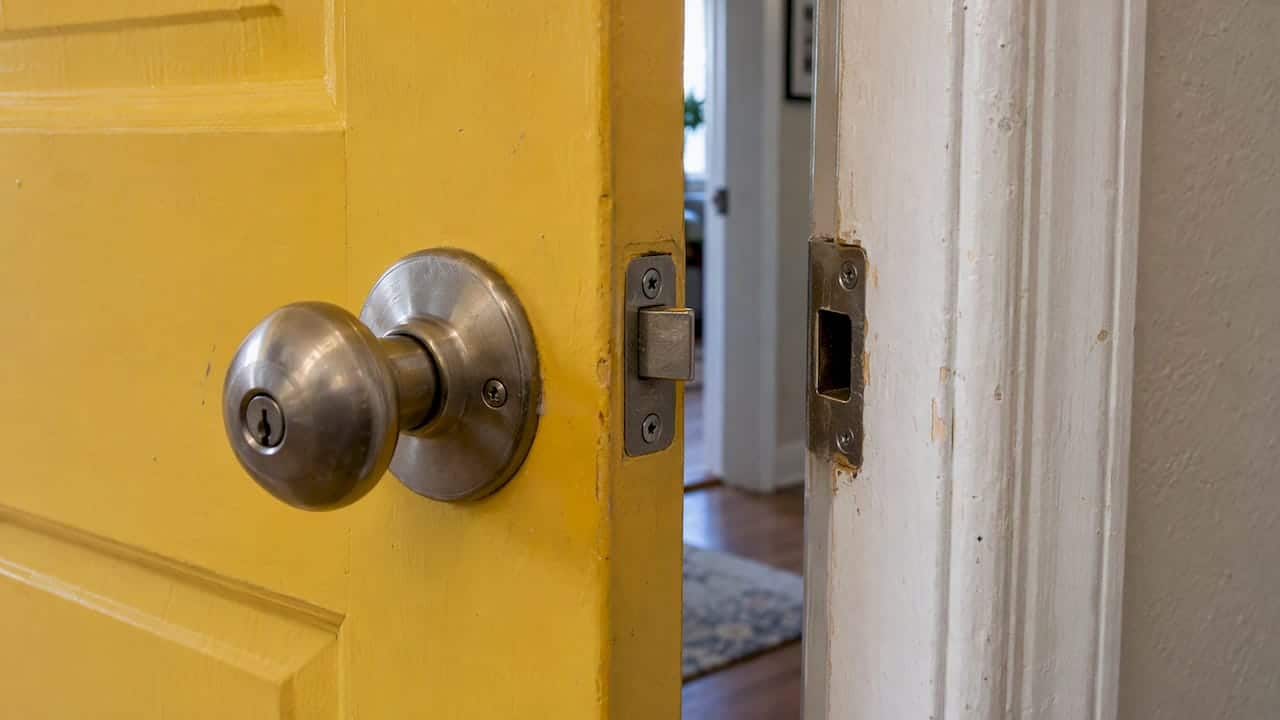
If your door latch is misaligned, the bolt is hitting the wrong spot on the strike plate, or missing the hole entirely. The fix depends on where it misses. Mark the bolt, close the door, and read the mark. A bolt that lands high usually points to a sagging door and loose hinges. A bolt that lands low, or off to the side, usually points to the strike plate or the frame. Most of the time you can sort it out in under an hour with a screwdriver, a file and a chisel.
We spend our days around door frames, thresholds and the seals that go with them, so we see a lot of doors that “suddenly” stopped catching. Here is how we work through it, in the order we would do it on site.
TL;DR
- Do the lipstick test first: mark the end of the latch bolt, close the door, and see where the mark lands on the strike plate.
- Tighten every hinge screw before you touch the strike plate. A sagging door is the most common cause of a door that won’t latch.
- Small miss: file the strike opening. Bigger miss: move the strike plate and fill the old screw holes first.
- If the door rubs, the frame is out of square, or the fix only lasts a week, the problem is the frame or the door, not the latch.
- Seasonal swelling in Ontario is real. Don’t make permanent changes based on the worst week of August or February.
Table of Contents
- What “misaligned” actually means
- Step 1: Test the latch with the door open
- Step 2: Run the lipstick test
- Step 3: Fix the hinges first
- Step 4: Adjust the strike plate
- Step 5: When the bolt goes in but not all the way
- Why a latch stops catching all of a sudden
- Exterior doors: threshold, seals and moisture
- A repair order that saves time
- What you will need
- Signs the problem is bigger than the latch
- Perspective
- When to hire help, and what we can do
- A few habits that keep latches working
- FAQ
- Sources
What “misaligned” actually means
A standard door latch has a spring-loaded bolt with an angled face. When you close the door, the angled face rides over the strike plate and the bolt springs into the hole in the frame. That hole has some forgiveness built in, but not much. If the bolt lines up with the opening within a small margin, it catches. If the door has moved even a few millimetres out of position, the bolt hits the metal plate or the wood next to it and the door bounces back open.
There are three separate things that can be off:
- The door, which may have dropped on its hinges, swollen, or warped.
- The frame, where the jamb has shifted and the strike plate is no longer where the bolt arrives.
- The hardware, meaning a sticky, worn or damaged latch, or a strike plate with a hole that is too shallow.
Most online guides jump straight to moving the strike plate. That is the right fix some of the time, but if the real problem is a sagging door, moving the plate just hides it until the door sags further.
Step 1: Test the latch with the door open
Before you blame alignment, take the door out of the equation. With the door open, turn the handle and let go. The bolt should pull in fully and snap back out with no hesitation. Push the bolt in with your finger and release it. It should spring out cleanly.
If it is slow, sticky or stays partly retracted, the mechanism is the problem. A worn or gummed-up latch is a hardware fault, and no amount of strike plate adjustment will fix it. Replacing the lockset is the cleaner answer there. If the bolt moves freely, carry on.
Step 2: Run the lipstick test
This is the quickest way to see what is really happening, and it works for any door in the house.
- Rub lipstick, chalk or a washable marker onto the angled end of the latch bolt.
- Close the door gently, with the handle held so the bolt is not retracted. Turn the handle slightly if you need to, then release it so the bolt presses on the strike.
- Open the door and look at the strike plate. The mark shows exactly where the bolt touched.
Now read the result:
| Where the mark lands | What it usually means | Where to start |
|---|---|---|
| Above the strike opening | The door has dropped (sagged) | Hinges: tighten screws, replace stripped ones |
| Below the strike opening | The door has lifted, or the frame has shifted | Check bottom hinge shimming, then move the strike plate |
| To the side, on the plate face | The door is not closing fully into the frame | Look for something blocking the door: seals, threshold, paint build-up |
| Inside the opening but the bolt will not go in | The hole is too shallow or too narrow | Deepen or enlarge the pocket behind the plate |
This is a guide, not a law. Doors are individual, and old Ontario homes in Oshawa, Whitby and Ajax have frames that have been settling for decades. Use the table to choose where to start, and let what you see on the door correct you.
Step 3: Fix the hinges first
If the latch lands high, the door has almost always dropped. The weight of the door pulls on the top hinge, and over the years the screws loosen in the jamb. Hinge screws are short, usually about an inch, and they only bite into the thin jamb, not the framing behind it.
Here is what we do:
- Open the door and check each hinge by lifting the door by the handle end. If the hinge leaf shifts or you see the screws move, they are loose.
- Tighten every screw on every hinge, on both the door side and the jamb side.
- If a screw just spins and won’t tighten, the hole is stripped. Replace the top hinge screw nearest the jamb with a longer one, about three inches, so it passes through the jamb and bites into the wall framing. This pulls the top of the door back toward the frame and often fixes the problem on its own.
- If the latch still lands low after the hinges are tight, a thin shim of cardboard behind the bottom hinge leaf pushes the door slightly the other way.
Try the door again, and repeat the lipstick test. If the mark has moved toward the opening, you are going the right way. Make small changes and test after each one.
Don’t skip the hinge check
A strike plate adjustment on a door with loose hinges is a repair that will not last. The door will drop again, and you will be back to square one. We would rather have you spend ten minutes on the hinges than an hour on the strike plate.
Step 4: Adjust the strike plate
Once the door sits properly in the frame, the strike plate may still be a little off. How you fix it depends on how far.
A small miss: file the opening
If the bolt is off by a couple of millimetres, use a small metal file to enlarge the strike opening in the direction the bolt needs to go. Take the plate off first so you don’t leave filings in the frame, file a little at a time, and test after each pass. You are not trying to make a big hole. You are giving the bolt enough room to drop in.
A common rule of thumb in the trade is that anything more than about 1/16 inch off needs the plate moved, not filed. Filing too much leaves a sloppy fit where the door rattles in its frame.
A bigger miss: move the plate
When the offset is larger, you move the whole strike plate.
- Unscrew the plate and hold it in the position where the bolt actually lands. Trace around it.
- Use a sharp chisel to extend the mortise (the shallow recess the plate sits in) to the new position. Keep the plate flush with the jamb.
- Fill the old screw holes before drilling new ones. Glue in wood slivers, toothpicks or a small dowel, let the glue set, and trim flush. Without this, the new screws can wander into the old holes and won’t hold.
- Drill new pilot holes, then screw the plate down. Test the latch before you finish.
Use long screws here, the same logic as the hinges. Short screws in a thin jamb give way when someone slams or kicks the door shut. A longer screw into the framing gives the strike plate something solid to hold.
Step 5: When the bolt goes in but not all the way
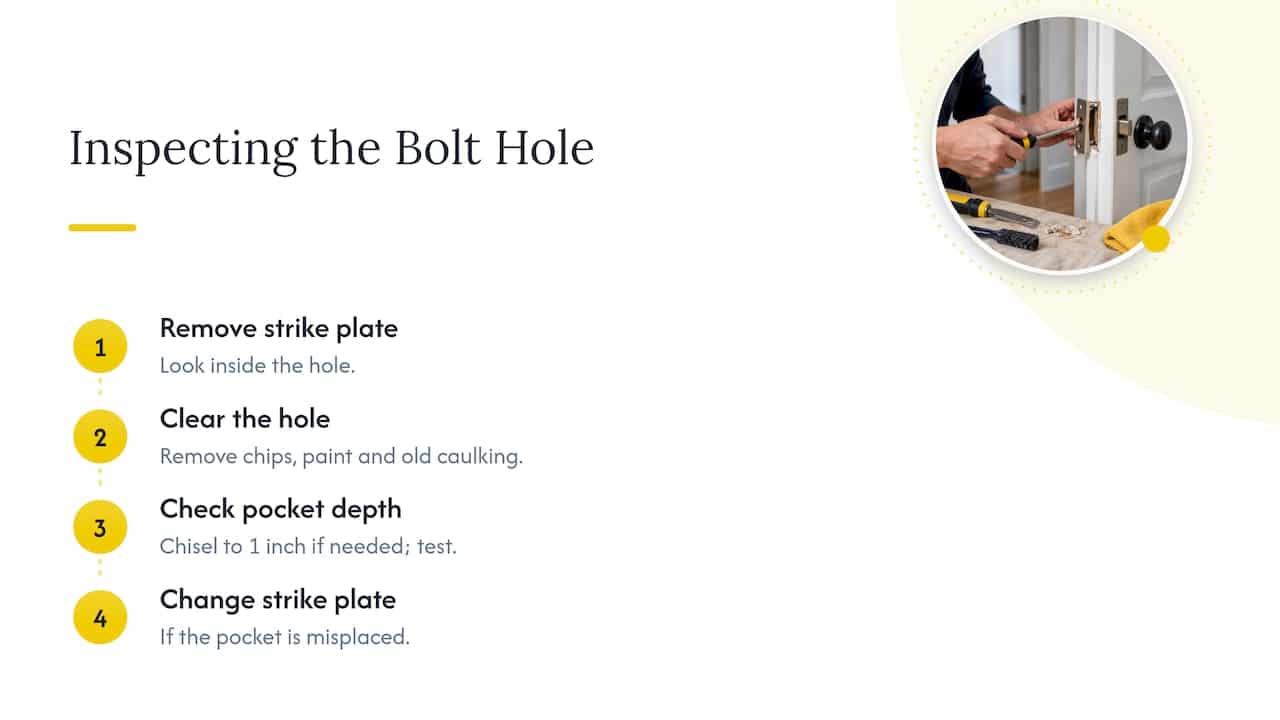
This is a different complaint: the latch catches but the door won’t close fully, or the bolt only partly enters the hole. The hole behind the strike plate may not be deep enough, or may be in slightly the wrong place. Schlage’s own guidance says to chisel the bolt hole until it is 1 inch deep and the bolt extends without dragging, or to change the strike plate if the pocket is the issue.
Take the plate off and look inside. Wood chips, paint drips and old caulking in the hole are common. Clear them out, deepen the hole if needed, and test again.
Why a latch stops catching all of a sudden
Homeowners often tell us the door was fine last month. That is believable. Several things change quickly:
- Humidity and swelling. Wood doors take on moisture and swell, especially after a wet spring or in a humid summer. Then the door sits tighter in the frame, and the latch arrives in a slightly different spot.
- Freeze-thaw movement. Ontario’s winters shift soil and framing a little each year. Thresholds can lift, and frames can move by small amounts.
- House settling. New builds in Durham Region settle in their first few years. Older houses settle more slowly but still move.
- Loose hinge screws. These loosen over time and the door drops a little at a time, so you may not notice until the latch fails.
- A new seal or threshold. Fresh weatherstripping, a replaced bottom sweep, or a new threshold can stop the door from closing to the position where the latch engages.
- Paint build-up. Layers of paint on the edge of the door, the jamb or the strike plate narrow the gap.
If the problem comes and goes with the weather, be careful. Don’t move the strike plate based on the door’s worst week of the year. In January, when the door has shrunk, you will find the latch rattles loose. Fix the cause, which is usually loose hinges or a bound edge, and leave the strike plate alone unless the door misses in mild weather too.
If your door rubs and sticks after the seals have been touched, our guides on how to spot bad door caulking and the top mistakes when caulking doors will help you see whether a bead of caulk or a new seal is part of the story.
Exterior doors: threshold, seals and moisture
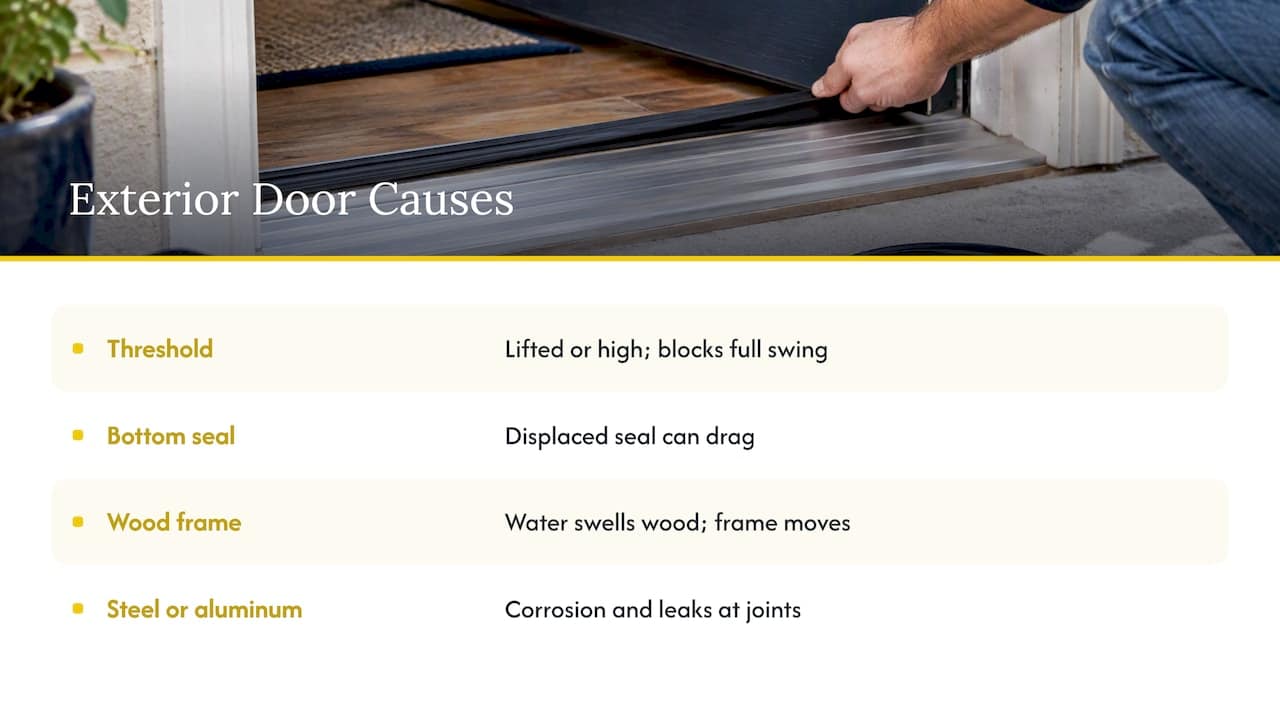
An exterior door has more going on than an interior one. The threshold, the bottom sweep, the weatherstripping and the caulking around the frame all affect how the door closes. A threshold that has lifted or been set too high can stop the door from swinging fully into the frame. A displaced bottom seal can drag. Water getting into the jamb over several winters can swell and soften the wood, and the frame moves with it.
If you suspect the threshold, our guide on exterior door threshold types explains what is on the market and how each one behaves. For doors that feel cold or drafty as well as misaligned, how to caulk around door thresholds walks through the sealing side.
Wood frames need extra attention. Water that gets behind the trim keeps the jamb damp, and a damp jamb moves. Our notes on whether caulking can help prevent frame rot and wood door caulking practices cover how to keep that moisture out. On steel and aluminum frames, the concern is corrosion and leaks at the joints, which we cover in caulking metal frames.
Don’t mix up house doors and garage doors
Garage doors have their own hardware and their own failure points: springs, cables, rollers and openers. If your garage entry door is the one that won’t latch, treat it like any other exterior door. If the overhead door is what is misbehaving, that is a separate job, and this guide’s hinge and strike plate steps do not apply. Garage door maintenance services deal with those parts, and the same basic principle holds: separate failed hardware from simple alignment before you pay for a repair.
A repair order that saves time
This is the sequence we follow, and it avoids most wasted effort:
- Check the latch mechanism with the door open.
- Run the lipstick test and note where the bolt lands.
- Tighten all hinge screws. Replace stripped ones with longer screws.
- Check for blockers: paint, seals, threshold, debris in the strike hole.
- File or move the strike plate only if the door still misses after the hinges are tight.
- Deepen the bolt hole if the bolt goes in but not all the way.
- Re-test in different weather before calling it done.
Notice that moving the strike plate is step five, not step one. That is where most people start, and it is also why so many fixes only last a season.
What you will need
Nothing fancy. Most of this is in a basic toolbox:
- Screwdriver or drill with a small bit
- Three-inch screws for the top hinge and strike plate
- Small metal file
- Sharp wood chisel and a small mallet
- Wood glue and toothpicks or slivers
- Lipstick, chalk or a washable marker
- Thin cardboard for shimming
- Pencil and a flat surface to hold the plate
Wear safety glasses when you chisel, and keep your free hand behind the chisel, never in front of it.
Signs the problem is bigger than the latch
Sometimes a latch that won’t catch is a symptom, not the problem. Stop adjusting and have someone look at the door if you see any of these:
- The gap around the door is uneven: wide at the top on one side, tight at the bottom on the other.
- The door rubs the frame in more than one place.
- The jamb is cracked, soft or discoloured near the strike plate or hinges.
- You can see daylight or feel drafts around the frame.
- The strike plate won’t line up no matter how you adjust it.
- The fix works for a week and then the door misses again.
In these cases the jamb may have shifted from settling, moisture or an old impact, and the opening itself may be out of square. If the door has dropped a lot, or the frame is out of square, a carpenter or a door installer is the right call. Replacing a lockset will not correct it, and moving a strike plate will not restore support to damaged hinges.
Perspective
After 25 years on jobs across Oshawa, Whitby, Ajax and out to Bowmanville and Cobourg, we can tell you that a door that stops latching is rarely a latch problem. Most of the time the door has moved, and the reason it moved is either loose hinge screws or water.
That second reason is where our work comes in. A frame that stays wet through an Ontario winter swells, softens and shifts. Failed caulking around the frame, a worn threshold seal and open joints at the trim are all ways water gets in. We see doors where the owner has moved the strike plate twice and the latch still fails, because nobody dealt with the moisture behind the trim.
Our approach is to do the job once, properly. That means finding out why the door moved, sealing the frame with premium materials suited to the Canadian climate, and checking that the repair holds up through freeze-thaw cycles, not just this week. If you have done the hinge and strike plate steps and the door still misses, or you can see signs of water around the frame, give us a call. We will look at the whole opening, tell you honestly what it needs, and tell you if it is a job for a carpenter rather than for us.
Felix
When to hire help, and what we can do
Fixing a strike plate is a fair job for a patient homeowner. Where the door, the frame and the weather seal all interact, it is worth having a professional look. We handle door caulking and weather sealing for homes and commercial properties across the Greater Toronto Area, and we also do window and door installation and brick and masonry repairs through our other services.
If you manage a multi-unit building or a commercial property, doors that no longer close properly are a maintenance issue and a security issue. A proper sealing program around frames and thresholds protects them and keeps drafts and water out. See our building envelope sealing service for larger properties.

Before winter, it also pays to have exterior doors checked. Our guide on door caulking for extreme weather explains what we look at, and how to seal a door from rain covers the water side. To book an assessment, start at kettlecontracting.com.
A few habits that keep latches working
- Check hinge screws once a year, in the fall, before the heating season starts.
- Don’t paint over the latch, the strike plate or the hinges. Remove hardware first, or mask it carefully.
- Keep the bolt clean. A little dry lubricant on the latch bolt helps, and heavy grease collects dirt.
- Look at your caulking and weatherstripping around exterior doors every spring and fall.
- Don’t hang heavy things on the door, such as bags or door-mounted racks, without checking the hinges.
- Leave the strike plate alone when the problem is seasonal.
These are small things, but together they prevent most of the calls we get about doors that suddenly stop catching.
FAQ
Why is my door misaligned all of a sudden?
Usually something small has changed: hinge screws have loosened, the wood has swollen from humidity, or the house has settled slightly. A new seal or threshold can also stop the door from closing fully. Check the hinges first, then look for anything rubbing or blocking the door.
How do I get a door latch that doesn’t go all the way in to engage?
Take off the strike plate and look at the hole behind it. If it is too shallow or clogged, clear it and chisel it deeper. Schlage suggests about 1 inch of depth so the bolt extends without dragging. If it is still tight, the plate may need to move slightly.
What should I do if the strike plate doesn’t line up with the latch?
Use the lipstick test to see how far off it is. If the miss is small, file the opening in the direction the bolt needs. If it is larger, move the plate, fill the old screw holes with glued wood slivers, and remount it. Tighten the hinges first so you are not chasing a sagging door.
Can I fix a misaligned latch without replacing the door?
In most cases, yes. Hinge screws, shims and a repositioned strike plate fix the majority of cases. The door only needs replacing or reframing when the frame is badly out of square, the wood is damaged by water, or the door itself has warped past the point where adjustment holds.