

Sealant warranties usually cover material defects, and labour only when a system or installer warranty says so. Silicone sealants often carry up to 20 years, hybrids about 10, and polyurethane or acrylic latex around 5. Register the warranty, keep your installation records, and notify the warrantor promptly if a defect appears.
TL;DR:
- Product warranties usually replace material only; contractor coverage commonly covers workmanship labor for one year, while system warranties include both when conditions are met.
- Extended coverage may exclude improper installation, substrate degradation, code deviations, and consequential damage, while limiting payment to the original product cost.
- Claim deadlines vary by warrantor, so send written notice within the stated window, preserve dated photographs, and allow an inspection.
- For commercial work, name substantial completion as the warranty start date, require the issued warranty document, and put product and labor coverage in the contract.
Table of Contents
- What does a sealant warranty cover?
- How long do sealant warranties last?
- What do sealant warranties exclude?
- How do you make a sealant warranty claim?
- Manufacturer vs installer warranties: why system warranties win
- What should your contract and submittals require?
- What maintenance keeps your warranty valid?
- What 25 years of claims has taught us
- How we help secure compliant installations and warranty paperwork
- FAQ
- Sources
What does a sealant warranty cover?
Not every warranty means the same thing, and the gap shows up in your wallet when a joint fails. CCDC guidance distinguishes several types of warranty:
- Product warranty: the manufacturer replaces defective material, usually nothing more. You pay for removal and reinstallation.
- Installer or contractor warranty: covers labour to fix workmanship defects, commonly for one year.
- System warranty: product and labour together, issued by the manufacturer once its conditions are met.
Remedies are usually capped. CCDC’s construction warranty bulletin notes that extended warranties normally limit scope and exclude consequential or incidental damages. In practice, a product-only warranty on a failed joint can leave you with free tubes of sealant and a full labour invoice.
How long do sealant warranties last?
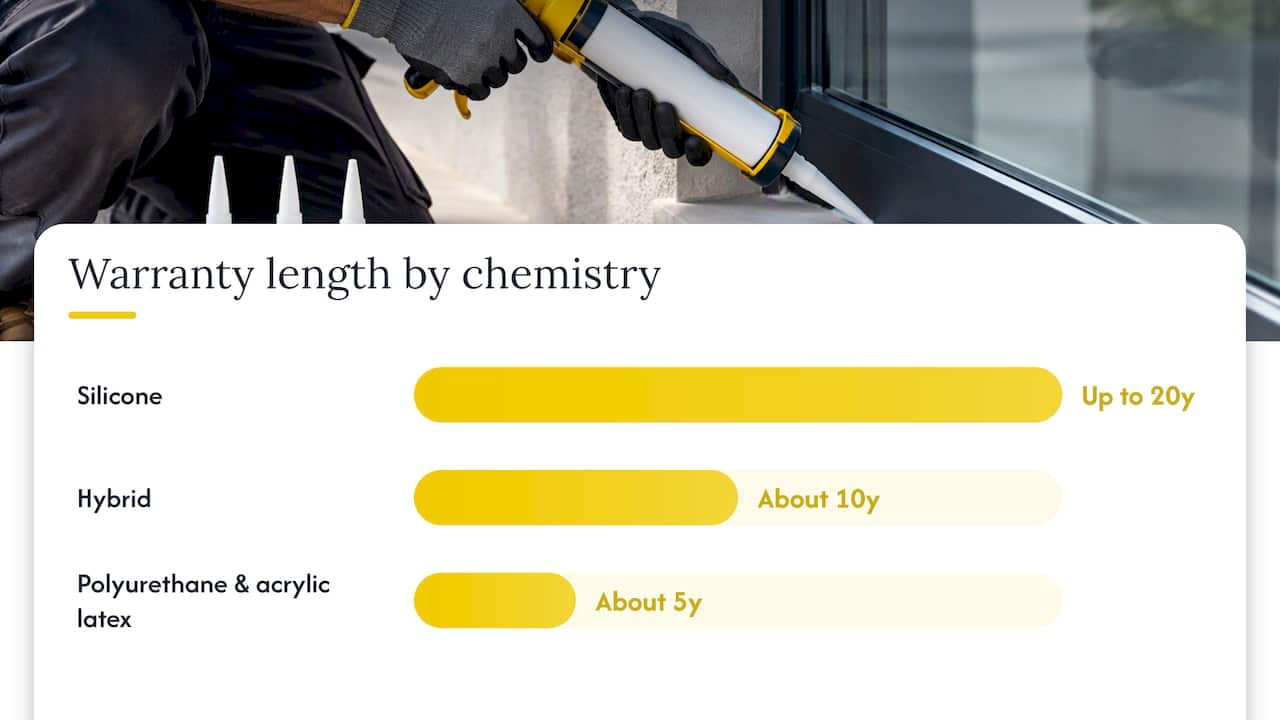
Length follows chemistry. A specification example from a joint sealants spec calls for a 2-year installer warranty plus manufacturer terms by type.
Silicone: up to 20 years. Hybrid: about 10 years. Polyurethane and acrylic latex: about 5 years.
- A 20-year number can still mean product replacement only. Look for the words “product and labour.”
- Shorter chemistries mean you plan reseal cycles sooner, so factor that into life-cycle costs.
- Extended manufacturer coverage often depends on approved installers or a warranty service package.
If you’re weighing chemistries, our guide to exterior joint sealing types walks through the differences.
What do sealant warranties exclude?
Most warranties list what they won’t touch. Thompson’s WaterSeal’s Canadian warranty excludes improper installation, departures from approved plans or building codes, acts of God, vandalism, and substrate degradation the sealant didn’t cause. DuPont’s Tyvek 10-year residential warranty requires installation strictly per published guidelines and limits the remedy to product replacement.
Watch for conditional wording too:
- Mandated primers or specific substrates
- Installer prequalification
- Mandatory registration within a set window
- Required inspections
- Liability capped at original product cost, with consequential damages excluded
Pro Tip: Read the conditions before the headline term. A 20-year warranty you’ve quietly voided on day one is worth nothing.
Many of these voiding behaviours are the same caulking mistakes homeowners make.
How do you make a sealant warranty claim?
Move fast and keep paper. Notice windows vary by warrantor, and DuPont’s warranty requires notice and a reasonable chance to inspect within stated timeframes. Check your own document for the exact deadline.
- Photograph the failure with dates, wide and close up.
- Pull your purchase receipts, installation records, and the warranty certificate.
- Notify the warrantor in writing within the stated notice window.
- Give access for inspection, and keep any removed sample if they ask for it.
- Confirm in writing what the remedy is: product only, or product and labour.
Liability limits decide your out-of-pocket cost, so ask early what the cap is.
Manufacturer vs installer warranties: why system warranties win
A manufacturer’s product warranty often stops at supplying replacement material. A system warranty can include labour and repair costs when conditions are met. CCDC prefers system warranties where possible for exactly that reason.
Typical conditions for one:
- Exclusive use of the manufacturer’s products
- A warranty service package
- Manufacturer jobsite quality observations
- Registration after installation
Royal Roofing explains how another trade handles registration and inspections on their warranty page, and the principle is the same. The contractor’s one-year warranty sits alongside the manufacturer’s coverage. It doesn’t replace it, and it’s often the only labour coverage you have in year one.
What should your contract and submittals require?
Warranties get enforced when the paperwork is in the contract. Specify the type and length, and require the manufacturer’s warranty document be issued to the owner. Name the start date as substantial completion. In commercial projects, CCDC notes that date starts the clock on all warranties.
- Specify product and labour coverage, plus term, in writing.
- Require operation and maintenance submittals: shop drawings, product data, MSDS, performance test data, maintenance instructions and warranty documents.
- Make registration, manufacturer observations, and installer prequalification conditions of extended coverage.
Pro Tip: Ask for the warranty form before you sign the contract. If the contractor can’t show you one, the “warranty” is just a promise.
Our piece on choosing a window caulking contractor lists the questions worth asking.
What maintenance keeps your warranty valid?
You can’t claim on a joint you never looked at. Keep a simple routine:
- Inspect joints regularly and photograph them with dates.
- Look for adhesion loss, cracking, and staining.
- Clean with mild soap and water. Skip harsh solvents and close-range pressure washing.
- Repair small failures early, before water gets behind them.
- File every photo and note with your warranty papers.
Addressing small failures early can help limit further damage, and your records show you looked after the seal. More on that in our look at how exterior sealant protects your asset.
What 25 years of claims has taught us
Good records make it easier to document a potential claim. Keep the warranty certificate, installation photos, and inspection log together, and check the warranty for any registration requirements.
Our workflow is short: document the installation, register the warranty, keep the QC photos, run scheduled inspections. Use an approved installer where the warranty requires one, and follow the manufacturer’s instructions. Most disputes we see aren’t about the sealant. They’re about missing paper.
— Felix
How we help secure compliant installations and warranty paperwork
Warranty coverage starts with doing the job to the manufacturer’s rules, and then proving it. Here’s what we handle:
- Manufacturer-compliant installation, with QC photos along the way
- Operation and maintenance submittals many system warranties require
- Documentation for warranty registration
- Building envelope sealing done to specification

Request a project consult or site inspection and we’ll confirm the warranty requirements before work begins. Book your consult with Kettle Contracting.
FAQ
Can sealant expire?
Check the shelf life printed on the tube or cartridge before using unopened sealant. If it is expired, follow the manufacturer’s instructions or contact them to confirm whether it is suitable to use. Warranty terms usually assume fresh, correctly applied material, so check dates before use.
Is weatherstripping covered under warranty?
It depends on the warranty wording. Sealant warranties generally cover the sealant itself, so weatherstripping is normally covered only if the warranty or the window or door manufacturer names it. Check the product’s own document.
What is the warranty on waterproofing?
It varies by product and system. Some manufacturers offer product and labour limited warranties on specific wall or flashing systems with multi-year terms and eligibility requirements. Others replace product only.
What does a sealant warranty not cover?
Typically improper installation, substrate failure, structural movement, acts of God, and vandalism. Consumer products add limits too: Behr’s warranty applies while the original purchaser lives in the home and excludes labour and consequential damages.